63亿美元被盗之夜:读懂加密货币与币安,全球最大交易所为何从未上市
10月29日晚,全球最大的加密货币交易所币安(Binance)遭遇了这个行业有史以来最大规模的盗窃:公司估计受影响资产约63亿美元,其中约30亿美元已被冻结,币安称将全额赔付用户损失。一夜之间,「加密货币到底是什么」「币安是什么」「把钱放在交易所里安不安全」,成了许多华人读者最想问的问题。本专题就用最通俗的话,把加密货币、币安、它的创始人赵长鹏,以及这个圈子里的人和事,一次讲清。
一、什么是加密货币
加密货币是一种只存在于网络上的数字货币,不由任何国家的中央银行发行。它的账本不是记在某一家银行的服务器里,而是记在一本由全世界成千上万台电脑共同维护、人人可查的公开账本上——这本账本就叫「区块链」,想改账,等于要同时改掉全世界大多数电脑里的记录,几乎做不到。
第一个加密货币是比特币,2009年由一个化名「中本聪」的人推出,总量上限2100万枚。比特币靠「挖矿」产生:全球的计算机比赛解题,谁先算出来,谁就有权记账并获得新币奖励。2015年上线的以太坊是第二大网络,它的代币叫以太币,还能运行自动执行的「智能合约」,是今天绝大多数加密应用的底座。
持有加密货币,靠的是一串叫「私钥」的密码。谁有私钥,币就是谁的;私钥一旦丢失,没有任何机构能帮你找回,币也就永远拿不回来了——这是它和银行存款最大的不同。真正自己保管私钥的人并不多,多数人是把钱放在币安、Coinbase这样的交易所里买卖:交易所相当于「券商加金库」,负责撮合成交、替用户保管资产。也正因如此,交易所一旦被黑客攻破或者经营出问题,用户的钱首当其冲。
还有一类叫「稳定币」,如USDT、USDC,价格与美元1比1挂钩,背后有美元现金和短期美国国债作储备,是币圈内部通用的「现金」。美国2025年7月通过的《GENIUS法案》,已经为这类稳定币立下1比1储备等规矩。
至于价格为什么暴涨暴跌:加密货币市场全天24小时交易、没有涨跌停板、杠杆交易普遍、又极受消息和情绪驱动,一天涨跌百分之十几并不稀奇。风险同样真实:被盗,今晚的币安事件就是最新的例子;诈骗,据FBI统计,仅加密货币投资诈骗一项,2024年报告的损失就达58亿美元;还有平台倒闭,2022年交易所FTX垮台,约80亿美元客户资金被挪用。美国证券交易委员会(SEC)等监管机构长期提醒公众,加密资产属于高风险投机资产,对社交媒体上「稳赚不赔」的荐币信息要高度警惕。
二、币安是怎么回事
2017年7月,赵长鹏与何一在上海创立币安,靠发行平台代币BNB募得约1500万美元起家。币安的撮合系统速度快、上币多、手续费低,上线约180天就冲上全球交易量第一,此后一直是全球最大的加密货币交易所。
2017年9月,中国发布禁令,叫停境内的加密货币交易平台。币安把业务迁出中国,先后辗转日本、马耳他等地,长期自称「没有总部」:母公司注册在开曼群岛,人员和运营分散在全球许多国家。这种「无国籍」架构帮它躲开了不少监管,也为它日后在美国的麻烦埋下了伏笔。2019年,币安又在美国推出由美国公司运营的独立平台Binance.US,与全球站分开,美国用户只能使用美国站。
转折点在2023年11月21日。美国司法部宣布,币安承认违反《银行保密法》、无牌从事汇款业务和违反制裁规定等罪名,同意支付约43亿美元罚款与没收——这是美国历史上金额最大的企业刑事和解之一。赵长鹏个人同时认罪、辞去CEO职务,并缴纳5000万美元罚款。接任CEO的是监管出身的Richard Teng(邓伟政),他曾在新加坡金融管理局任职十余年,并担任过阿布扎比全球市场金融服务监管局CEO。此后,2025年5月,SEC撤销了对币安的民事诉讼;2025年12月,联合创始人何一出任联席CEO,与邓伟政共同掌舵;同月,币安全球平台获得阿布扎比全球市场(ADGM)的完整授权,2026年1月起转入阿联酋的监管框架。据彭博报道,截至2026年6月,币安的注册账户已超过3.2亿。
今晚的盗窃案,是币安成立以来最大的安全危机。据币安通报与综合报道,公司估计受影响资产约63亿美元,约30亿美元已被冻结;何一当晚表示用户资金安全,币安将承担全部黑客损失;赵长鹏以股东身份发文,称预期全部用户资金都能获得覆盖。币安称目前没有发现钱包私钥泄露的证据,充值与提现暂停、待完成安全扫描,在美国独立运营的Binance.US表示未受影响。多家区块链情报机构把攻击指向与朝鲜有关的黑客组织,币安尚未确认攻击者身份。此前的行业纪录是2025年2月Bybit交易所约15亿美元被盗,本次规模约为它的四倍。
三、创始人赵长鹏:从温哥华打工少年到币圈首富
赵长鹏1977年出生于江苏连云港的一个教师家庭,1989年、12岁时随家人移民加拿大温哥华,少年时代在麦当劳、加油站打工补贴家用。他从麦吉尔大学计算机专业毕业后,先为东京证券交易所的承包商开发交易撮合软件,后到纽约的彭博Tradebook做了四年期货交易软件,2005年回到上海创业,做高频交易系统。
2013年,他在一次牌局上从同行Bobby Lee那里听说比特币,随后卖掉上海的房子、把全部身家换成比特币,加入钱包平台Blockchain.info的团队,之后又担任交易平台OKCoin的首席技术官。在交易所行业里摸爬滚打几年后,2017年,他与何一共同创办了币安。
2023年11月,他在美国承认币安未能维持有效的反洗钱制度,辞去CEO;2024年4月,他被判处4个月监禁,同年9月刑满释放。2025年10月,特朗普总统签署赦免令,对他予以完全赦免。他现在住在阿联酋,通过投资机构YZi Labs继续做行业投资,并推动免费教育项目Giggle Academy。按照认罪安排,他不能再回币安担任管理职务,但仍是币安的控股股东。
他的身家本身就是个谜:福布斯在2026年度富豪榜上估计其净资产约1100亿美元、列全球第17位,财富绝大部分来自他所持的约九成币安股份;而赵长鹏本人近期受访时称,自己只有100亿到300亿美元,与福布斯的数字相去甚远。两组数字差了几倍,恰恰因为币安不是上市公司——没有股价,就没有公认的身价。
四、币安是哪一年上市的?答案是:从未上市
这是读者最常问的问题之一,答案很干脆:币安自2017年创立至今,从未在任何证券交易所上市,也从未公开递交过上市申请。所以「哪一年上市」无从谈起——它是一家私人公司,不公布完整股东名册,也不发布经审计的财报,任何券商软件里都买不到它的股票。
外界能看到的股权图景,全部来自财经媒体的长期追踪,只能算估算:福布斯与彭博估计,赵长鹏持有币安约九成股份,是绝对控股股东;据《华尔街日报》2023年的报道,联合创始人何一持有开曼母公司至少一成股份。2025年3月,阿布扎比投资机构MGX以20亿美元入股币安、取得少数股权,这是币安成立以来第一次接受机构投资者,具体持股比例没有披露;据《纽约时报》报道,这笔交易对币安的估值约为750亿美元。以上数字,币安从未正式确认过。
对照组是美国的Coinbase:它走了完全相反的一条路,2021年4月14日就在纳斯达克直接上市(股票代码COIN),成为美国第一家上市的大型加密货币公司,股权、财务、风险全部写在公开文件里,人人可查。
五、哪些币圈公司上了市
币安是个例外。2025年被业内称为加密公司上市大年,一批同行排队敲钟。交易所与平台类有:Coinbase(纳斯达克:COIN,2021年上市,是这批公司的龙头);网络经纪商eToro(纳斯达克:ETOR,2025年5月);稳定币USDC的发行商Circle(纽交所:CRCL,2025年6月);交易所Bullish(纽交所:BLSH,2025年8月);Winklevoss兄弟创办的交易所Gemini(纳斯达克:GEMI,2025年9月);做区块链借贷的Figure(纳斯达克:FIGR,2025年9月);数字资产托管商BitGo(纽交所:BTGO,2026年1月上市,是2026年以来唯一完成上市的加密公司);以及综合性数字资产公司Galaxy Digital(纳斯达克:GLXY)。
第二类是「持币财库」公司:Strategy(纳斯达克:MSTR,原名MicroStrategy)把持续买入比特币当作公司战略,是全球持有比特币最多的上市公司;BitMine(BMNR)主打以太坊财库;SharpLink(SBET)同样以囤积以太坊为主业。第三类是比特币矿企,Marathon Digital(MARA)、Riot Platforms(RIOT)、CleanSpark(CLSK)等都已在纳斯达克上市多年。
另一家大型交易所Kraken的上市路则走了一半:它在2025年11月秘密递交了上市申请,2026年3月因市场状况暂停进程,可能推迟到2027年。币安与它们的区别在于,它连申请都从未递交过。据Kaiko、Cleasky等市场数据机构的统计,2025年扎堆上市的这批加密股,进入2026年后随着比特币从历史高点回调,股价已普遍下跌。
六、币圈人物网:今晚这条新闻里的人
何一,币安联合创始人。她与赵长鹏在2017年共同创办币安,长期主管市场与用户业务,并执掌投资部门YZi Labs;据报道她持有币安母公司至少一成股份。2025年12月,她升任联席CEO。今晚盗窃案发生后,她是币安对外发声、承诺赔付的第一人。
Richard Teng(邓伟政),币安联席CEO。新加坡籍的资深监管者,2021年加入币安,2023年11月在赵长鹏辞职后接任CEO,主抓合规与牌照,与何一形成「一位管监管、一位管业务」的双头格局。
孙宇晨,中国创业者,2017年创办公链波场TRON,是币圈最活跃的华人人物之一。2023年3月,美国SEC起诉他及旗下公司,指控未注册发行、销售TRX与BTT代币;2024年11月,他以约620万美元拍下意大利艺术家的香蕉装置作品《喜剧演员》,并在香港当众把香蕉吃掉;2025年8月,他乘坐蓝色起源的飞船完成了一次太空飞行。他与币安是同行也是交易对手:波场是币安平台上交易的主要公链之一。今晚与他相关的另一条新闻在娱乐版:他起诉演员景甜及其父母、索讨三千余万元「彩礼」的官司已经立案,本站另有报道。
Sam Bankman-Fried(业内称SBF),2019年创办交易所FTX,一度是币安最大的对手。币安曾是FTX的早期投资者,退出时收下大笔FTX自家代币FTT;2022年11月6日,赵长鹏宣布币安将清仓FTT,挤兑随即发生,FTX在五天后申请破产。此后检方查明,SBF挪用了约80亿美元客户资金。2023年11月,陪审团裁定他七项欺诈与共谋罪名全部成立;2024年3月,他被判处25年监禁;2026年6月,联邦上诉法院维持了原判。
Vitalik Buterin,俄裔加拿大程序员,2013年写出以太坊白皮书,2015年以太坊上线。他主导的技术路线让以太币成为仅次于比特币的第二大加密货币,本人是这个行业最有影响力的技术人物。
Brian Armstrong,2012年与Fred Ehrsam共同创办Coinbase,任CEO至今,2021年亲手把公司送上纳斯达克。他领导的Coinbase总部在美国、以合规和上市公司的透明度立足,是币安在全球市场最主要的竞争者。
从43亿美元和解,到今晚63亿美元被盗,币安和它身后这张人物网,几乎就是一部浓缩的加密货币简史。币安表示,将在完成安全扫描后恢复充值与提现,并发布详细的技术报告;赔付与追赃的后续进展,本站将持续跟进。
关联:63亿美元被盗:币安遭遇史上最大加密货币盗窃,约30亿已被冻结,公司称全额赔付
关联:三千余万元彩礼成官司:孙宇晨起诉景甜及其父母,案件已立案
关联:Coinbase第三季度净利7.19亿美元:总收入12.2亿美元降35%、所持加密资产收益撑起利润
关联:货币监理署 OCC 定版稳定币终规:1比1储备、两日赎回 2027年1月18日随《GENIUS法案》生效
关联:加密货币投资诈骗2024年损失58亿美元:FBI通知的受害人中76%当时不知自己受骗
关联:7500万美元发币免注册:SEC提出《加密资产监管条例》,代币首次有了「毕业」通道
来源:GSM·美国
The Night $6.3 Billion Was Stolen: Cryptocurrency and Binance Explained, Why the World's Largest Exchange Has Never Gone Public
On the evening of October 29, Binance, the world's largest cryptocurrency exchange, suffered the biggest theft in the industry's history: the company estimates that about $6.3 billion in assets was affected, roughly $3 billion has been frozen, and Binance says users will be reimbursed in full. Overnight, three questions reached every corner of the Chinese-speaking internet: What exactly is cryptocurrency? What is Binance? And is money kept on an exchange safe? This feature answers them in plain language — and maps the company, its founder Changpeng Zhao, and the people around tonight's story.
1. What is cryptocurrency?
A cryptocurrency is a form of digital money that exists only online and is issued by no central bank. Its ledger is not kept on one bank's server; it is a public record maintained simultaneously by thousands of computers around the world — the "blockchain." To rewrite history, an attacker would have to overpower most of those computers at once.
The first cryptocurrency was Bitcoin, launched in 2009 by a person or group using the name Satoshi Nakamoto, with a hard cap of 21 million coins. New bitcoins are created through "mining," a race among computers to solve mathematical puzzles for the right to record transactions. Ethereum, launched in 2015, is the second-largest network; its token is ether, and its "smart contracts" — programs that execute automatically — underpin most crypto applications today.
Ownership comes down to a "private key," a string of characters that works like an unchangeable password. Whoever holds the key owns the coins; lose it, and no institution on earth can recover the funds — the starkest difference from a bank deposit. In practice, most people do not hold their own keys. They keep money on exchanges such as Binance or Coinbase, which act as broker and vault in one: matching trades and custodying assets. That is precisely why an exchange hack, like tonight's, hits users first.
A third category matters for tonight's story: stablecoins such as USDT and USDC are pegged one-to-one to the U.S. dollar and backed by cash and short-term Treasury bills — the industry's internal "cash." The GENIUS Act, signed in July 2025, wrote reserve rules for them into U.S. law.
Prices swing violently because crypto trades around the clock with no circuit breakers, heavy leverage, and sentiment-driven flows; double-digit moves in a day are unremarkable. The risks are equally concrete. Theft: tonight's Binance breach is the latest example. Fraud: the FBI counted $5.8 billion in reported losses from crypto investment fraud alone in 2024. Platform failure: when the exchange FTX collapsed in 2022, about $8 billion in customer money had been misused. U.S. regulators, including the Securities and Exchange Commission (SEC), have long warned that crypto assets are highly speculative and that "guaranteed profit" pitches on social media should be treated with suspicion.
2. What is Binance?
Binance was founded in Shanghai in July 2017 by Changpeng Zhao and Yi He, raising about $15 million by issuing its BNB token. Its matching engine was fast, its listings numerous and its fees low; within roughly 180 days it was the world's largest exchange by trading volume, a position it still holds.
In September 2017, China banned domestic crypto trading platforms. Binance moved its operations out of China, passing through Japan and Malta, and for years described itself as having no headquarters: its parent company is registered in the Cayman Islands, with staff scattered across many countries. That stateless structure helped it outrun regulators — and planted the seeds of its American troubles. In 2019 it launched Binance.US, a separate platform run by a U.S. company for American customers.
The reckoning came on November 21, 2023. The U.S. Department of Justice announced that Binance had pleaded guilty to violating the Bank Secrecy Act, operating an unlicensed money-transmitting business and breaching sanctions rules, agreeing to roughly $4.3 billion in fines and forfeiture — among the largest corporate criminal resolutions in U.S. history. Zhao pleaded guilty personally, resigned as CEO and paid a $50 million fine. He was succeeded by Richard Teng, a career regulator who spent more than a decade at the Monetary Authority of Singapore and ran the financial regulator of Abu Dhabi Global Market (ADGM). The SEC dismissed its civil case against Binance in May 2025. In December 2025, co-founder Yi He became co-CEO alongside Teng, and Binance's global platform won full authorization from ADGM; since January 2026 it has operated under the Abu Dhabi framework. According to Bloomberg, Binance's registered accounts passed 320 million as of June 2026.
Tonight's breach is the largest security crisis in the company's history. Binance estimates about $6.3 billion was affected and says roughly $3 billion has been frozen. Yi He said user funds are safe and that Binance will bear all losses; Zhao, posting as a shareholder, said he expects all user funds to be covered. The company says it has found no evidence of private-key leakage, has paused deposits and withdrawals pending security scans, and notes that the independently operated Binance.US is unaffected. Several blockchain intelligence firms have attributed the attack to hackers linked to North Korea; Binance has not confirmed the attacker's identity. The previous industry record was the roughly $1.5 billion theft from the exchange Bybit in February 2025 — tonight's figure is about four times that.
3. The founder: Changpeng Zhao
Zhao was born in 1977 in Lianyungang, Jiangsu, into a family of schoolteachers. In 1989, at age twelve, he emigrated with his family to Vancouver, Canada, working jobs at McDonald's and a gas station as a teenager. After studying computer science at McGill University, he built trade-matching software for a Tokyo Stock Exchange subcontractor, then spent four years developing futures-trading software at Bloomberg Tradebook in New York, before returning to Shanghai in 2005 to build high-frequency trading systems.
In 2013, over a poker game, fellow entrepreneur Bobby Lee told him about Bitcoin. Zhao sold his Shanghai apartment and put everything he had into it, joined the wallet company Blockchain.info, and later became chief technology officer of the exchange OKCoin. In 2017, he and Yi He founded Binance.
In November 2023, Zhao pleaded guilty in the United States to causing Binance to fail to maintain an effective anti-money laundering program and stepped down as CEO. In April 2024 he was sentenced to four months in prison; he was released that September. In October 2025, President Donald Trump signed a full pardon for him. Zhao now lives in the United Arab Emirates, investing through YZi Labs and backing Giggle Academy, a free education project. Under his plea arrangement he cannot return to manage Binance, but he remains its controlling shareholder.
His fortune is itself a matter of dispute. Forbes, in its 2026 billionaires ranking, estimated his net worth at about $110 billion — 17th in the world — almost all of it from an estimated 90 percent stake in Binance. Zhao himself recently put his wealth at only $10 billion to $30 billion. The gap exists precisely because Binance is not a public company: with no share price, there is no agreed number.
4. What year did Binance go public? It never did.
It is one of the most common questions about the company, and the answer is short: Binance has never listed on any stock exchange, and it has never publicly filed to do so. There is no listing year. It is a private company that publishes neither a full shareholder register nor audited financial statements, and its shares cannot be bought in any brokerage account.
Everything known about its ownership comes from financial-press reporting, and it is estimation, not disclosure. Forbes and Bloomberg estimate that Zhao holds about 90 percent of Binance, making him the controlling shareholder. The Wall Street Journal reported in 2023 that co-founder Yi He owns at least 10 percent of the Cayman Islands parent company. In March 2025, Abu Dhabi investment firm MGX bought a minority stake for $2 billion — Binance's first-ever institutional investment — without disclosing the percentage; The New York Times reported the deal valued Binance at about $75 billion. Binance has never officially confirmed a complete ownership breakdown.
The contrast is Coinbase, which took the opposite path: on April 14, 2021, it listed directly on Nasdaq under the ticker COIN, becoming the first major U.S. crypto company to go public, with its ownership, finances and risks laid out in public filings for anyone to read.
5. Which crypto companies are listed?
Binance is the exception. The year 2025 became the industry's great IPO wave. Among exchanges and platforms: Coinbase (Nasdaq: COIN, listed 2021, the sector's leader); online broker eToro (Nasdaq: ETOR, May 2025); Circle, issuer of the USDC stablecoin (NYSE: CRCL, June 2025); the exchange Bullish (NYSE: BLSH, August 2025); Gemini, founded by the Winklevoss brothers (Nasdaq: GEMI, September 2025); blockchain lender Figure (Nasdaq: FIGR, September 2025); custodian BitGo (NYSE: BTGO, January 2026 — the only crypto IPO completed so far in 2026); and digital-asset conglomerate Galaxy Digital (Nasdaq: GLXY).
A second group holds crypto as a corporate treasury: Strategy (Nasdaq: MSTR, formerly MicroStrategy) has made buying bitcoin its corporate strategy and is the largest corporate holder of bitcoin; BitMine (BMNR) is built around an ether treasury, as is SharpLink (SBET). A third group, the bitcoin miners — Marathon Digital (MARA), Riot Platforms (RIOT) and CleanSpark (CLSK) — has traded on Nasdaq for years.
Another big exchange, Kraken, got halfway: it filed confidentially for a listing in November 2025, then paused the process in March 2026 as markets weakened, possibly until 2027. Binance, by contrast, has never filed at all. And according to market-data firms including Kaiko and Cleasky, the class of 2025 has given back much of its debut gains in 2026 as bitcoin retreated from its record high.
6. The people web behind tonight's story
Yi He, Binance's co-founder and co-CEO. She built Binance with Zhao in 2017, long ran its marketing and customer operations, and heads its investment arm, YZi Labs; she is reported to own at least 10 percent of the parent company. When tonight's breach broke, hers was the first voice promising that users would be made whole.
Richard Teng, Binance's co-CEO. A Singaporean career regulator, Teng joined Binance in 2021 and took over as CEO when Zhao resigned in November 2023, focusing on compliance and licensing — a deliberate pairing with He's product and user base.
Justin Sun, the Chinese entrepreneur who founded the TRON blockchain in 2017 and remains one of crypto's most visible Chinese figures. In March 2023 the SEC sued him and his companies over the unregistered offer and sale of the TRX and BTT tokens. In November 2024 he paid about $6.2 million for the banana artwork "Comedian" and ate the banana at a Hong Kong press event; in August 2025 he flew to the edge of space aboard Blue Origin. TRON is among the major blockchains traded on Binance. His connection to tonight's news cycle runs through the entertainment pages: a court has accepted his lawsuit against actress Jing Tian and her parents over a betrothal gift of more than RMB 30 million, reported separately by GSM.
Sam Bankman-Fried, known as SBF, founded the exchange FTX in 2019 and became Binance's biggest rival. Binance had been an early FTX investor and received a large amount of FTX's own FTT token when it exited. On November 6, 2022, Zhao announced Binance would sell its FTT; the run that followed bankrupted FTX within five days. Prosecutors later proved that Bankman-Fried had misused about $8 billion of customer money. A jury convicted him on all seven fraud and conspiracy counts in November 2023; he was sentenced to 25 years in March 2024, and a federal appeals court upheld the conviction in June 2026.
Vitalik Buterin, the Russian-born Canadian programmer who wrote the Ethereum white paper in 2013 and launched the network in 2015. Ether is the world's second-largest cryptocurrency, and Buterin remains the industry's most influential technologist.
Brian Armstrong co-founded Coinbase with Fred Ehrsam in 2012 and has been its CEO ever since, taking it public on Nasdaq in 2021. U.S.-based, listed and compliance-forward, Coinbase is Binance's principal global competitor — the opposite corporate model in almost every respect.
From a $4.3 billion settlement to tonight's $6.3 billion theft, Binance and the web of people around it amount to a compressed history of cryptocurrency itself. Binance says deposits and withdrawals will resume once its security review is complete and that it will publish a detailed technical report; GSM will follow the reimbursement and recovery effort as it develops.
Related: Coinbase Posts $719 Million Third-Quarter Net Income as Total Revenue Falls 35% to $1.22 Billion
Source: GSM America
来源:GSM·美国(原文链接)
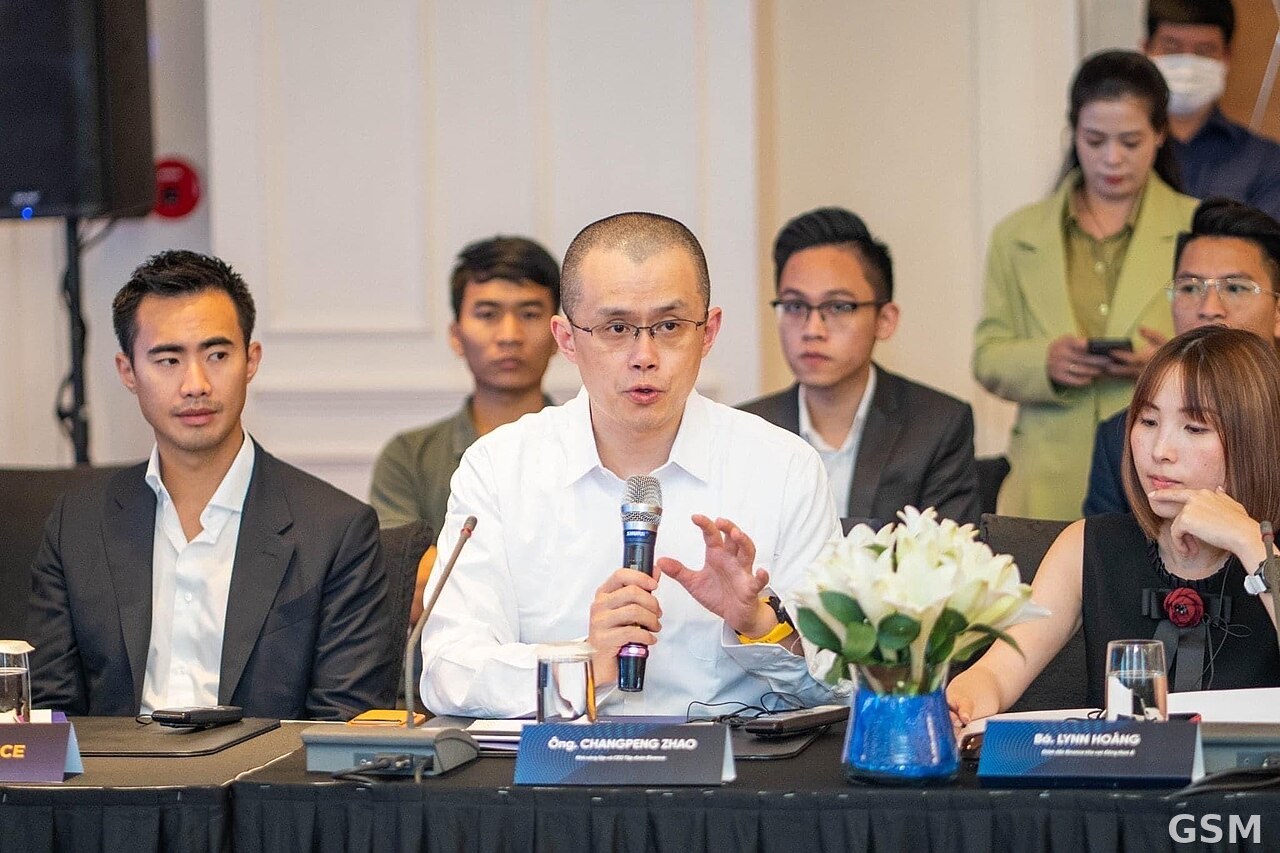
图片来源:图:币安联合创始人赵长鹏2022年在越南NFT峰会上发言。图片:Aevozer/Wikimedia Commons(CC BY-SA 4.0)。 / Binance co-founder Changpeng Zhao speaks at the Vietnam NFT Summit in 2022. Photo: Aevozer via Wikimedia Commons (CC BY-SA 4.0).