洛杉矶无家可归者现状:2026年统计结束两年下降,市内露宿者增至约2.9万人,市县治理权今天表决
洛杉矶无家可归者服务管理局(LAHSA)7月24日公布的2026年大洛杉矶无家可归者统计显示,在连续两年下降之后,区域无家可归者人数出现回升:全县估计73,040人,比2025年增加1.2%;洛杉矶市45,194人,增加3.4%。管理局同时指出,总体增幅在统计上不显著。
露宿者的增幅更为明显。全县露宿者增加3.3%,市内露宿者增加7.9%,市内露宿者估计达29,115人。全县73,040人中,露宿者49,002人(占67%),收容者24,038人;长期无家可归者32,563人,占全县总数的45%。统计在2026年1月下旬用三天时间完成。
管理局把回升的主要原因归于限时补贴(Time Limited Subsidies)的注册暂停。资金削减迫使这项灵活租金援助暂停接受新申请:通过限时补贴新安置的人数从2024年的10,308人降至2025年的6,590人;2025年全区永久安置总数降至23,532人,比2024年28,625人的纪录少约5,100人。没有这项补贴,2025年从临时住所迁入永久住房的人数下降36%(从12,120人降至7,770人),从街头进入临时住所的人数下降8%(从16,724人降至15,380人)。
管理局临时首席执行官吉塔·奥尼尔在公布统计时说:"统计学家认为这些变化在统计上不显著,但我们知道,这些数字代表的是真实的人——为在我们地区获得一个永久家园而努力的真实的人。"她还说,管理局的行政数据可以清楚地说明进展为什么停滞,以及恢复进展需要什么;她把增幅归于经济困难,尤其是洛杉矶的生活成本。
回升之前是两年的下降。2019年,全县无家可归者58,936人、市内35,550人;2023年达到峰值,全县75,518人、市内46,260人;2024年首次下降,全县75,312人、市内45,252人;2025年再度下降。2025年统计经美国住房与城市发展部复核后微调:全县总数从72,308人修正为72,195人,市内从43,699人修正为43,695人,修正幅度不到150人,管理局称在误差范围内、无统计显著性。
2025年统计还显示了另外两组数字:全区街头居所减少12.6%,市内街头居所从2024年的12,717处降至11,010处,降幅约13.5%;18岁以下露宿儿童青少年从1,558人增至1,897人,增幅近22%,有子女的露宿家庭从903户增至1,067户,增幅18%。管理局在公布2025年统计时指出,地区仍需要超过48.5万套可负担住房来满足需求。
统计方法本身也存在争议。兰德公司的独立清点结果与官方数字的差距在2025至2026年扩大,兰德研究人员估计,在滑雪街(Skid Row)地区,官方统计遗漏了其独立清点所确认人口的约39%。兰德研究人员同时表示,这反映的是两种统计方法的差异,不证明官方数字就是错误的。
人数回升的同时,市县正在争夺这套系统的掌控权。洛杉矶无家可归者服务管理局是1993年成立的市县联合机构,协调联邦、州、县、市四级资金。美国住房与城市发展部此前以涉嫌欺诈与滥用纳税人资金为由,暂停该局获取联邦资金,该局起诉要求推翻暂停决定,案件仍在进行中。县政府随后成立了自己的无家可归者服务与住房部,并于7月1日启动;据福克斯洛杉矶报道,县已拨3亿多美元建立该部门。
四项行政职责控制着每年约2.4亿美元的联邦无家可归者资金,决定区域如何申请和支配这笔资金、谁被纳入系统、谁获得永久支持性住房。本月早些时候,洛杉矶连续照护体系全体成员以331票对9票,把其中两项职责——担任协作申请方与年度时点统计主导方——交给县政府。上周五,市议会以10票对0票支持市县临时协议;10月26日星期一,连续照护体系全体成员把剩余两项职责——无家可归者管理信息系统(HMIS)与协调录入系统(CES)的监管权——也交给县政府。县政委员会定于今天(10月27日)表决,是否让县无家可归者服务与住房部及住房部门签署与市政府的两项协议;四项职责的最终归属仍待联邦法官复核。
根据市县临时协议,县政府将与市政府签约,由市政府管理所有市资助资源的匹配流程,即市内无家可归者可优先获得市住房;市政府保留现有的系统数据访问权,并获得市内无家可归者的全部数据,包括县资助项目中的人员数据;县政府出资为市工作人员与市资助服务机构提供培训、技术支持,并根据市政府的合理要求出资维护系统修改。
市政府此前一直争取这两项职责,理由是洛杉矶需要对本市项目与住房安置有更大话语权;市政府认为,市出资建造和资助了不成比例的住房,而县把其他城市的人员安置进了市纳税人出资的床位。县政委员凯瑟琳·巴格在连续照护体系投票后说,这是加强联邦资金管理问责与协调服务的机会,今天的投票是朝着更协调、更可问责的区域应对迈出的积极一步。市住房部无家可归者监督局局长金伯利·法纳姆说,她坚信共享治理模式最有利于这套系统;市政府要求的不仅是直接获取数据,还包括参与数据管理与系统开发,以便定期核验数据准确性。
市议会无家可归者与健康委员会主席伊莎贝尔·胡拉多在上周五的市议会会议上说,新协议"比我们以前拥有的要多",市政府将获得现有系统数据以及支撑数据的原始数据,从而可以实时制作自己的报告与仪表盘,"这是我们从未有过的"。市议员蒂姆·麦科斯克对协议的可执行性与按比例代表权条款表示关切,认为不应奖励把无家可归者推入洛杉矶市、却不提供替代办法的县内地区。连续照护体系董事会主席本·凯10月14日致信市长、市议会与县政委员说,这场争端已从"团结对抗联邦干预"变成了"分裂内斗",可能浪费保住本地控制权、避免联邦进一步介入的机会。
街头行动仍在继续。市长巴斯的"市内安全"(Inside Safe)行动队10月3日通报,截至当时已把6,200多名洛杉矶人带离街头:9月29日在兰帕特村的第143次行动把64人带入室内,其中59人通过"市内安全"安置、5人通过市县合作的其他临时住房项目安置,行动前警方逮捕了5名在该营地侵害露宿者的人;10月1日在帕科伊马的第144次行动把27人及其宠物带入临时住房,并移走6辆房车。10月13日,行动队在市中心附近把35人带入安全稳定的住房,并移走6辆车与14辆房车;这是州长纽森签署AB 647法案后的首次行动,该法案扩大并延长了一项试点,允许对价值4,000美元以下的废弃房车作永久处置,而不是任其回流街头。市长办公室说,累计已有200辆房车从市内街道移走。巴斯说,长期以来房车经营者向弱势者出售或出租不安全、破旧的房车,"变成了死亡陷阱"。
县政委员会今天的表决、联邦法官的复核,以及下一轮年度时点统计,将是这套系统下一步的三个时间点。
关联:中美如何处理流浪汉问题:美国一年数一次人头,中国救助站计人次,口径不同,数字不能直接比
关联:跟进:洛杉矶地区无家可归事务总会投票,由县府接管HMIS与协调准入系统两项数据职能
关联:洛杉矶市县就无家可归者数据共享达成协议:市府将获市内全部数据与按比例代表权,周一下午待区域总会表决、周二法院听证定四职
Los Angeles Homelessness in 2026: Count Rises After Two Years of Declines, City Unsheltered Population Nears 29,000 as County Board Votes on Governance Deal
The Los Angeles Homeless Services Authority (LAHSA) released the results of the 2026 Greater Los Angeles Homeless Count on July 24, showing that after two consecutive years of declines, homelessness in the region rose again: an estimated 73,040 people countywide, up 1.2% from 2025, and 45,194 people in the City of Los Angeles, up 3.4%. The authority said neither overall change is considered statistically significant.
The increase was sharper among people living unsheltered. Unsheltered homelessness rose 3.3% countywide and 7.9% in the city, where the unsheltered population is estimated at 29,115. Of the 73,040 people countywide, 49,002 (67%) were unsheltered and 24,038 were sheltered; 32,563 people, or 45% of the countywide total, were experiencing chronic homelessness. The count was conducted over three days in late January 2026.
LAHSA attributed the rise mainly to a pause in enrollments for Time Limited Subsidies, a flexible rental assistance program. Funding reductions forced the pause on new enrollments: the number of people newly housed using the subsidies fell from 10,308 in 2024 to 6,590 in 2025, and the total number of people permanently housed across the region fell to 23,532, about 5,100 fewer than the record 28,625 in 2024. Without the subsidies, movement from interim to permanent housing fell 36% in 2025 (from 12,120 to 7,770), and movement from the street to interim housing fell 8% (from 16,724 to 15,380).
"While statisticians do not consider these shifts statistically significant, we know that these numbers represent real people — real people striving for a permanent home in our region," LAHSA Interim CEO Gita O'Neill said when the count was released. She said the authority's administrative data shows clearly why progress stalled and what it will take to get back on track, and she attributed the increase to economic hardship, particularly the cost of living in Los Angeles.
The rise followed two years of declines. In 2019, the county counted 58,936 people experiencing homelessness and the city 35,550; the crisis peaked in 2023 at 75,518 countywide and 46,260 in the city; 2024 brought the first decline, to 75,312 countywide and 45,252 in the city; and 2025 fell further. The 2025 count was later revised slightly after a review by the U.S. Department of Housing and Urban Development: the countywide total was adjusted from 72,308 to 72,195 and the city total from 43,699 to 43,695, changes of fewer than 150 people that LAHSA said fell within the margin of error and were statistically insignificant.
The 2025 count also showed two other figures: street dwellings across the region fell 12.6%, and in the city they fell from 12,717 in 2024 to 11,010, a drop of about 13.5%; unsheltered children and teenagers under 18 rose nearly 22%, from 1,558 to 1,897, and unsheltered families with children rose 18%, from 903 to 1,067. When it released the 2025 count, LAHSA said the region still needs more than 485,000 affordable housing units to meet demand.
The counting method itself is disputed. RAND Corporation's independent enumeration diverged further from the official numbers in 2025–26, and RAND researchers estimated that in Skid Row the official count missed about 39% of the population identified by RAND's professional enumeration. The researchers said the gap reflects differences between two methodologies, not proof that the official count is wrong.
As the numbers rose, the city and county fought over who controls the system. LAHSA was created in 1993 as a joint powers authority of the city and county, coordinating federal, state, county and city funds. The U.S. Department of Housing and Urban Development suspended the authority's access to federal funds over allegations of fraud and misuse of taxpayer money, and LAHSA sued to overturn the suspension; the case is ongoing. The county then created its own Department of Homeless Services and Housing, which launched on July 1; Fox Los Angeles reported that the county diverted more than $300 million to establish the department.
The four administrative roles control about $240 million a year in federal homelessness money, deciding how the region applies for and spends it, who is tracked in the system and who is placed in permanent supportive housing. Earlier in October, the general membership of the Los Angeles Continuum of Care voted 331–9 to award the county two of the roles — serving as collaborative applicant and lead for the annual point-in-time count. On Friday, the City Council voted 10–0 to support a tentative city-county agreement, and on Monday, October 26, the Continuum of Care general membership awarded the county the two remaining roles — oversight of the Homeless Management Information System (HMIS) and the Coordinated Entry System (CES). The County Board of Supervisors is scheduled to vote today, October 27, on whether to let the county's Department of Homeless Services and Housing and its Housing department sign two agreements with the city; final authority over the four roles remains subject to review by a federal judge.
Under the tentative agreement, the county would contract with the city to manage the matching process for all city-funded resources, giving people experiencing homelessness within the city priority for city housing; the city would keep its current access to system data and gain all data on unhoused people within city limits, including those in county-funded programs; and the county would pay for training, technical assistance and reasonable system changes requested by the city.
The city had sought the two roles, arguing that Los Angeles needs more say over its own homelessness programs and housing placements, and that the city builds and funds a disproportionate share of the housing while the county placed people from other cities into beds paid for by city taxpayers. County Supervisor Kathryn Barger said after the Continuum of Care vote that the agreement was an opportunity to strengthen accountability in administering federal funding and coordinating services, and that the day's vote was a positive step toward a more coordinated and accountable regional response. Kimberly Farnham, director of the Los Angeles Housing Department's Homelessness Oversight Bureau, said she strongly believes a shared governance model best serves the system, and that the city asked not just for direct access but for inclusive data management and system development so it can regularly validate data accuracy.
Councilwoman Ysabel Jurado, who chairs the council's Homelessness and Health Committee, told Friday's City Council meeting that the proposed agreement was "an increase from what we've had before," giving the city current system data plus the raw data underneath it so the city can produce its own reports and dashboards in real time: "That's something we've never had." Councilman Tim McOsker raised concerns about the enforceability of the agreement and its proportional representation provisions, saying the county should not be rewarded for parts of the county that drive homelessness into the city of Los Angeles without providing alternatives. Continuum of Care board chair Ben Kay wrote to the mayor, City Council and county supervisors on October 14 that the dispute had shifted from "a united front against federal encroachment to splintered infighting," risking the chance to keep local control and head off further federal involvement.
Street-level operations continue. Mayor Karen Bass's Inside Safe team reported on October 3 that it had brought more than 6,200 Angelenos inside to date: its 143rd operation, on September 29 in Rampart Village, brought 64 people indoors, 59 through Inside Safe and five through other interim housing programs with city and county partners, after police arrested five people who had been preying on people in the encampment; its 144th operation, on October 1 in Pacoima, brought 27 people and their pets into interim housing and removed six RVs. On October 13, the team brought 35 people near Downtown Los Angeles into safe, stable housing and removed six vehicles and 14 RVs. It was the first operation since Governor Gavin Newsom signed Assembly Bill 647, which expands and extends a pilot program to permanently dispose of abandoned RVs valued at $4,000 or less rather than see them sold back onto the streets. The mayor's office said 200 RVs have been removed from city streets in total. Bass said RV operators had long taken advantage of vulnerable Angelenos by selling or renting them unsafe, broken-down RVs that "become deathtraps."
The County Board of Supervisors' vote today, the federal judge's review, and the next annual point-in-time count are the system's next three milestones.
Related: Follow-Up: L.A. Continuum of Care Votes to Award County the HMIS and Coordinated Entry Roles
来源:GSM·美国(原文链接)
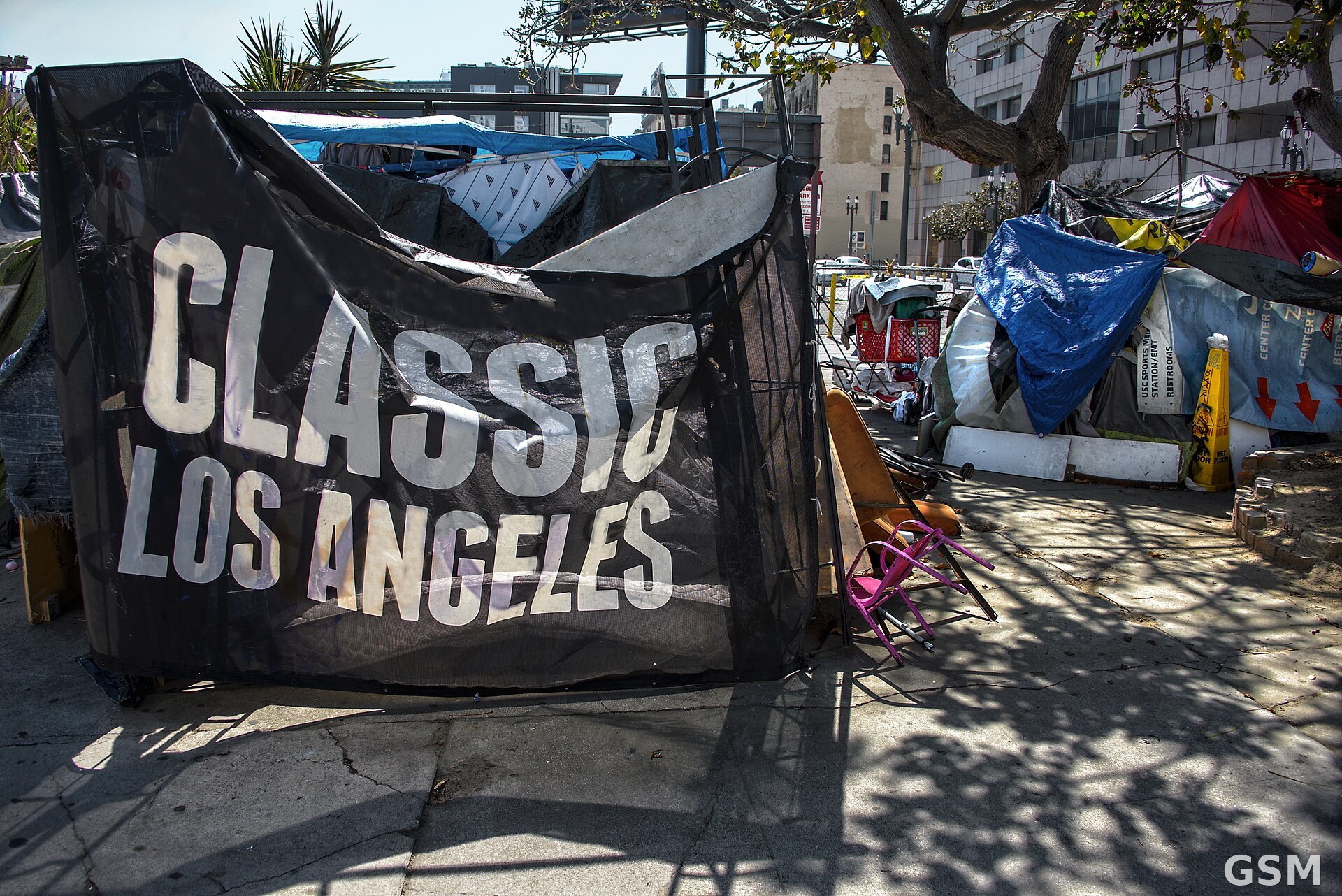
图片来源:洛杉矶市中心 Skid Row 地区的无家可归者营地,2021年3月30日摄。照片:Russ Allison Loar,CC BY-SA 4.0,经维基共享资源。 / A homeless encampment in Skid Row, downtown Los Angeles, photographed March 30, 2021. Photo: Russ Allison Loar, CC BY-SA 4.0, via Wikimedia Commons.
- 2026-10-26 22:41洛杉矶市县就无家可归者数据共享达成协议:市府将获市内全部数据与按比例代表权,周一下午待区域总会表决、周二法院听证定四职
- 2026-10-27 04:10跟进:洛杉矶地区无家可归事务总会投票,由县府接管HMIS与协调准入系统两项数据职能
- 2026-10-27 15:14洛杉矶无家可归者现状:2026年统计结束两年下降,市内露宿者增至约2.9万人,市县治理权今天表决本篇