加州高铁监察长审查2026年商业计划:成本估算不可比,资金最快2027年12月耗尽
2026年7月31日,加州高铁监察长办公室向州长与州议会领袖提交审查报告,认定加州高速铁路局(California High-Speed Rail Authority)的2026年商业计划在透明度上存在重大问题:计划未能清楚交代 Merced 至 Bakersfield 段成本估算的范围变化与涨幅,管理局「模糊了项目的基本事实」;报告并警告,若不尽快落实融资,管理局现有资金最快将在2027年12月耗尽。
报告指出,监察长办公室2026年4月审查商业计划草案时,已认定草案缺少多项法律要求的要素、「客观上不完整」,并曾要求董事局指示管理局补齐;最终版虽有改进,但仍未按新近生效的州法提供资金计划信息。
成本估算不可比是报告的核心批评。管理局先后给出三个 Merced 至 Bakersfield 段估算:2025年8月的补充项目更新报告为367.5亿美元(171英里、以单线为主);2026年商业计划的「缩减范围」估算为356.62亿美元(162英里,Merced 与 Bakersfield 车站均迁出市中心);而符合州法 SB 198 定义的估算为476.54亿美元(171英里、双线、市中心车站)。报告称,计划没有以可直接比较的方式呈现这些估算,不符合法律对成本估算跨报告可比的要求;在范围未缩减的部分,成本实际上已大幅上涨。
报告还指出,356.62亿美元的缩减范围估算排除了多项实际成本,包括36亿至66亿美元的融资成本、约12亿美元的应急预算差额、假设由其他机构承担的8.16亿美元建设成本,以及基于「地方协议可以修改」假设的约17亿美元差额。此外,商业计划草案曾漏计约8.7亿美元,最终版才予更正。
工期方面,计划只披露该段工期在2025年8月至2026年3月间推迟了九个月,却未解释其所称「优化与待定政策变化」的原因;计划也未披露,基于风险的统计分析已把工期窗口从2032至2033年延后到2034年9月。
监察长 Benjamin Belnap 在报告中表示,管理局近年年度报告屡屡不完整且迟交,「模糊了项目的基本事实」,妨碍立法者对项目进行有效监督。监察长办公室因此把建议直接提给董事会:制定并强化年度报告政策,为报告的准备与审查留足时间,让利益相关方能在报告定稿前审阅。
2026年商业计划将旧金山至洛杉矶、阿纳海姆的一期工程总估价定为约1261亿美元。Merced 至 Bakersfield 段是全线最先施工的区段,目前中央谷地119英里路段在建。
关联:加州高铁监察长报告:68.05万美元顾问差旅未获事先批准,不合规支出含健身房、夜总会与雪茄吧
关联:加州高铁董事会收回首席执行官合同签署权:2500万美元以下合同须经内部律师审核
关联:加州高铁管理局首席执行官辞职:Choudri 递交辞职信,财政厅长 Stephenshaw 任临时首席执行官
关联:加州「烂尾账本」走红华人社群:高铁、911、无家可归者拨款,逐项对照官方记录
关联:中美基建类比:高铁、大桥、调水三组同类项目,花销、工期、质量对照
来源:加州高铁监察长办公室《2026年商业计划审查报告》(2026年7月31日)。
California High-Speed Rail Inspector General Reviews 2026 Business Plan: Cost Estimates Not Comparable, Funding Could Run Out by December 2027
On July 31, 2026, the Office of the Inspector General for California high-speed rail submitted a review to the governor and legislative leaders finding serious transparency problems in the California High-Speed Rail Authority's 2026 Business Plan: the plan fails to clearly communicate the scope changes and cost increases behind its Merced-to-Bakersfield estimates, the Authority "has obscured basic facts about the project," and, the review warns, the Authority will exhaust its current funding as soon as December 2027 if it does not secure financing.
The inspector general's office said it had reviewed a draft of the business plan in April 2026 and found it missing many statutorily required elements, making the draft "objectively incomplete." The final plan improved in completeness, the review found, with one notable exception: it still did not provide funding plan information required by a recently enacted state law.
The review's central criticism is that the cost estimates cannot be compared. The Authority has produced three different estimates for the Merced-to-Bakersfield segment: $36.75 billion in the August 2025 Supplemental Project Update Report (171 miles, predominantly single track); $35.662 billion for the 2026 Business Plan's "reduced scope" segment (162 miles, with the Merced and Bakersfield stations relocated out of downtown); and $47.654 billion for the estimate the Authority says complies with state law SB 198 (171 miles, dual track, downtown stations). The plan, the review said, does not present the estimates in a directly comparable way as SB 198 requires, obscuring the fact that, absent scope reductions, costs have substantially increased.
The reduced-scope estimate also excludes significant costs, the review found: financing costs estimated at $3.6 billion to $6.6 billion, a default-level contingency difference of about $1.2 billion, $816 million in construction costs the Authority assumes other entities will pay, and about $1.7 billion tied to a local agreement the Authority assumes it will be able to modify. The draft business plan had also inadvertently omitted about $870 million from the segment estimate, an error corrected in the final plan.
On schedule, the plan disclosed a nine-month slip in the segment between August 2025 and March 2026 but offered no explanation of the "optimization and pending policy changes" it cited as the cause, the review said. Nor did the plan disclose that its risk-based statistical analysis had moved the schedule window from 2032-2033 to September 2034.
Inspector General Benjamin Belnap wrote that the Authority's recent annual reporting has been incomplete and late, and that the Authority "has obscured basic facts about the project, hindering lawmakers' ability to provide effective oversight." The office directed its recommendations to the Board, urging it to adopt and reinforce a policy governing the Authority's annual reports, with adequate timelines for preparing and reviewing complete reports before issuance.
The 2026 Business Plan puts the total cost of Phase 1, from San Francisco to Los Angeles and Anaheim, at about $126.1 billion. The Merced-to-Bakersfield segment is the first under construction, with 119 miles now being built in the Central Valley.
Source: Office of the Inspector General, High-Speed Rail, Review of the 2026 Business Plan (July 31, 2026).
来源:GSM·美国(原文链接)
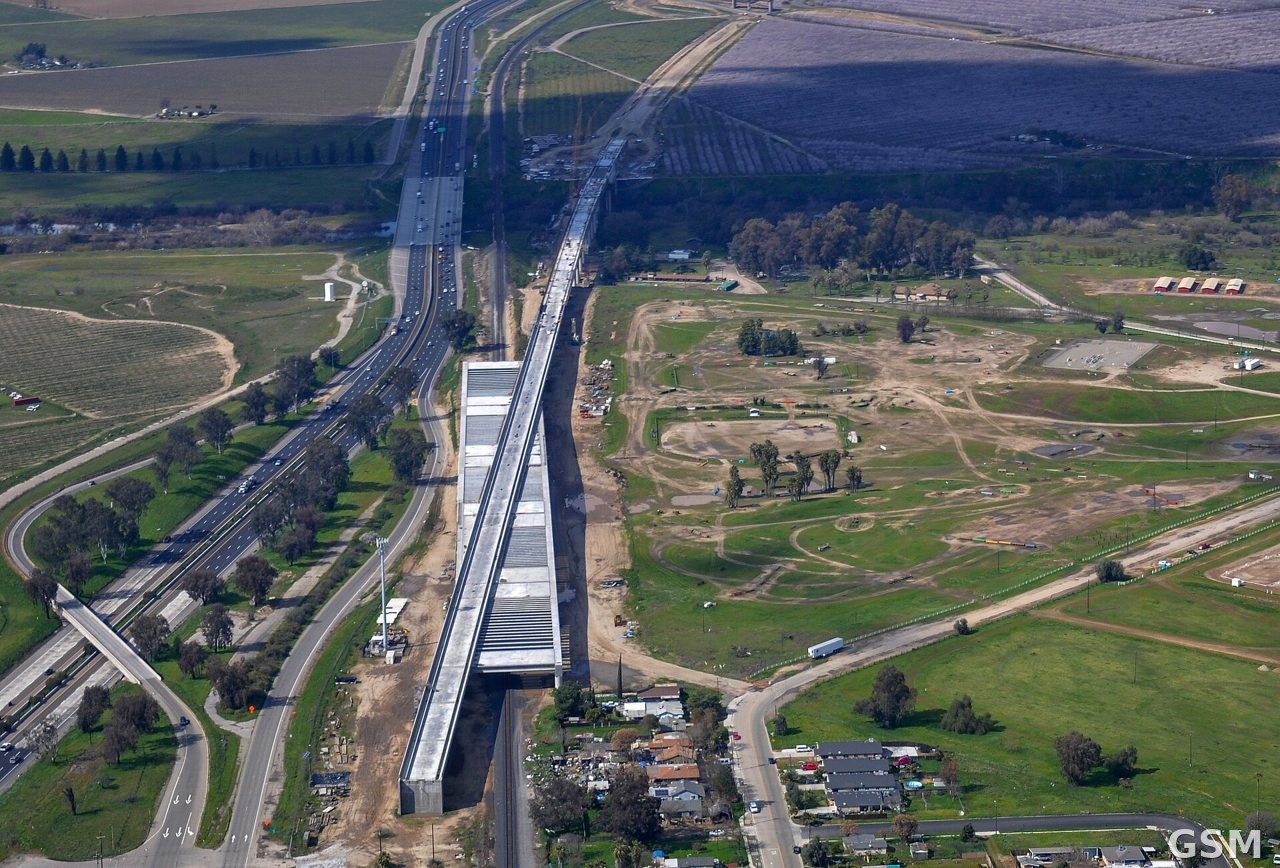
图片来源:图:圣华金河高架桥航拍(加州高速铁路局图)。Aerial view of the San Joaquin River Viaduct. (California High-Speed Rail Authority)