加州「烂尾账本」走红华人社群:高铁、911、无家可归者拨款,逐项对照官方记录
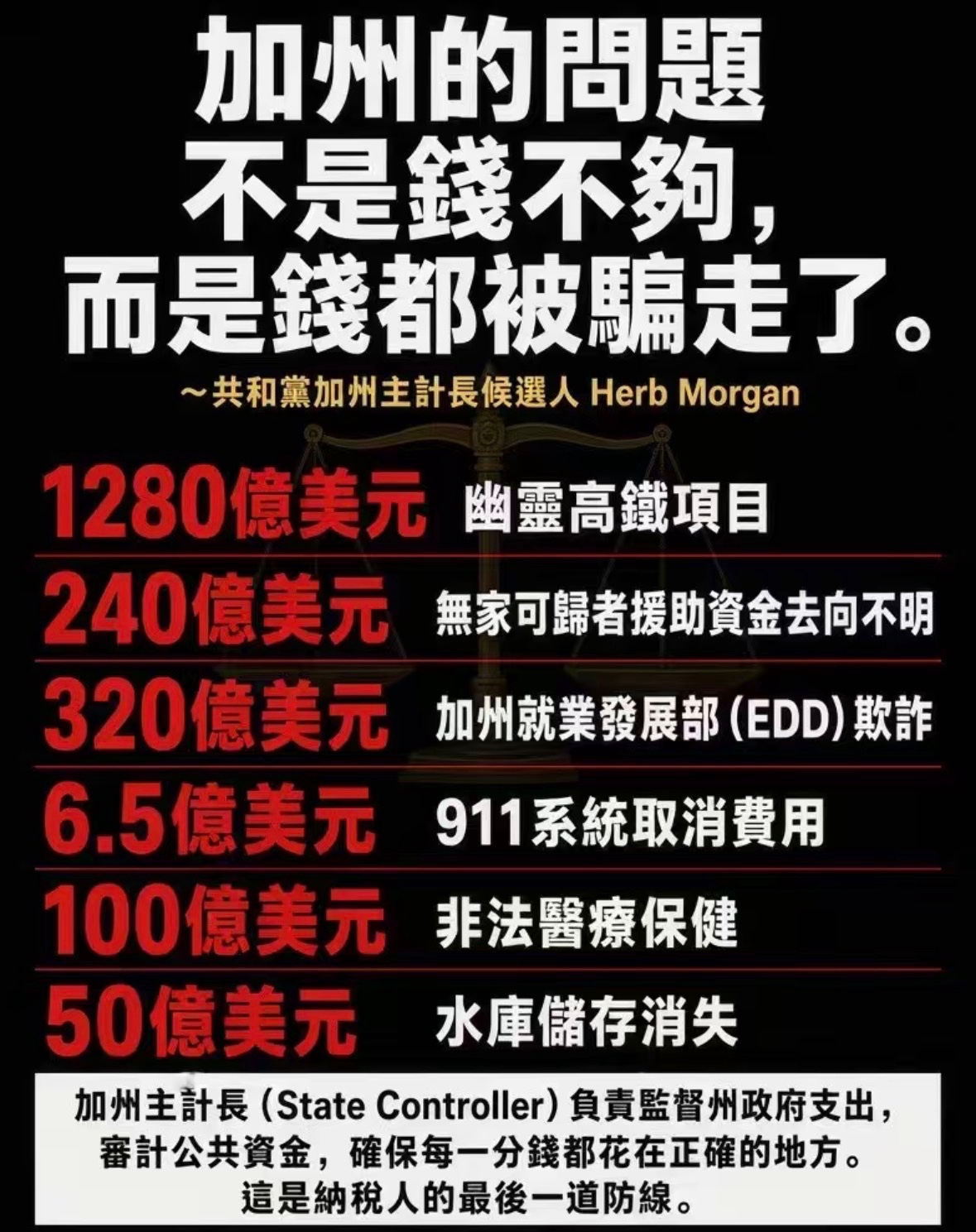
一张列出六个数字的图片近日在华人社群广泛流传:加州高铁「花了1280亿美元」、无家可归者援助金「240亿美元去向不明」、就业发展局欺诈「320亿美元」、911系统「取消时已花6.5亿美元」、非法移民医疗保险「100亿美元」、水库储存「50亿美元消失」。图片出自共和党州主计长候选人赫伯·摩根(Herb Morgan)的竞选材料。主计长是加州的首席财政官,摩根将在11月3日大选中挑战现任主计长玛莉亚·科恩。本篇逐项对照州审计长报告等官方记录,看看这六个数字各自是什么口径。
一、高铁:1280亿是估算,不是已花的钱
2008年11月,加州选民通过1A号提案,授权发行99.5亿美元债券修建高铁,当时全线估算约330亿美元、目标2020年通车。工程2015年在中央谷地动工。按高铁局2026年2月商业计划草案,一期工程(旧金山至洛杉矶)估算约1262亿美元,与图片的1280亿接近,但这是完工估算而非已支出金额。迄今实际支出约150亿至180亿美元;截至2026年2月,一期494英里中约80英里导轨段与58座结构物完工、119英里在建,尚无任何客运段通车。默塞德至贝克斯菲尔德约171英里区段估算约347.6亿美元、目标2033年通车,一期目标2040年。资金缺口约900亿美元。特朗普政府已撤销约40亿美元联邦资金,加州起诉后又撤诉。网络上流传的2310亿美元,是未经优化的历史情景数字,不是高铁局现行方案。
二、无家可归者240亿:审计的结论是「效果未追踪」,不是钱不见了
州审计长2024年4月发布的报告(编号2023-102.1)显示,2018-19至2022-23五个财年间,加州在30多个无家可归者项目上支出约240亿美元。审计发现的问题是结果追踪缺失:五大项目中三个无法判定成效、两个可能具成本效益,并非资金去向不明。同期加州无家可归人口从2019年的151,278人增至2024年1月的187,084人。州法AB 799要求相关报告在2027年2月1日前提交、2027年6月1日前公开,届时才有第一批可核对的成效数据。
三、EDD 320亿:官方口径约200亿,320亿是外部高位估算
疫情期间加州就业发展局(EDD)失业金欺诈泛滥。EDD曾表示约200亿美元很可能涉及欺诈;其后来提出的550亿美元「不符合资格」估算被州审计长认定缺乏依据。图片上的320亿美元属于外部高位估算。迄今追回约60亿美元;2023至2024年不当支付约15亿美元,其中2024年欺诈超过5亿美元。加州至今仍欠联邦超过200亿美元失业保险贷款,是全美唯一尚未偿还的州。
四、911系统:六项中唯一确认「花了钱又废弃」的一项
加州紧急服务办公室2019年启动区域版下一代911系统,签下四家承包商、初始合同三年共1.32亿美元。2025年该系统被废弃,据报已花约4.5亿至5亿美元,低于图片所称6.5亿。替代的全州新系统目标约2030年建成。这是六项指控中唯一一项「支出后整体废弃」得到证实的条目。
五、医疗保险100亿:约等于一年的项目成本,不是欺诈金额
加州医疗补助(Medi-Cal)自2024年1月起扩围至26至49岁人群、不问移民身份,最初估算每年约31亿美元;2024-25财年一般基金实际支出约84亿美元,另一估算为每年约95亿美元,超支约31亿至50亿美元,州政府为此借款34亿美元。2025年6月通过的预算自2026年1月1日起冻结无证成年移民的新登记,并自2027年起收取每月30美元保费。图片上的100亿美元大体相当于该扩围项目一年的成本量级,而非欺诈损失。
六、水库「50亿消失」:查无对应公开来源
没有任何公开来源与「50亿美元水库资金消失」的说法对应。2014年通过的1号提案是75.45亿美元水务债券,其中27亿美元用于储水项目。塞兹水库(Sites Reservoir)自1950年代提出至今未建,库容150万英亩英尺,造价从2021年的39亿美元升至2025年的62亿至68亿美元,州政府已承诺约13.63亿美元。最终取水许可将于2026年11月4日由州水资源委员会审议,计划2027年动工、2034年供水。
七、图片之外的两项
三角洲输水隧道长约45英里、设两处取水口、设计流量每秒6000立方英尺,水资源厅估算约201亿美元,反对者估算600亿至1000亿美元以上;其融资方案已被初审法院与第三区上诉法院驳回,州最高法院2026年4月拒绝审查,目前没有机构承诺承建,另一上诉裁决预计12月9日作出。州议会大厦附楼造价则从5.43亿美元涨至11亿美元,数名议员已联名要求州主计长审计。
三种状态要分清
把六个数字按官方记录归类,状态并不相同:花钱后废弃的,只有区域版911系统一项;长期拖延未建的,是高铁、塞兹水库与三角洲隧道;超支后收紧的,是医疗保险扩围与无家可归者资金。接下来几个时间点值得留意:11月4日塞兹水库许可审议、12月9日三角洲隧道上诉裁决、2027年无家可归者成效数据首次公开、2033年高铁首段目标通车。
关联:中美基建类比:高铁、大桥、调水三组同类项目,花销、工期、质量对照
California's “Unfinished Projects” List Goes Viral in Chinese Communities: High-Speed Rail, 911, Homeless Funds Checked Against Official Records
A campaign image listing six figures has been circulating widely in Chinese communities: California high-speed rail "$128 billion spent," homelessness aid "$24 billion unaccounted for," EDD fraud "$32 billion," the 911 system "$650 million spent before cancellation," health coverage for undocumented immigrants "$10 billion," and reservoir storage "$5 billion vanished." The image comes from the campaign of Herb Morgan, the Republican candidate for State Controller — California's chief fiscal officer — who faces incumbent Malia Cohen in the November 3 general election. This article checks each figure against official records, including State Auditor reports.
1. High-speed rail: $128 billion is an estimate, not money spent. Proposition 1A, passed in November 2008, authorized $9.95 billion in bonds against an estimate of roughly $33 billion and a 2020 opening target. Construction began in the Central Valley in 2015. The Authority's February 2026 draft business plan puts Phase 1 (San Francisco to Los Angeles) at about $126.2 billion — close to the image's figure, but that is a completion estimate, not spending to date. Actual spending is roughly $15-18 billion. As of February 2026, about 80 miles of guideway and 58 structures are complete and 119 miles are under construction out of 494 Phase 1 miles, with no passenger segment open. The Merced-Bakersfield segment (about 171 miles, about $34.76 billion) targets 2033; Phase 1 targets 2040. The funding gap is about $90 billion. The Trump administration revoked about $4 billion in federal funds; California sued, then dropped the suit. The $231 billion figure circulating online is a legacy unoptimized scenario, not the Authority's current plan.
2. Homelessness $24 billion: the audit found outcomes untracked, not money missing. The State Auditor's April 2024 report (2023-102.1) counted about $24 billion across 30-plus programs over fiscal years 2018-19 through 2022-23. The finding was missing outcome tracking: three of five major programs could not be assessed and two were likely cost-effective. California's homeless population rose from 151,278 in 2019 to 187,084 in January 2024. Under AB 799, the first checkable outcome data is due in a report by February 1, 2027, public by June 1, 2027.
3. EDD $32 billion: the official figure is about $20 billion; $32 billion is a high-end outside estimate. EDD has said about $20 billion was likely fraud during the pandemic; its later $55 billion ineligibility estimate was found unsubstantiated by the Auditor. About $6 billion has been recovered; improper payments in 2023-2024 were about $1.5 billion, including over $500 million in fraud in 2024. California still owes the federal government more than $20 billion in unemployment loans — the only state yet to repay.
4. The 911 system: the only item confirmed as spent-then-scrapped. Cal OES launched a regional Next Gen 911 system in 2019 with four contractors and an initial $132 million over three years. It was scrapped in 2025 after a reported $450-500 million spent — below the image's $650 million. A replacement statewide system targets completion around 2030.
5. Health coverage $10 billion: roughly one year of program cost, not fraud. Medi-Cal expansion to ages 26-49 regardless of status was completed in January 2024, initially estimated at about $3.1 billion a year. Actual general-fund spending in FY2024-25 was about $8.4 billion, with another estimate of $9.5 billion a year, an overrun of roughly $3.1-5.0 billion; the state borrowed $3.4 billion. The June 2025 budget froze new enrollment of undocumented adults from January 1, 2026, with $30 monthly premiums from 2027. The $10 billion figure is approximately the program's annual cost, not a fraud loss.
6. The reservoir "$5 billion vanished": no matching public source exists. Proposition 1 (2014) was a $7.545 billion water bond including $2.7 billion for storage. Sites Reservoir, proposed since the 1950s, remains unbuilt at 1.5 million acre-feet; its cost rose from $3.9 billion (2021) to $6.2-6.8 billion (2025), with about $1.363 billion committed by the state. Its final water-right permit goes to the State Water Board on November 4, 2026, with construction planned for 2027 and first water in 2034.
7. Two more items beyond the image. The Delta tunnel (about 45 miles, two intakes, 6,000 cfs) is estimated by DWR at about $20.1 billion versus opponents' $60-100+ billion; its financing was rejected by a trial court and the Third District Court of Appeal, the state Supreme Court declined review in April 2026, and no agency has committed to build it, with another appeal decision expected December 9. The Capitol annex grew from $543 million to $1.1 billion, prompting lawmakers to request a Controller's audit.
Three different states of affairs. Classified by the official record, the six figures are not the same kind of problem: spent-then-scrapped applies only to the regional 911 system; delayed-and-unbuilt covers high-speed rail, Sites Reservoir and the Delta tunnel; over-budget-then-tightened covers the Medi-Cal expansion and homelessness funds. Dates to watch: November 4 (Sites permit), December 9 (Delta appeal), 2027 (first public homelessness outcome data), 2033 (first high-speed rail segment target).
来源:GSM·美国(原文链接)
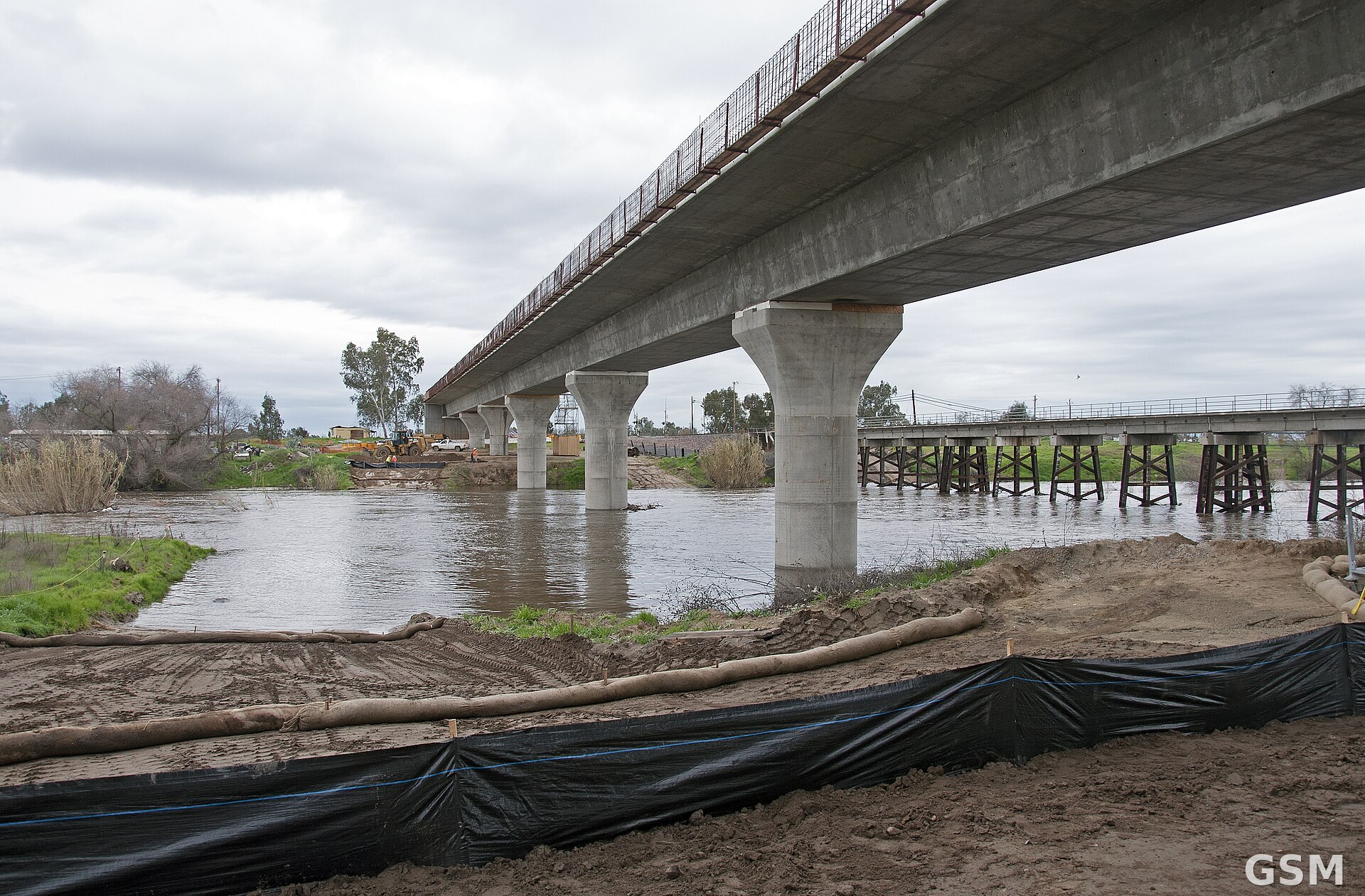
图片来源:2017年2月施工中的加州高铁弗雷斯诺河高架桥。图片:加州高铁管理局,公共领域,取自维基共享资源。