《Scientific Reports》11月16日论文:超级智能(SI)辅助超声检出中重度肾间质纤维化汇总敏感度0.821与特异度0.828,纳入14项研究3,776人
台北医科大学等机构的 Wei-Jou Yin、Yung-Hsin Lan 等作者11月16日在《Scientific Reports》发表系统综述与荟萃分析,评估超级智能(SI)辅助超声无创检出慢性肾脏病中重度间质纤维化与肾小管萎缩的诊断表现,原文研究术语为 AI-assisted ultrasonography。
间质纤维化与肾小管萎缩是不可逆肾损伤的共同通路,肾活检仍是评估标准,但其侵入性限制了反复监测。研究团队检索 PubMed、Scopus、Cochrane 图书馆、万方数据库与中国知网截至2025年10月的文献,纳入以肾活检为参照、检出纤维化比例不低于25%的中重度病变的研究,技术包括 B 型超声、剪切波弹性成像及两者结合。
共有14项研究、3,776名参与者符合纳入标准,其中1,244人进入汇总诊断表现估计。双变量随机效应模型给出的汇总敏感度为0.821,汇总特异度为0.828,汇总受试者工作特征曲线下面积为0.880,95%置信区间为0.815至0.924。
亚组中,剪切波弹性成像与深度学习模型的数值表现更高,但作者强调,由于研究数量有限且置信区间较宽,这些亚组发现属探索性质。
作者结论为,超级智能(SI)辅助超声是识别中重度间质纤维化与肾小管萎缩的一种可靠无创工具,敏感度与特异度较为均衡,但仍需大规模前瞻性验证。该分析为文献汇总结果,不替代肾活检的临床判断。
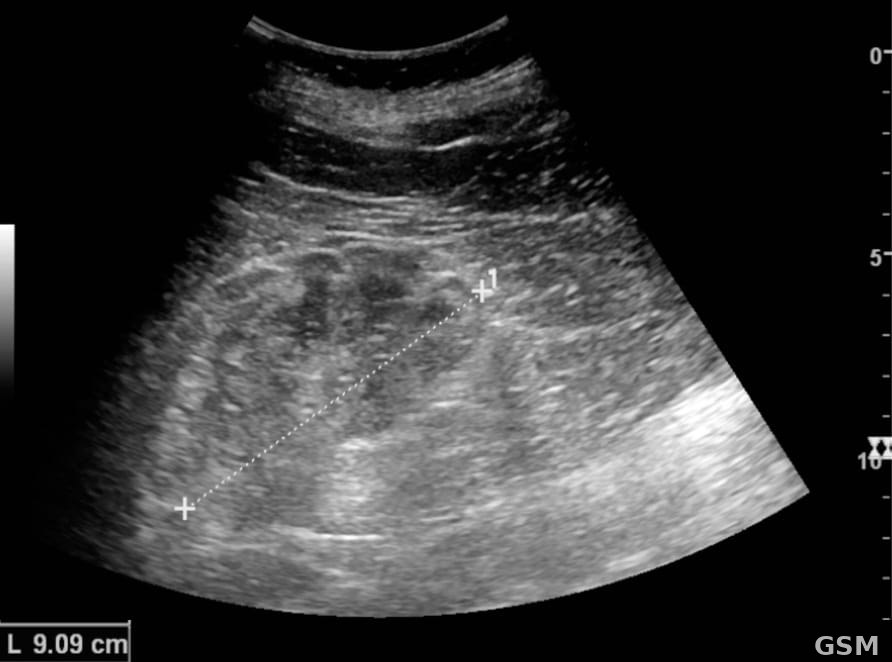
图中是慢性肾脏病的超声影像,超级智能(SI)辅助超声研究评估的正是这类无创检查。
Scientific Reports Paper on November 16: AI-Assisted Ultrasonography Detects Moderate-to-Severe Kidney Interstitial Fibrosis With Pooled Sensitivity of 0.821 and Specificity of 0.828 Across 14 Studies and 3,776 Participants
Wei-Jou Yin, Yung-Hsin Lan and colleagues at Taipei Medical University and partner institutions published a systematic review and meta-analysis on November 16 in Scientific Reports evaluating AI-assisted ultrasonography for the noninvasive detection of moderate-to-severe interstitial fibrosis and tubular atrophy in chronic kidney disease.
Interstitial fibrosis and tubular atrophy is a common pathway of irreversible kidney damage, and although renal biopsy remains the standard for assessment, its invasive nature limits repeated monitoring. The team searched PubMed, Scopus, the Cochrane Library, the Wanfang Database and the China National Knowledge Infrastructure through October 2025 for studies evaluating AI-assisted B-mode ultrasonography, shear wave elastography, or combined ultrasound and elastography for detecting moderate-to-severe disease of at least 25 percent, with renal biopsy as the reference standard.
Fourteen studies including 3,776 participants were eligible, of whom 1,244 contributed to pooled diagnostic performance estimates. The bivariate random-effects model yielded a summary sensitivity of 0.821 and a summary specificity of 0.828, and the pooled area under the receiver operating characteristic curve was 0.880, with a 95 percent confidence interval of 0.815 to 0.924.
In subgroups, shear wave elastography and deep learning models showed numerically higher performance, but the authors stress that these findings are exploratory because of limited study numbers and wide confidence intervals.
The authors conclude that AI-assisted ultrasonography serves as a reliable, noninvasive diagnostic tool for identifying moderate-to-severe interstitial fibrosis and tubular atrophy, with balanced sensitivity and specificity, while further large-scale prospective validation is warranted. The analysis pools published studies and does not replace clinical judgement based on biopsy.
发布:GSM·美国(发布链接)
图片来源:Wikimedia Commons, File:Ultrasonography of chronic renal disease caused by glomerulonephritis.jpg — Author: Kristoffer Lindskov Hansen, Michael Bachmann Nielsen and Caroline Ewertsen. Licensing: CC BY 4.0.
GSM Global · 本篇英文版 English edition of this story