【视频】跟进:卢比奥在联邦主义者协会演讲批国际法遭武器化,称国际刑事法院是「假法院」
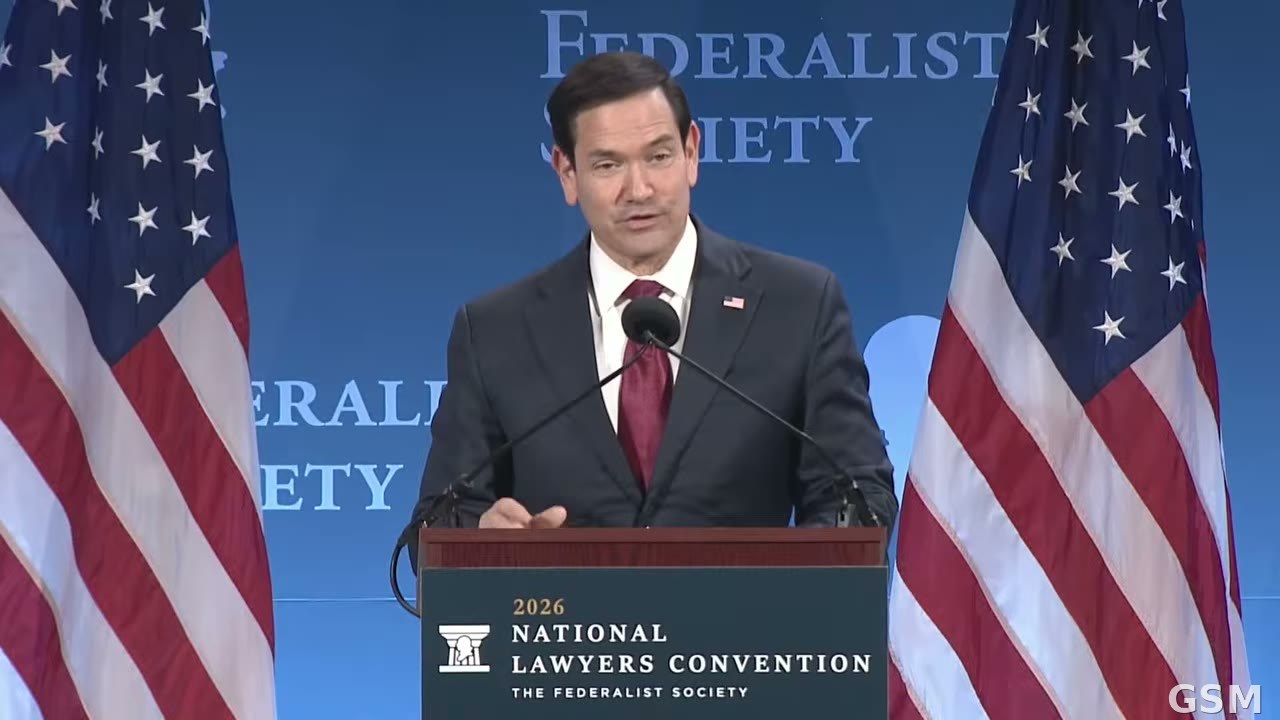
美国国务卿卢比奥(Marco Rubio)11月13日晚在华盛顿举行的联邦主义者协会(Federalist Society)全国律师大会上发表年度 Barbara K. Olson 纪念演讲,演讲已于美西时间15时32分结束,国务院官方频道的直播随之转为全程回放。共和党在11月3日中期选举中失去国会两院控制权之后,这是卢比奥发表的首场长篇演讲。他的女儿 Daniela 介绍他出场,Daniela 是弗吉尼亚大学法学院三年级学生。
卢比奥以里根的1982年开场。他说,里根第一任期还不到两年,一切似乎都在朝错误的方向走:支持率从68%跌到43%,比卡特同期的支持率还低四个百分点,经济陷入衰退,共和党在中期选举中惨败,保守派运动处处被动。正是在那样的低迷、焦虑和绝望之中,有新的东西开始萌生:1982年4月,四名法学院学生在康涅狄格州纽黑文组织了一场联邦主义研讨会,约200人到场,来自芝加哥的46岁教授安东宁·斯卡利亚(Antonin Scalia)在会上说,保守派在联邦层面的力量对比中,半个世纪以来一直处于下风。联邦主义者协会就此诞生。
他说,从这个成功里能学到的第一课是,政治需要的远不只是赢得选举,因为政府不是政治权力的唯一来源。他说:「权力也存在于大学里。权力存在于新闻界。权力存在于整个公民社会。」在美国,统治阶层不只在白宫、国会和法院,也在学术界、在非营利机构和非政府组织、在企业董事会和高管层、在智库、期刊、基金会和大众媒体里,盘踞在商业、教育和文化的「制高点」上。他说:「选举决定谁在一个季节里执政。但选举本身不能决定我们的机构教什么、我们的律师信什么。」这种转变要一代人甚至更久,只能靠一个跨机构的联盟共同完成。
卢比奥说,同样的事,他在国务院亲眼看到它发生在国际法领域:特朗普总统下令军方在加勒比海击沉贩毒船,被告知这违反国际法;美军抓获委内瑞拉的马杜罗(Nicolás Maduro)并把他带到美国受审,招来的还是同样的指责;就连在美国本土执行移民法,也有人请联合国来调查。他说:「对这个全球精英群体来说,国际法不是一套中立的规则。国际法是一种工具,一种在普世原则的幌子下推进他们自身利益的工具。」
他点名批评国际刑事法院(ICC),称它是「假法院」,是「一个未经选举的世界法庭」,声称要凌驾于主权国家的法律和宪法之上,哪怕这些国家从未同意加入。他说,这个法院和它在全球官僚体系中的盟友,「自己任命自己当国际秩序的法官、陪审团和刽子手」,却对任何人都不负责任。特朗普总统今年早些时候已下令制裁该法院。卢比奥引用罗马将军庞培的话说,如果这个法院愚蠢到要把它的「纸面法令」强加给美国人,美国的回答大概会和庞培一样:「不要对持剑的人引用法律。」
他还说,苏联共产主义作为一种制度已经被击败,但「马克思的精神还活着」,它活在那些企图让国家意志屈从于全球共识的新学说里。他说:「美国一向是、我相信也永远会是一个怀有不可抑制之雄心的国家。」屈从于激进法官或「无灵魂的全球官僚」的愿景,就是背叛美国的本性。他说,这个时代的根本问题是:「美国人是否有道德权利作为一个独特的国家、一个独特的民族存在下去,并由此要求一个把捍卫和追求我们的利益置于一切之上的政府。」
演讲最后,卢比奥说,不要把一次挫败、一次失败、一场选战的失利,看作共和国的终结。他举了1776年的华盛顿:那年12月,华盛顿手下能战的士兵不到3,000人,华盛顿写信说「这盘棋差不多要输了」,但又说,他坚信自己事业的正义,「前景终会明朗」。五年后,英军在约克镇投降。他说:「经久的伟业,是用数十年、而不是选举周期建成的。今后两年、六年、二十年,我们还有很多事要做。」他表示,这一代人将留给子孙后代的,是美国人向来留给子孙后代的东西—「历史上最伟大的国家」。
演讲结束后,卢比奥还回答了现场提问。一名法学院学生问基督徒律师应如何面对「把信仰留在门外」的压力,他说:「律师是你做的事,信仰是你这个人。」他还谈到下周的行程:他将随特朗普总统飞赴菲律宾出席东盟会议,再飞往中国出席亚太经合组织(APEC)会议。他说:「中国政府为中国谋利益,而且从不为此道歉……在每一个问题上,我都站在美国一边。连这句话都非说不可,这本身就令人吃惊。」
(来源:美国国务院)
[Video] Follow-Up: Rubio at Federalist Society Says International Law Has Been Weaponized, Calls ICC a 'Fake Court'
U.S. Secretary of State Marco Rubio delivered this year's Barbara K. Olson Memorial Lecture at the Federalist Society National Lawyers Convention in Washington on the evening of November 13; the address concluded at 3:32 p.m. Pacific Time, and the State Department's official livestream has since become a full replay. It was Rubio's first extended speech since Republicans lost control of both chambers of Congress in the November 3 midterm elections. He was introduced by his daughter Daniela, a third-year law student at the University of Virginia.
Rubio opened with Reagan's 1982. Less than two years into Ronald Reagan's first term, he said, everything seemed headed in the wrong direction: approval down 25 points, from 68% to 43%, four points less popular than Jimmy Carter at the same point, a full-fledged recession, devastating midterm losses for the president's party, and the conservative movement on the defensive. It was against that backdrop of plummeting morale, anxiety and despair, he said, that something new began to stir: in April 1982, four law school students organized a symposium on federalism in New Haven, Connecticut; about 200 people came, and one speaker was a 46-year-old professor from Chicago named Antonin Scalia, who said conservatives had simply been outgunned at the federal level for half a century. That was how the Federalist Society began.
The first lesson from that success, Rubio said, is that politics requires more than simply winning elections, because the government is not the only source of political power. "Power also lives in the universities. Power lives in the press. Power lives in the whole expanse of civil society," he said. America's ruling class resides not just in the White House, Congress or the courts, but in academia, nonprofits and NGOs, corporate boardrooms and C-suites, think tanks, journals, foundations and mass media, across "the commanding heights of business and education and culture." "Elections decide who holds office for a season," he said. "But elections do not decide by themselves what our institutions teach or what our lawyers believe." Change of that kind takes a generation or more, and only through a coalition working across institutions.
Rubio said the State Department has seen the same thing firsthand in the realm of international law. When President Trump ordered the military to sink cartel boats in the Caribbean, they were told it violated international law; when American forces captured Venezuela's Nicolás Maduro and brought him to the United States to face justice, the same accusations followed; even enforcing immigration law on American soil has drawn petitions for a United Nations investigation. "For this global elite, international law is not a neutral body of rules," he said. "International law is an instrument, an instrument to advance their interest under the pretense of universal principles."
He took aim at the International Criminal Court, calling it a "fake court" and "an unelected world tribunal" that claims to supersede the laws and constitutions of sovereign states, even those that never signed up for it. The court and its allies in the global bureaucracy, he said, "have appointed themselves judge and jury and executioner of the international order," while being accountable to no one. President Trump sanctioned the court earlier this year. If the ICC is "foolish enough to try to enforce their paper decrees on Americans," Rubio said, the answer would probably be the same as that of the Roman general Pompey to those invoking their city's charters against his legions: "Stop quoting laws to men with swords."
Rubio said that even as the institution of Soviet communism was defeated, "we did not triumph over the spirit of Marx. That spirit of Marx, it lives" on in new doctrines that would subordinate the national will to a global consensus. "America has always, and I believe will always, be a nation of irrepressible ambition," he said, and to submit to the sterile vision of radical judges or "soulless global bureaucrats" would be to betray who Americans are. "The ultimate question of our time," he said, "is whether Americans have a moral right to exist as a distinct nation and a distinct people, and thus to demand a government that defends and pursues our interests above all else."
He closed by urging the audience not to treat one setback, one defeat or one bad election as the end of the republic. He recalled Washington in December 1776, with fewer than 3,000 men fit for duty, writing that "the game is pretty near up" yet holding to "a full persuasion of the justice of our cause"; five years later, the British surrendered at Yorktown. "Great things that last are built in decades, not election cycles," Rubio said. "We have much more to do over the next two, the next six, the next 20 years." This generation, he said, will leave its children and grandchildren what Americans have always left theirs: "the single greatest nation in the history of the world."
After the address, Rubio took questions from the audience. Asked how Christian attorneys should respond to pressure to leave their faith at the door, he said: "Attorney is what you do. Your faith is who you are." He also described next week's travel: he will fly with President Trump to the Philippines for the ASEAN conference and then to China for the APEC conference. "The Chinese government is in favor of what's good for China and they don't apologize for it," he said. "I'm on the American side of every issue. And that I even have to say that is stunning."
(Source: U.S. Department of State)
Related: [Video Rubio Delivers Keynote Address at the Federalist Society National Lawyers Convention]
来源:美国国务院
发布:GSM·美国(发布链接)
图片来源:图:卢比奥在联邦主义者协会全国律师大会发表演讲,美国国务院官方视频截图 / Photo: Secretary Rubio delivering the keynote at the Federalist Society National Lawyers Convention; frame from the U.S. Department of State official video
GSM Global · 本篇英文版 English edition of this story
- 2026-11-13 13:16【视频】卢比奥在联邦主义者协会全国律师大会发表主旨演讲
- 2026-11-13 17:05【视频】跟进:卢比奥在联邦主义者协会演讲批国际法遭武器化,称国际刑事法院是「假法院」本篇