OPT收费提案今夜截止收意见:学校首荐7万美元、其后每次3万美元,国土安全部自估年收124亿美元,留美通道被重新定价
今夜23时59分,那个页面关门
华盛顿时间11月9日夜里,联邦法规门户 regulations.gov 上,案卷号 ICEB-2026-0100 的页面还开着。再过几个小时—美东时间23时59分—这条通道准时关闭:美国国土安全部10月8日刊出的《选择性实习训练收费》(Optional Practical Training Fees)拟议规则,停止接收公众意见。
这是这个秋天美国移民政策里最拥挤的一条案卷。截至11月2日,门户已收到意见4,844条,10月中旬时还只有约1,615条。规则刊出的10月8日当天,美国教育委员会与校长联盟已经公开表态反对;此后一个月,NAFSA 的意见信、美国移民律师协会与美国移民委员会的联合意见、商会与雇主团体的联署信接连进入案卷。今晚截止的,是一场定价之争的第一回合。
一、钱向谁收、怎么收
先把机制说清,因为这份提案最容易被误读的一点,是付款人。
按拟议文本,向每个参加选择性实习训练(OPT)的 F-1 学生收费—首次 OPT 7万美元,其后任何一次 OPT 3万美元,STEM OPT 延期按「其后一次」计—但法定付款方不是学生,而是学生所在的 SEVP 认证学校。学校必须在校内指定官员(DSO)于 SEVIS 系统录入该生的 OPT 推荐之前缴清相应费用;费用未付,DSO 不得录入推荐,美国公民及移民服务局(USCIS)也不得批准该生的工卡申请。「首次」的定义是该生第一次参加任何类型的 OPT,不分毕业前还是毕业后,一生只收一次;学生此后每多参加一次 OPT,学校再付3万美元。若工卡最终未签发,SEVP 可个案裁量是否退款。
作为对照:现行制度下,学生自己向 USCIS 提交 I-765 工卡申请,费用为在线470美元、纸质520美元。新提案不动这笔钱,它是在学校一侧另开一张账单,数量级完全不同。
国土安全部在提案里给了一个自己的算例:若一名学生把12个月拆成毕业前 OPT 加毕业后 OPT,学校要付7万加3万、共10万美元;该部因此假设,学校与学生会改走单次毕业后 OPT,只付7万美元。
二、国土安全部自己算的账
这份提案罕见地把账本摊得很开。按其经济分析:若规则定版,每年收到的费用在84亿至165亿美元之间,主估算为124亿美元;十年期的费用转移总额,主估算达1,094亿美元(按3%贴现)。
测算的基数来自2024年数据:当年 OPT 参与(授权)194,554人、STEM OPT 95,384人;低端基数取2022至2024年均值,为 OPT 88,374人、STEM OPT 74,088人。更值得注意的是低情景的假设方式:国土安全部假设,在低参与情景下,学校只会替有资格续接24个月 STEM 延期的学生付首费—换句话说,在该部自己的模型里,非 STEM 学生是先被价格筛掉的一群。该部同时估算,SEVP 认证学校中56%属于小型实体。
钱的去向也写在明处:所收费款依《美国法典》第31卷第3302条存入财政部、列作杂项收入,移民与海关执法局(ICE)无权留存或使用。
三、GSM观察:这份定价单的设计说明了什么
以下为本刊基于提案原文与公开记录的观察。
其一,收费对象选学校,是把「守门人」写进了价格里。国土安全部在正文中称学校是 OPT 的「初始守门人」,并指近年欺诈案件显示「闸门开得太宽」。按人头向守门人收费,等于让每一次推荐先过一道财务关—筛选发生在推荐之前,而不是审批之时;学校愿不愿意为一名学生押上7万美元,本身就成了第一轮裁决。
其二,这笔钱不进执法经费。它进财政部杂项收入,与 ICE 的查处预算脱钩;而国土安全部在原文中明说,尽管如此,收费对处理 OPT 的「脆弱性」仍属必要。按其自身文本,这首先是一件定价与威慑工具,其次才谈得上经费。该部也直言,学校可以把费用转嫁给学生本人、全体学生或雇主,并称把成本压到学生身上会进一步抑制以工作或居留为主要目的的参与—筛选意图,写在明处。
其三,看时点。OPT 参与人数在2024/25学年创下294,253人的纪录,同比增长21%,规模本身成了提案的论据背景。去年9月的总统公告已给 H-1B 加上10万美元费用,而这份提案正文把 OPT 明确定位为可能被用来「绕开 H-1B 计划」的通道。从学生身份到工作签证的这条路,正在每一个接口被同步标价,而不是单点修补。
其四,程序选择耐人寻味。同样是收紧实习训练,课程实习(CPT)走的是今年8月两条「广播消息」,如今在法院被指为未经征求意见程序擅自改规;OPT 收费则完整走完《联邦公报》刊登、征求意见的正式程序。同一部门、同一条通道、两种程序—前者已进诉讼,后者今晚关门。
四、各方把话说到了什么程度
各方一致的事实并不少:费额、付款方是学校、规则尚未生效、意见今晚截止—无人否认。分歧在正当性与后果。
国土安全部的摘要只有三个词组:打击欺诈、维护移民体系完整性、保护美国工人。正文展开为:确保只有「高度合格」的学生参加、避免劳动力市场被低薪外国劳工「过度饱和」。其欺诈依据主要援引2020年的「OPTical Illusion」执法行动与政府问责局2019年的一份报告。ICE 发言人对《Daily Californian》表示,拟议收费旨在回应针对该计划「欺诈与滥用」的担忧。
NAFSA 于11月3日提交意见信,强烈反对并要求撤回提案。其执行主任兼首席执行官 Fanta Aw 表示,提案「给国际学生制造了深深的不确定性」;她还说:「把国际学生的人才、视角与抱负拒之门外,只会损害美国的创新、经济增长、劳动力发展与全球领导地位。」
校长联盟在提案公布当日即表态反对、要求撤回;其联邦政策副主任 Zuzana C. Wootson 称该计划威胁国际人才管道。联盟随后为各校准备意见撰写指引,并推动企业、商会、经济发展组织与雇主联署一封联合意见信。
美国移民律师协会与美国移民委员会11月6日提交联合意见,反对提案、敦促国土安全部撤回。校园一线,加州大学伯克利分校学生政府通过决议,要求校方提交反对意见;加州大学校长办公室向校报表示,已认识到收费对国际学生的不利影响,但当时尚未正式谴责提案。美国国家政策基金会(NFAP)的分析则指出,国土安全部对欺诈的论证更多倚赖个案,其援引的标志性执法案例主要来自2020年。
五、同一条通道上的其他关口
OPT 不是这条通道上唯一被动过的接口。同一批组织—美国大学协会(AAU)、NAFSA、校长联盟与马萨诸塞州独立学院和大学协会—已于10月5日就 SEVP 8月12日与24日发出的两条广播消息起诉国土安全部(AAU 诉国土安全部案,马萨诸塞联邦地区法院,案号1:26-cv-14520,科比克法官审理)。广播消息把 CPT 收紧为:实习必须是所在专业「全体学生必修」才合格,计入学分的选修实习不再算数,而法规条文并未修改。原告请求法院暂缓执行广播消息;11月6日法院就初步禁令与暂缓动议举行听证,截至11月7日未见裁决,广播消息目前仍属有效。OPT 提案的正文里亦写明,CPT 同样存在欺诈与国家安全关切—两条线,在同一份文件里接上了头。
本周还有两个截止日排在今晚之后:取消 H-1B 等八类就业类非移民60天裁量宽限期的提案(案卷号 USCIS-2026-0364),意见11月10日截止;取消移民局延期审批「从旧」惯例的提案(案卷号 USCIS-2026-0529),意见11月13日截止。
六、接下来会发生什么
程序上,今晚关门之后,国土安全部须审议全部意见,再决定原样定版、修改后定版或撤回;按拟议文本,最终规则自公布之日起60天后才生效。这条程序还有一条尾巴:与信息收集相关的意见可单独提交至12月7日(须注明联邦行政管理与预算局控制编号1653-0038)。
(分析)以同类措施今年的轨迹看,定版不等于落地:把 F、J 类停留期改为固定期限的最终规则,9月已被法院命令在全国范围暂缓;CPT 广播消息正在诉讼之中。多家律所与政策机构已预告,OPT 收费一旦定版「几乎肯定」面临法律挑战;争议焦点之一,是收费授权的法律基础—提案自己就写明,因制定法未授权 ICE 留存这笔钱,费款只能上缴财政部。可以预见的是(推测):这场定价之争的下一站,大概率从意见栏转到法庭;而在裁决到来之前,各校已须按最坏情形做下一学年的预算—这本身,就是价格信号的一部分。
总结
回到今晚关闭的那个页面。意见总数最终停在哪个数字,要等门户关门之后才知道;但这份提案已经完成了一件事:它第一次用国土安全部自己的账本,把 OPT 的价格算给所有人看—每名学生首次7万美元、十年主估算1,094亿美元、费款与执法经费脱钩、低情景下非 STEM 学生先出局。
支持者与反对者争的,其实是同一组数字的两种读法:一边读作给「闸门」装上价签,一边读作给通道挂上锁。规则会不会定版、价格会不会改小,要等下一纸《联邦公报》。而今晚23时59分之后,案卷关门—轮到政府在数千条意见之上,写它自己的答复。
OPT Fee Proposal Closes for Comment Tonight: $70,000 for a First Recommendation, $30,000 for Each One After — DHS Puts the Annual Take at $12.4 Billion as the Stay-in-America Pipeline Is Repriced
At 11:59 p.m. Tonight, the Page Closes
On the night of November 9, Washington time, one page on the federal eRulemaking portal, regulations.gov, is still open: Docket No. ICEB-2026-0100. In a few hours — at 11:59 p.m. Eastern Time — the channel closes on schedule, and the Department of Homeland Security's proposed rule "Optional Practical Training Fees," published on October 8, stops taking public comments.
It has been the most crowded docket in U.S. immigration policy this autumn. As of November 2, the portal had received 4,844 comments, up from roughly 1,615 in mid-October. On October 8, the day the rule appeared, the American Council on Education and the Presidents' Alliance had already publicly opposed it; over the following month, a NAFSA comment letter, a joint comment from the American Immigration Lawyers Association and the American Immigration Council, and a coalition letter from business and employer groups all entered the record. What ends tonight is the first round of a fight over a price tag.
1. Who Is Charged, and How
Start with the mechanics, because the most commonly misread point of this proposal is who pays.
Under the proposed text, a fee would attach to each F-1 student who takes part in Optional Practical Training (OPT): $70,000 for initial OPT and $30,000 for any subsequent OPT, with a STEM OPT extension counting as a subsequent one. But the statutory payer is not the student — it is the student's SEVP-certified school. The school must pay before its designated school official (DSO) enters the student's OPT recommendation in SEVIS; if the fee is unpaid, the DSO may not enter the recommendation, and U.S. Citizenship and Immigration Services (USCIS) may not approve the student's work permit. "Initial" means the first time the student participates in any type of OPT, whether pre-completion or post-completion, and it is charged only once; each further period of OPT costs the school another $30,000. If the work permit is ultimately not issued, SEVP may decide on a refund case by case.
For comparison: under the current system, students themselves file Form I-765 for the work permit, at $470 online or $520 on paper. The proposal leaves that fee untouched. It opens a second bill, on the school's side, of an entirely different order of magnitude.
DHS supplied its own worked example: if a student splits 12 months into pre-completion OPT and post-completion OPT, the school pays $70,000 plus $30,000 — $100,000 in total. The department therefore assumes schools and students will shift to a single post-completion OPT and pay only $70,000.
2. The Ledger DHS Wrote Itself
The proposal lays out its own arithmetic in unusual detail. In DHS's economic analysis, annual fee collections under a final rule would range from $8.4 billion to $16.5 billion, with a primary estimate of $12.4 billion; over ten years, the transfers would reach a primary estimate of $109.4 billion, discounted at 3 percent.
The modeling base is calendar year 2024 data: 194,554 OPT participants (authorizations) and 95,384 on STEM OPT; the low-end base, averaged over 2022–2024, is 88,374 OPT and 74,088 STEM OPT participants. More revealing is the low scenario's construction: DHS assumes that, in a low-participation scenario, institutions would pay the initial fee only for students eligible for the 24-month STEM extension — that is, in the department's own model, non-STEM students are the first group priced out. DHS also estimates that 56 percent of SEVP-certified institutions are small entities.
Where the money goes is stated plainly: under 31 U.S.C. 3302, the fees would be deposited in the Treasury of the United States as miscellaneous receipts. U.S. Immigration and Customs Enforcement (ICE) would not retain or use them.
3. GSM's Reading: What the Design of This Price Tag Shows
The following is this newsroom's analysis, based on the text of the proposal and the public record.
First, making the school the payer writes the "gatekeeper" into the price. In the preamble, DHS calls SEVP-certified institutions the "initial gatekeepers" of OPT and says recent fraud cases show the gates "have opened too widely." Charging the gatekeeper per head turns every recommendation into a financial decision taken before any adjudication: whether a school will stake $70,000 on a student becomes the first round of screening.
Second, the money does not fund enforcement. It goes to the Treasury as miscellaneous receipts, decoupled from ICE's investigative budget — and DHS states in the text that the fees remain "essential" to addressing the program's vulnerabilities regardless. On its own terms, this is first a pricing and deterrence instrument, and only second a funding measure. The department also states openly that schools may pass the cost on to the F-1 students themselves, to all students, or to employers, and that passing it to students would further discourage participation by those whose intent is "primarily to work or reside in the U.S." The screening intent is written on the face of the rule.
Third, consider the timing. OPT participation hit a record 294,253 students in the 2024/25 academic year, up 21 percent — the program's scale itself became the backdrop of the case for the rule. A presidential proclamation last September attached a $100,000 fee to H-1B, and this preamble expressly frames OPT as a possible means "to circumvent the H-1B visa program." The student-to-work pipeline is being repriced at every joint at once, not patched at a single point.
Fourth, the choice of procedure is worth noticing. The tightening of Curricular Practical Training (CPT) was done through two August "broadcast messages," now challenged in court as rulemaking without the required process; the OPT fee, by contrast, went through the full Federal Register notice-and-comment route. Same department, same pipeline, two procedures — one is already in litigation, the other closes its comment file tonight.
4. What Each Side Has Actually Said
The agreed facts are not few: the amounts, the school as payer, the rule's status as a proposal, tonight's deadline — no party disputes them. The dispute is over justification and consequences.
DHS's summary uses three phrases: combat fraud, strengthen the integrity of the immigration system, and protect U.S. workers. The preamble expands: the fee would ensure that only "highly qualified" students participate and keep the labor market from being "oversaturated with low-paid foreign workers." Its fraud record rests mainly on the 2020 "Operation OPTical Illusion" enforcement action and a 2019 Government Accountability Office report. An ICE spokesperson told The Daily Californian the proposed fee is meant to address concerns of "fraud and abuse in the program."
NAFSA submitted its comment letter on November 3, strongly opposing the proposal and urging DHS to withdraw it. Its executive director and CEO, Fanta Aw, said the proposal "creates deep uncertainty for international students," and added: "Driving away the talents, perspectives, and aspirations of international students will only hurt American innovation, economic growth, workforce development, and global leadership."
The Presidents' Alliance opposed the proposal and called for its withdrawal on the day it was released; its deputy director of federal policy, Zuzana C. Wootson, said the plan threatened the international talent pipeline. The Alliance then prepared comment guidance for institutions and promoted a joint comment letter signed by businesses, chambers of commerce, economic development organizations and employers.
The American Immigration Lawyers Association and the American Immigration Council filed a joint comment on November 6 opposing the rule and urging its withdrawal. On campus, the University of California, Berkeley's student government passed a resolution urging the university to submit a comment in opposition; the UC Office of the President told the campus newspaper it recognized the fee's adverse impacts on international students but had not, at that point, formally condemned the proposal. An analysis by the National Foundation for American Policy noted that DHS's fraud case leans heavily on anecdotes, with its signature enforcement examples dating from 2020.
5. The Other Joints in the Same Pipeline
OPT is not the only joint in this pipeline that has been moved. The same organizations — the Association of American Universities (AAU), NAFSA, the Presidents' Alliance and the Association of Independent Colleges and Universities in Massachusetts — sued DHS on October 5 over two SEVP broadcast messages issued on August 12 and 24 (Association of American Universities v. DHS, No. 1:26-cv-14520, U.S. District Court for the District of Massachusetts, before Judge Kobick). The broadcasts narrowed CPT to training that is required of every student in the program; an elective internship taken for academic credit no longer qualifies, while the regulation text itself was never amended. The plaintiffs asked the court to stay the broadcasts; a hearing on the preliminary injunction and stay motion was held on November 6, no ruling had been reported as of November 7, and the broadcasts remain in effect. The OPT preamble, for its part, states that CPT also presents fraud and national security concerns — the two lines meet inside the same document.
Two more deadlines follow tonight's this week: comments on the proposal to eliminate the discretionary 60-day grace period for eight categories of employment-based nonimmigrants, including H-1B workers (Docket No. USCIS-2026-0364), close on November 10; comments on the proposal to remove USCIS's deference to its own prior approvals in extension cases (Docket No. USCIS-2026-0529) close on November 13.
6. What Happens Next
Procedurally, once tonight's window closes, DHS must review the comments received and then decide whether to finalize the rule as proposed, finalize it with changes, or withdraw it. Under the proposed text, a final rule would take effect 60 days after its publication. One procedural tail remains open: comments on the proposal's information-collection provisions may be submitted separately until December 7, and must carry OMB Control Number 1653-0038.
(Analysis) Judging by the trajectory of parallel measures this year, finalization would not mean the fee takes effect unchallenged: the final rule replacing duration of status with fixed admission periods was postponed nationwide by court order in September, and the CPT broadcasts are in litigation now. Law firms and policy organizations have predicted that an OPT fee rule, once finalized, would "almost certainly" be challenged in court; one expected front is the legal basis for the fee itself — the preamble concedes the collections must go to the Treasury precisely because the statute does not authorize ICE to keep them. It is a reasonable expectation (speculation) that the next venue for this pricing fight is a courtroom rather than a comment portal — and that, in the meantime, schools must already budget for the worst case next academic year. That, too, is part of how a price signal works.
In Summary
Return to the page that closes tonight. The final comment count will not be known until the portal shuts; but the proposal has already done one thing: for the first time, it has priced OPT in public, using DHS's own ledger — $70,000 per student the first time, a ten-year primary estimate of $109.4 billion, collections decoupled from enforcement funding, and non-STEM students first out the door in the low scenario.
Supporters and opponents are, in the end, reading the same set of numbers two ways: one side reads a price tag fitted to a gate; the other reads a lock fitted to a pipeline. Whether the rule is finalized, and at what price, awaits the next issue of the Federal Register. After 11:59 p.m. tonight, the docket closes — and it becomes the government's turn to write its answer on top of several thousand comments.
来源:美国国土安全部
发布:GSM·美国(发布链接)
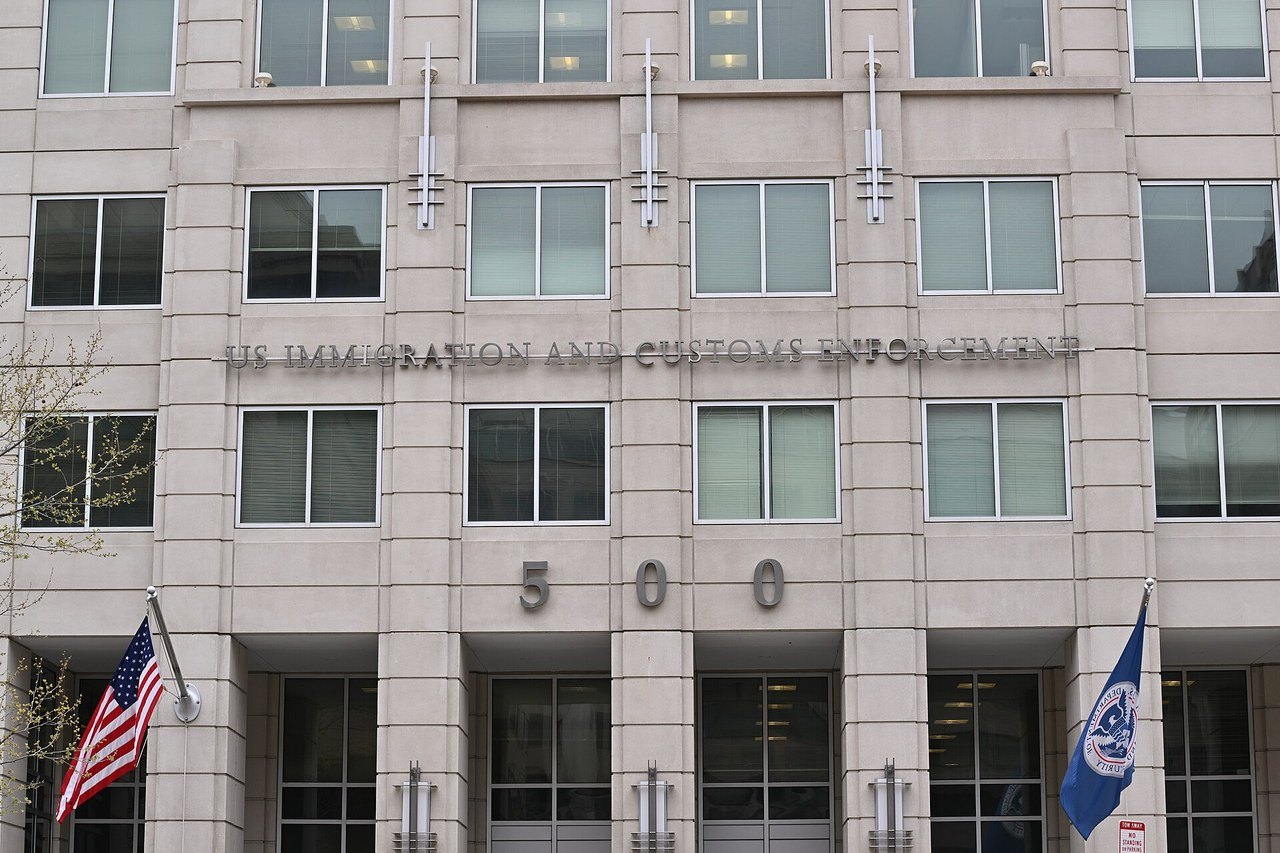
图片来源:美国移民与海关执法局总部大楼(GSM 固定图库)
GSM Global · 本篇英文版 English edition of this story
- 2026-10-07 08:45国土安全部拟对留学生OPT收七万美元培训费,学校先缴费才能办毕业工签
- 2026-11-03 12:24跟进:留学生OPT拟收费7万美元 公众意见征询11月9日截止
- 2026-11-09 11:43华盛顿OPT收费拟议规则意见今日11月9日截止:学校首荐7万美元、续荐3万美元,须美东时间23时59分前经法规门户提交,规则尚未生效
- 2026-11-09 01:24OPT收费提案今夜截止收意见:学校首荐7万美元、其后每次3万美元,国土安全部自估年收124亿美元,留美通道被重新定价本篇