科技越进步人越忙:外卖骑手大军背后的效率账
《The Star》栏目组 观察整理
社区一位邻居在群里聊起科技进步时,一连发了两段话。第一段说:「以前1亿人才能做完的活儿,现在100万人就能完成了。提高了效率,集中了财富,留下很多外卖骑手。」
他紧接着又说:「科技进步带来闲暇,似乎只是一个美好的愿望。事实上,随着科技的发展,人们越来越忙啦……不仅忙,还焦虑……又忙又焦虑,还穷还挫败……」
话说得直白,却戳中了许多人的真实感受。效率、财富、骑手、忙碌、焦虑,这几个词背后,其实都各有各的数据。先看全球的大账,再分别看中国和美国。
先看效率这一头。邻居说的「1亿人」和「100万人」是夸张的比方,方向却没有错:世界经济论坛《2025年就业未来报告》测算,到2030年,技术进步等结构性变化将替代全球约9200万个现有岗位。过去需要大量人手重复完成的活儿,正在被软件、机器和算法一件件接管。
世界经济论坛的测算同时指出,到2030年,新技术将创造约1.7亿个新岗位,比被替代的还多,净增约7800万个;大数据、人工智能、软件开发等岗位增速最快,轻型卡车与配送司机也名列增长最快的职业行列。换句话说,骑手大军本身,就是新技术创造出来的新行当。
先看中国。被「留下」的骑手,确实成了一支大军。公开数据显示,中国外卖骑手已经超过1100万人。美团研究院披露,2024年美团平台月均有单骑手336万;中国人民大学2025年2月发布的报告显示,饿了么活跃骑手超过400万。中华全国总工会第九次全国职工队伍状况调查显示,全国新就业形态劳动者已达8400万人,占职工总数的21%。
再看美国。在美国,骑手和零工同样无处不在。皮尤研究中心的调查显示,16%的美国成年人曾经通过网约零工平台赚过钱,其中9%在过去一年里做过;18岁到29岁的年轻人里,这一比例高达三成。仅外卖平台DoorDash一家,2024年就有超过750万人在平台上跑过单,全年经平台发出的收入超过170亿美元。
再看财富这一头。订单、派单规则和定价权,握在少数平台公司手里;干活的人数以百万计,收入却按单结算、起伏不定。皮尤的数据显示,低收入成年人中有25%做过平台零工,高收入成年人中只有9%;过去一年做过零工的人里,约三成以此为主业,多数人是拿它补贴家用。与此同时,零工通常没有雇主提供的医疗保险和退休计划兜底。邻居那句「还穷」,一部分就来自这里。
不过,故事还有另一面。DoorDash等平台则强调,时间灵活是许多人选择跑单的原因;皮尤的调查里,多数平台零工对这份工作的整体评价也是正面的。
忙和焦虑,同样有数字。盖洛普《2025年全球职场状况报告》显示,全球有40%的雇员表示,自己在前一天承受了大量的压力;美国和加拿大的这一比例高达50%,居全球各地区之首。
无论中国还是美国,技术让协作随时随地,也让工作和生活的边界越来越淡:消息随时进来,单子随时派下,人很难真正「下班」。
问题因此不在于技术有没有创造价值,而在于价值如何分配、节奏由谁来定。
回到这位邻居的两段话。它们未必严谨,却说中了一种普遍的体感:机器替人干的活越来越多,人要干的活却没有变少,只是换了地方、换了形式、换了催促的方式。科技进步最终能不能换来闲暇,眼下还没有答案;但街头那支越来越庞大的骑手队伍提醒人们,每一次「效率提升」的账,最后都要落到具体的人头上。
(来源:皮尤研究中心、盖洛普、世界经济论坛、美团研究院、中国人民大学、中华全国总工会)
As Technology Advances, People Get Busier: The Efficiency Ledger Behind the Food-Delivery Rider Army
Observed and compiled by The Star, GSM’s features desk
A neighbor in our community, chatting in a group about technological progress, sent two messages in a row. The first read: "Work that once took 100 million people to finish can now be done by one million. Efficiency went up, wealth got concentrated, and what got left behind is a lot of food-delivery riders."
He followed it with a second: "The idea that technological progress would bring leisure seems to be just a beautiful wish. In fact, as technology advances, people are getting busier and busier... not just busy, but anxious... busy and anxious, and poor and frustrated on top of it..."
The words are blunt, but they strike a chord with many people. Behind each of his keywords — efficiency, wealth, riders, busyness, anxiety — there are hard numbers. Start with the global picture, then look at China and the United States in turn.
Start with efficiency. The neighbor's "100 million" and "one million" are an exaggeration, but the direction is right: the World Economic Forum's Future of Jobs Report 2025 estimates that by 2030, technological change and other structural shifts will displace some 92 million existing jobs worldwide. Work that once took large numbers of people doing the same thing over and over is being taken over, piece by piece, by software, machines and algorithms.
The same World Economic Forum report projects that new technologies will create some 170 million new jobs by 2030 — more than the number displaced, for a net gain of about 78 million. Big data, artificial intelligence and software development are among the fastest-growing fields, and light truck and delivery drivers also rank among the fastest-growing occupations. In other words, the rider army is itself a new trade created by new technology.
Start with China. The riders who were "left behind," meanwhile, have become an army. Public figures show that China now has more than 11 million food-delivery riders. The Meituan Research Institute reports that the platform averaged 3.36 million riders taking orders each month in 2024, and a February 2025 report from Renmin University of China put Ele.me's active riders at more than 4 million. A survey by the All-China Federation of Trade Unions found 84 million workers in new forms of employment nationwide, 21 percent of all employees.
Now the United States. In the United States, riders and gig workers are just as ubiquitous. A Pew Research Center survey found that 16 percent of American adults have earned money through an online gig platform, 9 percent of them within the past year; among 18- to 29-year-olds, the share reaches 30 percent. On the DoorDash platform alone, more than 7.5 million people delivered in 2024, earning more than $17 billion through the platform over the year.
Then there is the wealth side. Orders, dispatch rules and pricing power sit in the hands of a handful of platform companies, while the people doing the work number in the millions and are paid by the task, with incomes that rise and fall. Pew's data show that 25 percent of lower-income adults have done platform gig work, compared with only 9 percent of upper-income adults; of those who did gig work in the past year, about three in ten relied on it as their main job, while most used it to supplement their income. Gig work also typically comes without employer-provided health insurance or a retirement plan. Part of the neighbor's word "poor" comes from exactly this.
But there is another side to the story. Platforms such as DoorDash stress that flexible hours are why many people choose to deliver, and in Pew's survey, most platform gig workers rated their experience positively overall.
The busyness and anxiety have numbers too. Gallup's State of the Global Workplace 2025 report found that 40 percent of employees worldwide said they had experienced a lot of stress the previous day; in the United States and Canada, the figure was 50 percent, the highest of any region in the world.
In China and the United States alike, technology makes collaboration possible anytime and anywhere — and blurs the line between work and life: messages arrive at all hours, orders are dispatched at all hours, and it becomes hard to ever truly clock out.
The question, then, is not whether technology creates value, but how that value is shared — and who sets the pace.
Which brings us back to the neighbor's two messages. They may not be rigorous, but they capture a widely shared feeling: machines are doing more and more of the work, yet the work people have to do has not shrunk — it has only moved elsewhere, taken new forms and found new ways to hurry us along. Whether technological progress will eventually buy back leisure remains an open question. But the ever-growing ranks of riders on the street are a reminder that every bill for "improved efficiency" is ultimately settled by real people.
(Source: Pew Research Center, Gallup, World Economic Forum, Meituan Research Institute, Renmin University of China, All-China Federation of Trade Unions)
来源:皮尤研究中心、盖洛普、世界经济论坛、美团研究院、中国人民大学、中华全国总工会
发布:GSM·美国(发布链接)
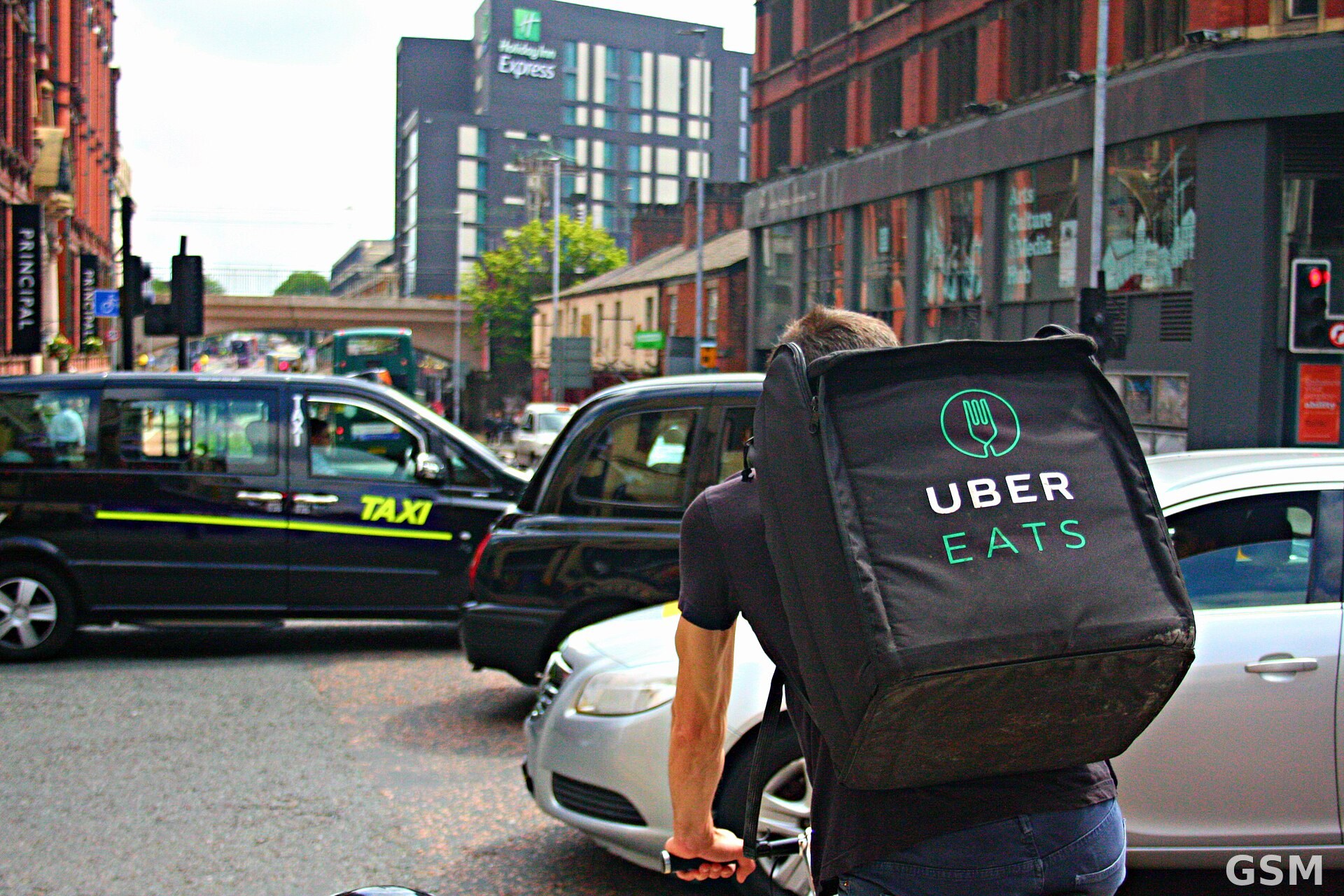
图片来源:英国曼彻斯特街头的外卖骑手。shopblocks 摄,CC BY 2.0,经 Wikimedia Commons。 / A food-delivery rider on a street in Manchester, UK. Photo by shopblocks, CC BY 2.0, via Wikimedia Commons.
GSM Global · 本篇英文版 English edition of this story