美国苗族40万人:加州11万居首,从老挝难民到美国市长与奥运冠军
美国人口普查局2025年美国社区调查数据显示,全美自认苗族(Hmong)者约40万人,其中加州约11.2万人、约占三成,为各州最多,明尼苏达州约11万人、威斯康星州约6.6万人次之。这个群体的父辈大多是1975年越战结束后从老挝来美的难民;半个世纪后的今天,美国出生的第二代、第三代已经成为主体,并走出了市长、州议员和奥运会冠军。
都会区层面(据2020至2024年五年期数据),明尼苏达州明尼阿波利斯—圣保罗地区约有9.7万苗族居民,是全美最大的苗族聚居区;加州的Fresno约3.7万人、Sacramento约3.5万人。圣保罗市约有3.3万苗族居民,约占全市人口一成,比例居全美城市之首。若只按「仅苗族」身份统计,全美苗族人口从2000年的17.5万人增至2025年的37万人,25年间增长114%。
苗族先民源于中国南方,数百年前陆续迁入老挝北部山区。越战期间,美国中央情报局在老挝开展「秘密战争」,招募以苗族为主的游击部队,协助美军对抗北越军队与巴特寮,兵力约三四万人,由老挝王家军队将领王宝(Vang Pao,1929至2011年)统领。
1975年,巴特寮接管老挝,王宝等人于当年5月从龙镇(Long Tieng)空运撤离;到1975年底,约4万苗人徒步越境抵达泰国难民营。据美方统计,1975年至1982年间,共有53,700名苗族及其他老挝山地难民获安置来美,1980至1990年代又有多批陆续抵达。初到美国时,难民家庭由教会与慈善机构担保、分散安置在各州;此后出于亲属团聚、气候与生计等原因自发迁徙,逐步在加州中央谷地、明尼苏达州双子城地区和威斯康星州形成今天的大型社区。
2025年是苗族大规模来美50周年。人口结构已经翻转:移民一代占全美苗族的比重从2000年的55%降至2023年的31%,美国出生者约22.5万人、成为多数;全美苗族中位年龄为26.8岁,美国出生者仅19.3岁。5岁以上者约73%在家中说苗语、约71%能熟练使用英语,美国出生者英语熟练比例达85%。25岁以上者中26%拥有本科或以上学历;苗族家庭收入中位数为85,700美元(2023年)。移民中九成已在美居住10年以上,85%已经入籍。
从政是这个群体扎根的标志之一。1991年,Choua Lee当选圣保罗校区董事会成员,成为全美首位经选举出任公职的苗族裔。2002年,Mee Moua在补选中进入明尼苏达州参议院,成为首位进入州议会的苗族裔;如今在明尼苏达州议会与各级地方政府任职的苗族裔民选官员已有十余人。2022年,Sheng Thao当选加州Oakland市长,成为美国大城市首位苗族裔市长(她已于2024年经选民投票罢免离任)。2025年11月,Kaohly Her当选圣保罗市长,成为该市首位女性市长和首位苗族裔市长,2026年1月就职。
体育界的代表人物是体操运动员苏妮萨·李(Sunisa Lee)。她出生于圣保罗一个苗族家庭,2021年在东京奥运会上夺得女子体操个人全能金牌,成为第一位苗族裔奥运会选手和奥运冠军;加上团体与单项奖牌,她在两届奥运会上共获得六枚奖牌。
与40万的人口规模相比,苗语媒体近乎空白。圣保罗有《苗族时报》(Hmong Times,1998年创刊)和《今日苗族》(Hmong Today,2004年创刊)两份社区报纸,双周发行、内容以英文为主,另有若干社区广播节目和小型电视台。学术研究指出,美国没有以苗文出版的日报,至今也没有一家覆盖全美的综合性苗语新闻机构;这个群体的日常新闻,很大程度上仍靠主流媒体与社区内部传播。
苗族新年在苗语中称「Noj Peb Caug」,意为「吃三十」,是稻谷收割完毕后庆祝丰收、辞旧迎新的节日,青年男女在节日期间以抛球(pov pob)对歌传情是流传至今的习俗。每年12月下旬,加州Fresno的Fresno Fairgrounds都会举办苗族新年庆典,由非营利组织The Hmong, Inc.主办,通常为期四天、每年逾10万人次参加,被普遍视为全美规模最大的苗族新年活动;2025年底举行的第50届庆典,恰逢苗族来美50周年。圣保罗等地的苗族新年多在11月至12月间举行,各地错开日期,方便亲友跨州相聚。
GSM 国际站以 23 种语言发布新闻,包括苗语版。
来源:GSM·美国
关联:Stockton苗族新年11月14日至15日举行:门票7美元、文化表演与排球赛事登场
关联:Sacramento苗族新年庆典11月27日至29日举行:Hmong Idol决赛与加州苗族小姐加冕同场
Hmong Americans at 400,000: California Leads With 110,000, From Laos Refugees to U.S. Mayors and an Olympic Champion
About 400,000 people in the United States identified as Hmong in the U.S. Census Bureau's 2025 American Community Survey. California is home to about 112,000 of them, roughly three in ten of the national total and more than any other state, followed by Minnesota with about 110,000 and Wisconsin with about 66,000. Most of their parents and grandparents arrived as refugees from Laos after the Vietnam War ended in 1975; half a century on, the U.S.-born second and third generations are now the majority, and the community has produced mayors, state lawmakers and an Olympic champion.
By metropolitan area (2020-2024 five-year estimates), Minneapolis-St. Paul in Minnesota has the largest Hmong community in the country, at about 97,000. Fresno, California, is home to about 37,000 Hmong residents and Sacramento to about 35,000. St. Paul's roughly 33,000 Hmong residents make up about one in ten of the city's population, the highest share of any U.S. city. Counting only those who identify as Hmong alone, the population grew 114 percent in 25 years, from 175,000 in 2000 to 375,000 in 2025.
The Hmong trace their origins to southern China and migrated over centuries into the mountains of northern Laos. During the Vietnam War, the CIA ran a "secret war" in Laos and recruited a guerrilla force drawn largely from the Hmong, some 30,000 to 40,000 fighters who aided U.S. forces against North Vietnam and the Pathet Lao, under Royal Lao Army General Vang Pao (1929-2011).
When the Pathet Lao took over Laos in 1975, Vang Pao and others were airlifted out of Long Tieng that May; by the end of 1975, about 40,000 Hmong had crossed into refugee camps in Thailand. Between 1975 and 1982, a total of 53,700 Hmong and other highland Lao refugees were resettled in the United States, with further waves arriving through the 1980s and 1990s. Sponsored by churches and charities, families were first scattered across many states; over time, kinship, climate and work drew them together again, forming today's large communities in California's Central Valley, Minnesota's Twin Cities and Wisconsin.
The year 2025 marked 50 years since large-scale Hmong arrivals in the United States began, and the population has flipped: immigrants were 55 percent of Hmong Americans in 2000 but only 31 percent in 2023, while the U.S.-born number about 225,000. The median age is 26.8, and just 19.3 among the U.S.-born. About 73 percent of those aged 5 and older speak Hmong at home, and 71 percent are proficient in English, rising to 85 percent among the U.S.-born. Among adults 25 and older, 26 percent hold a bachelor's degree or higher, and the median Hmong household income was $85,700 in 2023. Nine in ten immigrants have lived in the United States for more than a decade, and 85 percent have become citizens.
Public office tells the story of the community's roots. In 1991, Choua Lee won a seat on the St. Paul school board, becoming the first Hmong American elected to public office in the United States. In 2002, Mee Moua won a special election to the Minnesota Senate, the first Hmong American in a state legislature; today, more than a dozen Hmong Americans hold elected office in Minnesota's legislature and local governments. In 2022, Sheng Thao was elected mayor of Oakland, California, the first Hmong American mayor of a major U.S. city (she was removed by a recall vote in 2024). In November 2025, Kaohly Her was elected mayor of St. Paul, the city's first woman mayor and first Hmong mayor, and took office in January 2026.
In sports, the best-known name is gymnast Sunisa "Suni" Lee, born to a Hmong family in St. Paul. At the Tokyo Olympics in 2021, she won the women's all-around gold medal, becoming the first Hmong American Olympian and Olympic champion; across two Olympic Games she has won six medals.
For a community of 400,000, Hmong-language media barely exists. St. Paul has two community newspapers: the Hmong Times, founded in 1998 and the longest-running Hmong newspaper in the country, and Hmong Today, founded in 2004. Both publish every two weeks, mostly in English, alongside community radio programs and small television operations. Researchers note that there is no daily newspaper published in Hmong and no nationwide, general-interest Hmong-language news organization; day-to-day news still travels largely through mainstream outlets and word of mouth within the community.
The Hmong New Year, Noj Peb Caug, literally "eat thirty," marks the end of the rice harvest, when the old year is farewelled and the new one welcomed; young people still court through pov pob, a ball-tossing song exchange. Every late December, the Hmong New Year celebration at the Fresno Fairgrounds in California, organized by the nonprofit The Hmong, Inc., runs for about four days and draws more than 100,000 visitors each year, widely regarded as the largest Hmong New Year celebration in the United States. The 50th edition, held in late December 2025, coincided with 50 years of Hmong life in America. St. Paul and other cities hold their celebrations in November and December, staggered so families can travel between them.
GSM Global publishes news in 23 languages, including a Hmong edition.
Source: GSM · USA
来源:GSM·美国(原文链接)
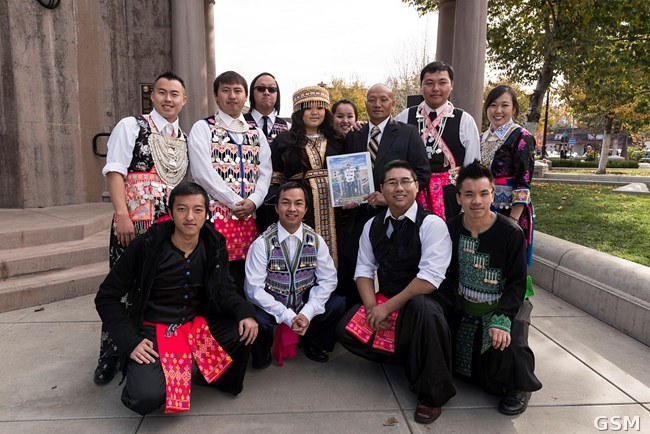
图片来源:加州Chico市苗族新年庆典上,身着传统服饰的苗族居民合影(资料图)。Carol M. Highsmith 摄,美国国会图书馆藏,美国国家公园管理局发布,公共领域。 / Hmong residents in traditional dress at the Hmong New Year celebration in Chico, California (file photo). Photo by Carol M. Highsmith, Library of Congress collection, via the U.S. National Park Service, public domain.
GSM Global · 本篇英文版 English edition of this story