联合国安理会辩论伊朗核问题:格罗西称核材料仍无法核实,400多公斤高浓缩铀去向未明
联合国安理会10月27日在纽约举行第10253次会议,审议不扩散与伊朗核问题:国际原子能机构(IAEA)总干事拉斐尔·格罗西通报称,伊朗尚未提供核查所需的信息与准入,该机构无法核实伊朗先前申报的核材料。会议未作出实质决定,与会各方围绕对伊制裁是否已经恢复各执一词。
会议在俄罗斯的要求下先进行程序性表决,安理会以11票赞成、2票反对、2票弃权通过临时议程,俄罗斯与中国投反对票,索马里与巴基斯坦弃权。表决前,俄罗斯与中国代表表示,安理会已于2025年10月18日结束对伊朗核问题的审议、终止了「不扩散」议题,并援引第2231号(2015年)决议第8段作为依据。法国、英国与美国代表反驳称,伊朗未履行保障监督义务,第2231号决议仍然有效;美国代表斥责对方的说法「毫无根据、自私自利」。
格罗西在通报中说,伊朗没有提供所要求的信息和准入,IAEA因而无法核实伊朗在保障监督之下的设施中先前申报的核材料,无论这些设施是否受到军事打击的影响。他表示,该机构核查人员累计在1400多处设施和地点开展了超过14000个日历日的核查活动,但在2025年6月军事打击开始后,出于安全原因被迫撤出。格罗西说:「这方面的法律义务在任何情况下都不能单方面中止。」他援引IAEA理事会2026年9月9日通过的GOV/2026/61号决议,促请伊朗澄清未决的保障监督问题,并向IAEA提供所需的信息与准入,以便机构核实全部相关设施和材料。他还表示,渐进的、技术性的小步措施,可以为伊朗恢复正常保障监督铺平道路,并营造有利于达成更广泛协议的建立信任氛围。
对浓缩铀库存的担忧成为多国发言的焦点。英国代表表示,伊朗已积存400多公斤浓缩至60%的铀,是唯一达到这一浓缩水平的无核武器国家,「没有任何可信的民用理由」;她说,这批库存一年多来去向未明,并呼吁伊朗允许IAEA核查人员重返所有核设施。法国代表警告说,这一数量的核材料潜在足以制造约10枚核爆炸装置,要求安理会履行职责、要求伊朗立即履行其国际义务,并紧急恢复与IAEA的有效合作。德国代表表示,此事关乎全球核不扩散体系的完整性与信誉,《不扩散核武器条约》的权利与义务必须得到维护。丹麦代表表示,「快速恢复制裁」机制已按第2231号决议全面启动,对伊制裁仍然有效。拉脱维亚代表说,伊朗若真心寻求和平的长期解决并最终解除制裁,就必须与IAEA充分合作。
美国代表谴责伊朗持续不履行自身义务,称所有重视《不扩散核武器条约》的人都应深感担忧。她表示,美国将与其他安理会成员合作,推动建立一个独立的多边机制,监督并报告1737制裁制度在全球的执行情况,并呼吁安理会与联合国大会的代表们支持这一「问责架构」。
俄罗斯代表称,西方国家所谓IAEA在伊朗没有核查活动的说法是新一轮「捏造」;他指出,即便在2025年6月美国和以色列对伊朗和平核基础设施发动首轮打击之后,伊朗仍与IAEA保持接触,包括对未受打击设施的视察。他说,围绕伊朗问题「制造一个替代现实」无助于安理会的工作,呼吁安理会成员停止利用安理会和IAEA「同德黑兰算政治账」,并强调政治和外交解决别无替代。中国代表表示,政治和外交手段是解决伊朗核问题的唯一出路,当前困局的根源是美国退出伊朗核问题全面协议、恢复并持续强化单边制裁、推行「极限施压」;美国和以色列两度打击受IAEA保障监督的伊朗核设施,是IAEA无法在相关场所开展保障监督的直接原因,中方呼吁美国停止对伊朗使用武力。
伊朗代表在发言中说:「伊朗是战争的受害者,不是侵略者。」他批评安理会在18个月前两个拥核国家对伊朗发动侵略面前「无可原谅地不作为」,指出针对受IAEA保障监督的伊朗核设施的11次袭击违反了安理会第487号(1981年)决议,此类打击带来辐射泄漏的严重风险,可能造成灾难性后果。他还表示,真正关心不扩散的成员应当看向以色列:以色列拥有200枚核弹头,置身于IAEA保障监督之外,也未加入任何裁军公约。
巴林代表表示,外交与对话仍是处理伊朗核档案的最佳途径。巴基斯坦代表敦促各方保持克制,打破僵局、达成谈判解决,并提到今年6月的《伊斯兰堡谅解备忘录》表明进展是可能的。
背景资料显示,安理会于2015年核可伊朗核问题全面协议:以解除制裁换取伊朗限制其核计划,并建立为期10年的监督框架,协议设有「快速恢复制裁」机制,即伊朗若不履行义务,制裁将自动恢复。2018年5月,美国退出该协议,伊朗随后逐步减少履行承诺。2025年9月,法国、德国与英国称德黑兰违反协议、已触发「快速恢复制裁」,制裁与2006年设立的1737委员会随之恢复,负责报告伊朗核计划;俄罗斯与中国则认为,美国退出协议意味着该机制已经失效。由于这一僵局,安理会至今未能就1737委员会的授权是否有效达成一致,也未能选出委员会主席或任命监督制裁执行的专家小组。今年2月,美国与以色列对伊朗发动军事打击,伊朗对邻国实施了反击,安理会内部分歧进一步加深。
UN Security Council Debates Iran Nuclear Programme: Grossi Says Nuclear Material Still Unverified, 400 kg of Highly Enriched Uranium Unaccounted For
The UN Security Council held its 10253rd meeting in New York on 27 October to take up non-proliferation and the Iranian nuclear issue. Rafael Grossi, Director General of the International Atomic Energy Agency (IAEA), told the Council that Iran has not provided the information and access needed for verification, and that the Agency cannot verify Iran's previously declared nuclear material. The meeting took no substantive decision, as speakers remained divided over whether sanctions on Iran are back in force.
The meeting opened with a procedural vote requested by the Russian Federation. By 11 votes in favour to 2 against, with 2 abstentions, the Council adopted its provisional agenda; the Russian Federation and China voted against, while Somalia and Pakistan abstained. Before the vote, the representatives of the Russian Federation and China asserted that on 18 October 2025 the Council had concluded its consideration of the Iranian nuclear issue and terminated the "non-proliferation" agenda item, citing paragraph 8 of resolution 2231 (2015). The representatives of France, the United Kingdom and the United States countered that Iran's non-compliance with its safeguards obligations meant that resolution 2231 (2015) remained in force, with the United States rejecting the opposing claims as "baseless, self-serving counterfactual" statements.
Grossi said Iran "has not provided the requested information and access so that the IAEA can verify previously declared nuclear material at Iran's facilities under safeguards, both those that have been affected by military attacks and those that have not". He noted that Agency inspectors had spent more than 14,000 calendar days conducting verification activities in more than 1,400 facilities and locations, but were compelled to withdraw for safety reasons after the commencement of military attacks in June 2025. "Legal obligations in this regard cannot be unilaterally suspended under any circumstances," he said, citing resolution GOV/2026/61, adopted by the IAEA Board of Governors on 9 September 2026, and he encouraged Iran to clarify outstanding safeguards questions and give the IAEA the information and access it requires so it can verify all relevant facilities and material, as is Iran's legal obligation. Such gradual, technical, incremental steps, he added, could pave the way to normal safeguards implementation in Iran while contributing to a confidence-building atmosphere conducive to a wider agreement.
Iran's enriched uranium stockpile drew alarm from several speakers. The United Kingdom's representative expressed concern over a stockpile of more than 400 kilograms of uranium enriched to 60 per cent, making Iran the only State without nuclear weapons to enrich to this level, "for which there is no credible civilian justification". She said the stockpile has remained unaccounted for for more than a year and called on Iran to allow the return of IAEA inspectors to all nuclear sites. France's delegate warned that such a quantity of material would potentially be enough for around 10 explosive nuclear devices, and said the Council must fulfil its role in responding to the proliferation crisis and demand that Iran immediately comply with its international obligations and urgently resume effective cooperation with the Agency. Germany's representative said the issue at stake is the integrity and credibility of the global nuclear non-proliferation regime, and that the rights and obligations of the Non-Proliferation Treaty must be upheld. Denmark's representative said the snapback mechanism had been activated in full accordance with resolution 2231 (2015) and the sanctions against Iran remain in force. Latvia's delegate said that if Iran is serious about a peaceful long-term solution and the eventual lifting of sanctions, it must fully cooperate with the Agency.
The United States representative rebuked Iran for its continued non-compliance with its obligations, adding that "all who value the NPT should be deeply concerned by this". She said the United States will work with other Council members to advance an independent multilateral mechanism to monitor and report on global implementation of the 1737 sanctions regime, and urged Council and General Assembly representatives to support "this architecture of accountability".
The Russian Federation's delegate said claims that there are no IAEA verification activities in Iran were another round of "fabrications", noting that even after the first series of strikes by the United States and Israel against Iran's peaceful nuclear infrastructure in June 2025, Iran continued to engage with the Agency, including inspections at facilities not affected by the strikes. Creating an "alternative reality" around the Iranian issue does not help the Council's work, he said, calling on Council members to stop using the Council and the IAEA "to settle political scores with Tehran", and adding that there can be no alternative to a political and diplomatic settlement. China's representative concurred that political and diplomatic means are the only solution, saying the root causes of the current predicament are the United States' withdrawal from the nuclear agreement, its resumption and continuous intensification of unilateral sanctions and its "maximum pressure" policy. Military strikes carried out twice by Israel and the United States on Iran's IAEA-safeguarded nuclear facilities are the direct cause of the IAEA's inability to carry out safeguards at relevant sites, he said, calling on the United States to cease using force against Iran.
Iran's delegate stressed that "Iran is a victim of war, not the aggressor", taking issue with the Council's "inexcusable inaction" in the face of aggression by two nuclear-weapon possessors against his country 18 months ago. He decried 11 repeated attacks against Iran's nuclear facilities under IAEA safeguards, in violation of Council resolution 487 (1981), saying such strikes create a grave risk of radiation release with potentially devastating consequences. Assailing what he called double standards, he said those with genuine non-proliferation concerns should look to Israel, which he said possesses 200 nuclear warheads, remains outside IAEA safeguards and is party to none of the disarmament conventions.
Bahrain's delegate said diplomacy and dialogue remain the best path to address the Iranian nuclear file. Pakistan's delegate urged all sides to exercise restraint and break the deadlock towards a negotiated settlement, pointing to the Islamabad Memorandum of Understanding reached in June, which he said demonstrates that progress is possible.
By way of background, the Council in 2015 endorsed the Joint Comprehensive Plan of Action, under which Iran received sanctions relief in exchange for limits on its nuclear programme and a 10-year monitoring framework; the agreement included a "snapback" mechanism under which sanctions would be reinstated if Tehran failed to fulfil its obligations. After the United States withdrew from the agreement in May 2018, Iran reduced its commitments. In September 2025, France, Germany and the United Kingdom argued that the snapback mechanism had been triggered by Tehran's alleged violations, reinstating the sanctions and the 1737 Committee, established in 2006 to report on Iran's nuclear programme. The Russian Federation and China contended that, the United States having withdrawn from the plan, the mechanism had lapsed. Because of the impasse, the Council has been unable to agree on whether the 1737 Committee's mandate is valid, has not elected a Chair for the Committee and has been unable to appoint a Panel of Experts to monitor the implementation of sanctions. Tensions worsened after the United States and Israel launched military strikes on Iran in February and Iran launched counterattacks against its neighbours.
来源:GSM·美国(原文链接)
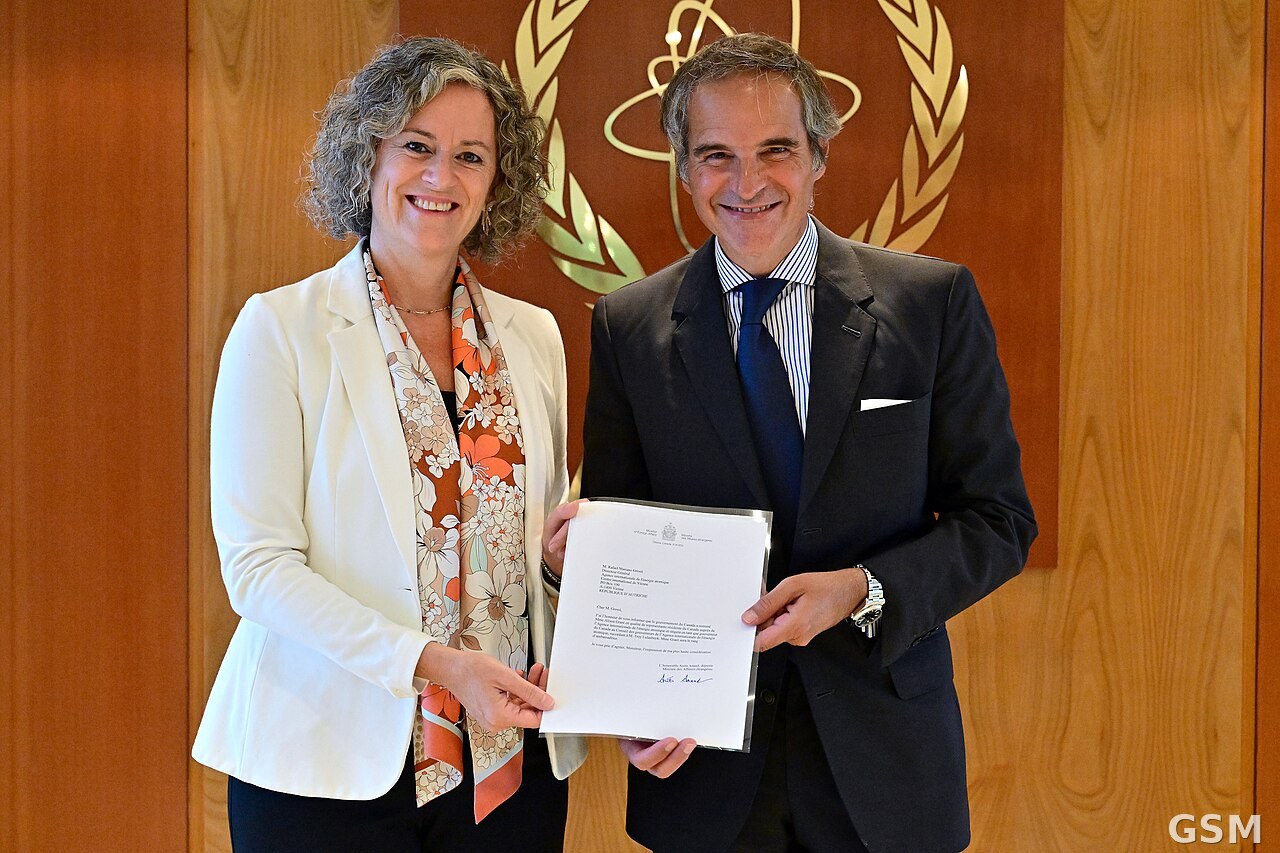
图片来源:国际原子能机构(IAEA)总干事格罗西(右),2025年8月摄于维也纳IAEA总部。照片:IAEA Imagebank / Dean Calma,CC BY 2.0,经 Wikimedia Commons