韦布望远镜「小红点」之谜获新解释:模拟显示其为首批超大质量黑洞的诞生地,黑洞约 1000 万倍太阳质量
詹姆斯·韦布空间望远镜发现的「小红点」天体获得一项新解释。朴茨茅斯大学 Daniel Whalen 领衔的团队通过先进宇宙学模拟提出,这类神秘天体很可能是原初星系,正在其中由超大质量原初恒星坍缩形成大质量黑洞。论文发表于《天体物理学杂志快报》(2026 年,DOI: 10.3847/2041-8213/aeb37a),2026 年 11 月 10 日对外报道。
自韦布望远镜以前所未有的深度巡视宇宙以来,天文学家已发现数百个致密明亮的「小红点」:它们出现在早期宇宙,只有几百光年大小,却和大得多的星系一样明亮,其 V 形光谱一直难以用既有理论解释,且缺乏可探测的 X 射线与射电辐射。
新模拟显示,这类系统内含有质量约 1000 万倍太阳质量的黑洞。黑洞仍包裹在形成它的巨大气体盘中,致密气体困住高能 X 射线,只放出部分紫外、可见光与红外光,从而自然复现韦布观测到的异常光特征。模拟还显示,这些小星系中另有一团致密星团,约 1 亿颗恒星挤在仅约 500 光年宽的区域内,贡献了光谱的蓝色部分,与真实「小红点」的观测相符。
研究团队称,新模型成功复现了多种「小红点」的性质,包括一些最遥远、最极端的例子。Whalen 表示,这可能意味着人类正在目睹首批超大质量黑洞的诞生;模拟早在数十年前就预言这类天体应存在。论文的结论是模型解释,而非直接观测确认,原文按此口径表述。
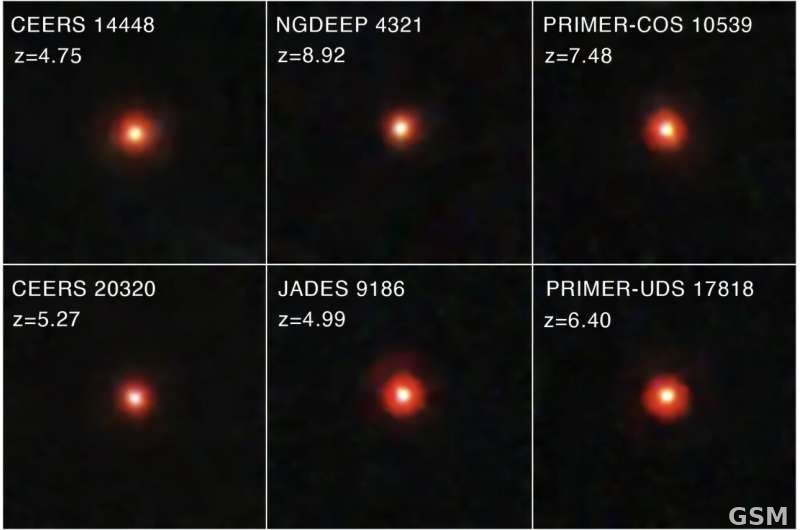
图中是韦布望远镜拍摄的「小红点」天体图像。
Webb's 'Little Red Dots' May Be Birthplaces of First Supermassive Black Holes, Simulations Suggest
Astronomers may have solved one of the biggest mysteries uncovered by NASA's James Webb Space Telescope. Using sophisticated cosmological simulations, a team led by Dr. Daniel Whalen of the University of Portsmouth's Institute of Cosmology and Gravitation shows that enigmatic objects known as little red dots are likely primeval galaxies hosting massive black holes formed by the collapse of supermassive primordial stars. The paper was published in The Astrophysical Journal Letters in 2026 (DOI: 10.3847/2041-8213/aeb37a) and reported on November 10, 2026.
Since Webb began observing, astronomers have found hundreds of compact, bright little red dots in the early universe. They are only a few hundred light-years across but as bright as much larger galaxies, with unusual V-shaped spectra and no detectable X-ray or radio emissions, defying existing explanations.
The simulations suggest these systems contain black holes with masses around 10 million times that of the Sun, still wrapped inside the enormous disks of gas that created them. The dense gas traps high-energy X-rays while allowing some ultraviolet, visible and infrared light to escape, naturally recreating the light signatures Webb sees. A neighboring dense cluster of around 100 million stars packed into a region only around 500 light-years across produces the blue portion of the spectrum, matching observations.
The model reproduces the properties of a wide variety of little red dots, including some of the most distant and extreme examples, the team reports. Whalen said the result may mean astronomers are witnessing the birth of the first supermassive black holes, objects simulations predicted decades ago. The finding is a simulation-based explanation, not a direct observational confirmation.
来源:朴茨茅斯大学
发布:GSM·美国(发布链接)
图片来源:图中是韦布望远镜拍摄的早期宇宙「小红点」天体图像。NASA, ESA, CSA, STScI, Dale Kocevski (Colby College)
GSM Global · 本篇英文版 English edition of this story