西北大学《Nature》新算法 FLIP:韦布灵敏度提升2至15倍,从旧观测中找回51 Eridani b
美国西北大学团队在《自然》(Nature)发表新算法 FLIP,可把詹姆斯·韦布空间望远镜(JWST)探测系外行星的灵敏度提升2至15倍。团队用该算法重新分析韦布望远镜2023年对51 Eridani系统的旧观测,从数据中找回了此前被漏掉的气态巨行星51 Eridani b。
FLIP全称为“Physics-based Learning for Imaging Planets”(基于物理的行星成像学习),其核心是把恒星光晕的噪声建模与行星信号分离,让微弱行星信号从背景中凸显。51 Eridani b是一颗年轻的气态巨行星,质量约为木星的数倍,轨道距离其宿主恒星约13个天文单位;此前基于同一批数据的分析未能确认它,FLIP的再分析将其找回。研究者表示,该算法无需新的望远镜观测时间,即可从已有的韦布档案数据中挖掘更多系外行星,并可用于未来直接成像巡天。
Northwestern's New Nature Algorithm FLIP Boosts Webb Sensitivity 2 to 15 Times, Recovers 51 Eridani b from Old Observations
A team at Northwestern University has published a new algorithm, FLIP, in Nature that boosts the James Webb Space Telescope's (JWST) sensitivity to exoplanets by 2 to 15 times. Applying FLIP to Webb's 2023 observations of the 51 Eridani system, the team recovered the previously missed gas giant 51 Eridani b.
FLIP, short for "Physics-based Learning for Imaging Planets," works by modeling the noise in a star's halo separately from the planet signal, allowing faint planetary signals to stand out from the background. 51 Eridani b is a young gas giant several times the mass of Jupiter, orbiting its host star at about 13 astronomical units; earlier analyses of the same data had failed to confirm it. The researchers said the algorithm can uncover more exoplanets from existing Webb archive data without requiring new telescope time, and can be applied to future direct-imaging surveys.
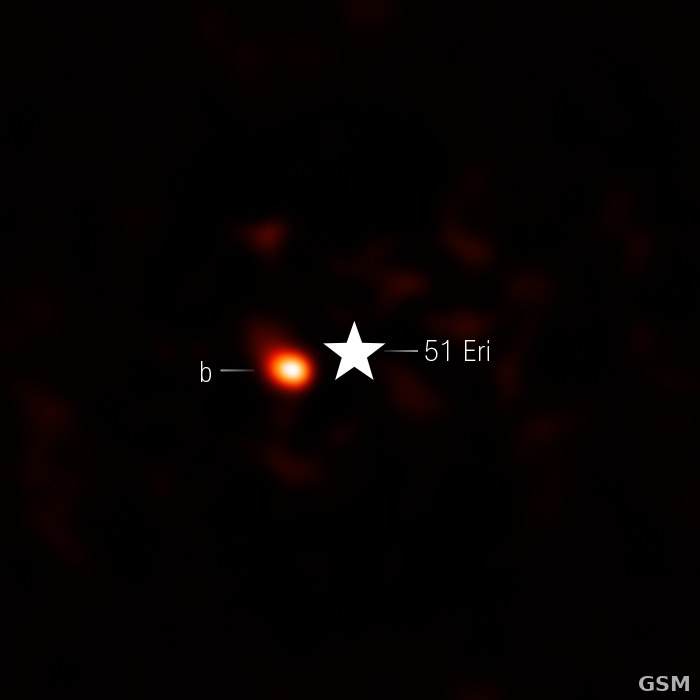
图中是韦布望远镜 NIRCam 拍摄的 51 Eridani 系统图像,本研究从该恒星的旧观测中找回行星 51 Eridani b。
来源:西北大学
发布:GSM·美国(发布链接)
图片来源:图为韦布望远镜 NIRCam 拍摄的 51 Eridani 系统。NASA, ESA, CSA, STScI, Public domain, via Wikimedia Commons
GSM Global · 本篇英文版 English edition of this story