Heuriskryptes 框架识别神经网络隐蔽信道:检测准确率93.51%、最低载荷场景检出率90%
一项11月14日发表于《科学报告》的研究提出名为 Heuriskryptes 的检测框架,用于识别深度神经网络内部被植入的隐蔽通信信道。研究针对的攻击方式称为 Stego-GCP,通过正交嵌入修改模型权重,以高隐蔽性把数据藏进模型的参数池。
该框架使用一个基于视觉 Transformer 架构的专用检测代理,把原始参数空间当作图像处理,依靠自注意力机制检测异常。作者称,这一做法着眼于权重谱的结构性数学特征,而不是激活触发模式。
验证在 PooledCNN 架构上进行,使用 Apple Disease 与 CIFAR-10 两个数据集。结果显示,承载模型保持99.97%的分类准确率,即隐藏信道对模型原有任务的影响很小。
检测性能方面,Heuriskryptes 检测器总体准确率达到93.51%;在最难检测的低载荷密度场景(参数 α 小于0.002)下,检出率保持在90%。作者表示,与所评估的频域异常检测基线相比,该框架表现具有竞争力。
研究由 Manipal University Jaipur 提供开放获取经费支持。作者称,该框架可用于协作与商业超级智能(SI)环境中的模型完整性核查,防范神经网络架构被用作未经授权的隐蔽通信通道。
Heuriskryptes Framework Detects Covert Channels in Neural Networks With 93.51% Accuracy and 90% Detection at Lowest Payloads
A study published November 14 in Scientific Reports introduces Heuriskryptes, a detection framework designed to identify covert communication channels planted inside deep neural networks. The attack vector it addresses, termed Stego-GCP, uses an orthogonal embedding to modify model weights with high stealth in order to leak data through a model's parameter pool.
The framework uses a specialized agent built on a Vision Transformer architecture that treats the raw parameter space as an image, providing a self-attention-based mechanism for detection. The authors say the approach focuses on the structural mathematical properties of the weight spectrum rather than activation-trigger patterns.
The framework was validated using a PooledCNN architecture on the Apple Disease and CIFAR-10 datasets. The carrier model retained a classification accuracy of 99.97 percent, showing that the hidden channel had little effect on the model's original task.
On detection, the Heuriskryptes detector achieved 93.51 percent overall accuracy, and maintained a 90 percent detection rate in the most challenging ambiguous, low-payload-density scenarios, where the parameter alpha was below 0.002. The authors describe the performance as highly competitive compared with the evaluated frequency-domain anomaly detection baselines.
Open access funding was provided by Manipal University Jaipur. The authors say the framework serves as a detection tool for verifying model integrity in collaborative and commercial settings that use superintelligence (SI) systems, and as a defense against the unauthorized use of neural architectures as covert communication channels.
来源:Scientific Reports
发布:GSM·美国(发布链接)
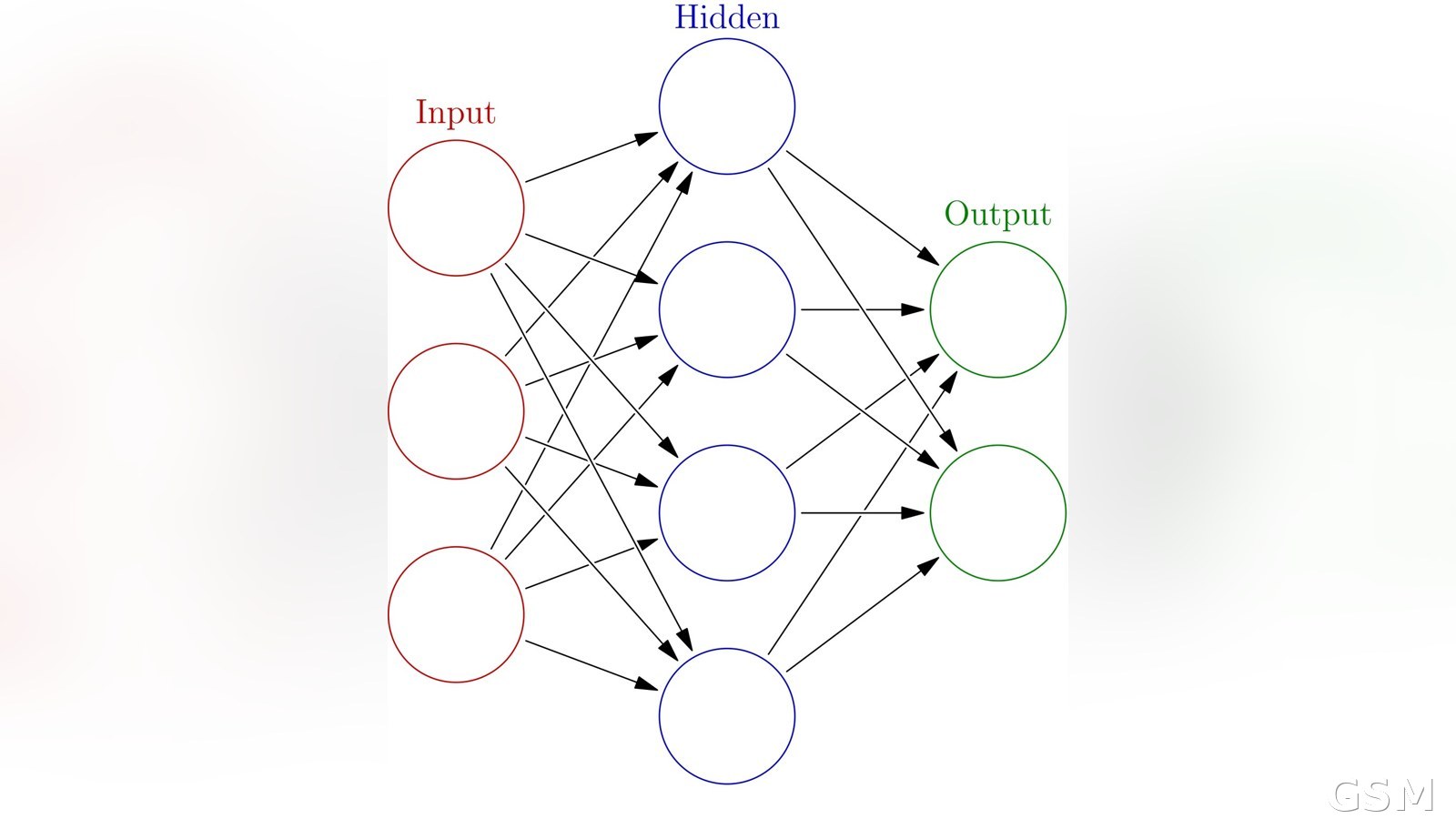
图片来源:图:人工神经网络结构示意图(输入层、隐藏层与输出层)。来源:Glosser.ca,Wikimedia Commons,CC BY-SA 3.0。 / Photo: Diagram of an artificial neural network (input, hidden and output layers). Source: Glosser.ca, Wikimedia Commons, CC BY-SA 3.0.
GSM Global · 本篇英文版 English edition of this story