NASA喷气推进实验室研究称轨道碎片长期风险96%来自失控物体 提出三项控制办法
NASA喷气推进实验室的 Slava Turyshev 在《Acta Astronautica》发表论文,讨论地球轨道碎片的治理。论文11月13日受到报道,其核心观点是,解决太空垃圾问题不只是清点垃圾,还涉及控制手段和经济机制。
论文援引提交给联邦通信委员会的文件称,运营着最大卫星星座的 SpaceX 报告,其 Starlink 卫星在2024年12月至2025年5月的六个月内共执行了144,404次避撞机动,平均每颗卫星约每周躲避一次潜在碰撞。
论文把不同高度的轨道分开讨论。500至600公里高度仍有足够大气,失效卫星和碎片会在数年内烧毁,属于部分自我清洁的区域。约850公里高度则停留着过去发射留下的大型火箭残骸,没有控制手段,也几乎没有大气阻力使其在合理时间内坠落,可能在轨停留数十年甚至数百年。论文援引欧洲航天局数据称,长期碰撞风险约96%来自这些失控物体。
Turyshev提出的第一项办法是监管。论文写道,联邦通信委员会已出台规则,要求卫星在任务结束后五年内离轨,取代此前沿用数十年的25年标准。按论文测算,若处置可靠度从90%提高到99%、允许的在轨滞留期缩短到五年,环境危害可降低为原来的五十分之一。
第二项办法是提升跟踪精度。论文建议,与其追踪每一颗螺栓,不如集中缩小高风险接近事件的不确定性范围,这与国家海洋和大气管理局正在扩展的太空交通协调系统 TraCSS 的方向一致。第三项办法是即时避撞,即在两件失控残骸即将相撞前,用地面激光或小型牧羊卫星群将其推离数米。
论文还讨论了经济机制。由于1967年《外层空间条约》的安排,私人公司不能直接处置他国遗弃的火箭残骸,且清理成本由一家承担、收益由所有运营者共享。Turyshev建议设立按可验证的长期风险削减付费的合同,并用处置保证金等方式筹资,激励企业优先清除最危险的物体。
JPL Study in Acta Astronautica: About 96% of Long-Term Orbital Collision Risk Comes From Dead Objects
A paper by Dr. Slava Turyshev of NASA's Jet Propulsion Laboratory, published in the journal Acta Astronautica and reported on November 13, argues that solving the space junk crisis is not just about counting trash, but about control and economics.
The paper cites filings made to the Federal Communications Commission showing that SpaceX, which runs the largest satellite megaconstellation, had its Starlink satellites perform 144,404 collision avoidance maneuvers in the six months from December 2024 through May 2025, an average of roughly one dodge per satellite per week.
The paper separates orbits by altitude. At 500 to 600 kilometers, enough atmosphere remains that dead satellites and debris burn up in a few years, making the region partly self-cleaning. At around 850 kilometers, giant rocket stages from past launches remain with no control and little atmosphere to drag them down, able to stay in orbit for decades or centuries. Citing European Space Agency data, the paper puts about 96% of the long-term collision risk on these dead objects.
The first lever Turyshev identifies is regulation. The paper notes that the FCC has introduced a rule requiring satellites to clear out within five years of retirement, rather than the 25 years that held for decades. According to the paper, if disposal reliability rises from 90% to 99% and a satellite's allowable afterlife is cut to five years, the environmental hazard decreases by a factor of 50.
The second lever is better tracking. Rather than tracking every bolt, the paper suggests concentrating on shrinking the uncertainty zone around high-risk close calls, aligning with upgrades through NOAA's Traffic Coordination System for Space, known as TraCSS. The third lever is just-in-time collision avoidance, using ground-based lasers or small swarms of shepherd satellites to move two dead objects a few meters apart just before impact.
The paper also addresses economics. Under the 1967 Outer Space Treaty, a private company cannot simply deorbit an abandoned rocket booster owned by another government, and one firm removing debris benefits all operators while bearing the cost alone. Turyshev proposes contracts that pay for verifiable reductions in long-term risk, financed in part by disposal bonds, to incentivize companies to remove the most dangerous pieces first.
来源:NASA喷气推进实验室
发布:GSM·美国(发布链接)
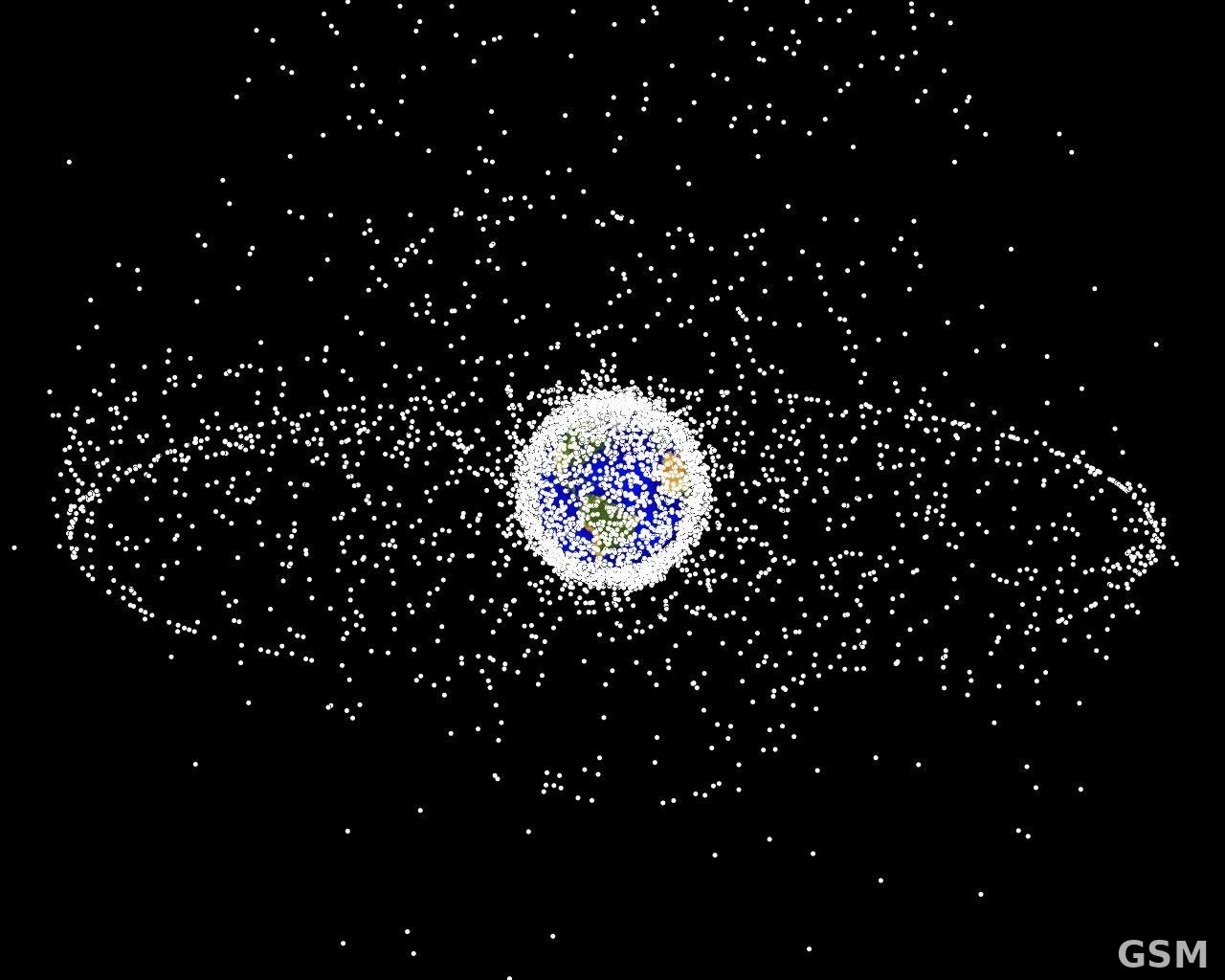
图片来源:图:地球轨道碎片分布示意图(对地静止轨道视角)。作者:NASA Orbital Debris Program Office,公共领域,维基共享资源。 / Photo: Visualization of orbital debris around Earth (GEO view). Credit: NASA Orbital Debris Program Office, public domain, via Wikimedia Commons.
GSM Global · 本篇英文版 English edition of this story