欧几里得望远镜发布首批大数据:逾9亿个星系入册,为宇宙三维地图奠基
欧洲空间局(ESA)11月12日发布欧几里得(Euclid)空间望远镜的首个大型数据批次 DR1-Foundation。这批数据收录了超过10亿个天体的光,覆盖的天区面积相当于9,500个满月,是这台望远镜2023年年中发射以来第一次大规模释放观测成果。
这批数据来自约13个月的观测:广域巡天覆盖1,900平方度天空,数据总量约170万GB。其中包括超过9亿个星系、约6,000万个类星体候选体,以及超过1.6亿个天体的光谱,光谱是测出星系距离、把星系放进宇宙三维结构的关键。
数据中最受关注的是约15,000个强引力透镜候选体。强引力透镜是前景星系把更遥远星系的光弯折放大的现象,能帮助科学家称量星系连同其暗物质的质量。这次的透镜目录是迄今最大的一个,规模超过以往所有同类目录的总和,其中不少是靠机器学习加上数千名公众科学志愿者一起找出来的。
欧几里得的任务是绘制宇宙的大尺度三维地图,借此研究暗物质、暗能量与星系结成的宇宙网。它2023年7月发射,2024年2月14日开始常规科学观测,计划用六年时间观测超过三分之一的天空、看向远达100亿光年外的星系。
这次发布只覆盖它最终要巡测天区的约14%。完整的第一批数据(DR1)预计2027年年中发布,届时将补上弱引力透镜观测与星系在宇宙网中的位置计算。欧空局科学主任 Carole Mundell 称这次发布是研究宇宙的一个科学里程碑,数据已通过 Euclid Data Space 平台向公众开放。
(来源:欧洲空间局)
Euclid Releases First Major Data Batch: More Than 900 Million Galaxies Catalogued for a 3D Map of the Universe
The European Space Agency (ESA) released the first major batch of data from its Euclid space telescope on November 12. Named DR1-Foundation, the release captures the light of more than a billion objects across an area of sky as large as 9,500 full Moons, and is the first major release of mission data since the telescope's launch in mid-2023.
The release rests on about 13 months of observations. The Wide Survey covers 1,900 square degrees of sky and the dataset totals about 1.7 million gigabytes. It includes more than 900 million galaxies, around 60 million quasar candidates, and the spectra of more than 160 million sources. Spectra are how Euclid measures galaxy distances and places galaxies into the three-dimensional structure of the Universe.
A headline item is the roughly 15,000 strong gravitational lens candidates. A strong lens forms when a foreground galaxy bends and magnifies the light of a more distant galaxy, letting scientists weigh galaxies including their invisible dark matter. ESA says this is the largest strong-lens catalogue ever assembled, bigger than all previous catalogues combined, found with machine learning and the help of thousands of citizen-science volunteers.
Euclid's job is to build a detailed 3D map of the cosmos to study dark matter, dark energy and the cosmic web of galaxies. The telescope launched in July 2023 and began routine science observations on February 14, 2024. Over its six-year survey it is to observe more than a third of the sky, reaching galaxies up to 10 billion light-years away.
Even at this scale, the release covers only about 14 percent of the sky area Euclid will survey. The full Data Release 1, due in mid-2027, will add weak-lensing observations and calculations of how galaxies and galaxy clusters fit into the cosmic web. ESA Director of Science Carole Mundell called the release a scientific milestone, and the data are publicly available through the Euclid Data Space platform.
(Source: European Space Agency)
来源:欧洲空间局
发布:GSM·美国(发布链接)
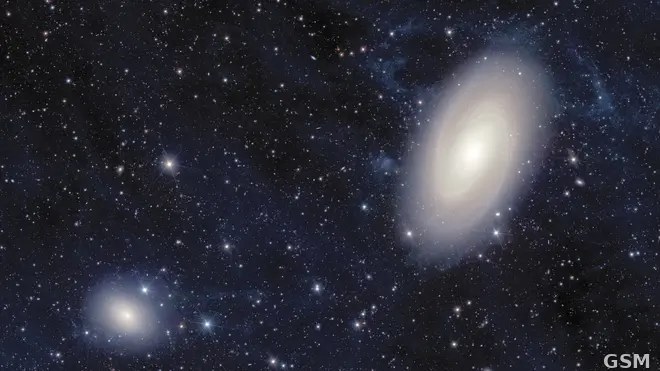
图片来源:图片来源:ESA/Euclid/Euclid Consortium/NASA「Messier 81星系群核心」(CC BY-SA 3.0 IGO),欧洲空间局2026-11-12随DR1-Foundation发布 Image: ESA/Euclid/Euclid Consortium/NASA, "Core of the Messier 81 galaxy group" (CC BY-SA 3.0 IGO), released by ESA on November 12, 2026, with DR1-Foundation
GSM Global · 本篇英文版 English edition of this story