最古老紧密类星体对现身宇宙黎明:大爆炸后仅9亿年,两个巨型黑洞相隔1.81万光年
美国国家科学基金会 NOIRLab 11月10日发布,国际双子天文台北座望远镜与詹姆斯·韦布空间望远镜的观测确认了一对极其古老的类星体,编号 J1602+4228AB,昵称 Nāpōwawāʻenakaulua。它们发出的光来自宇宙大爆炸后仅约9亿年时,那时宇宙的年龄只有现在的十三分之一。这是迄今发现的第三对宇宙黎明时期的类星体,也是早期宇宙中相距最近的一对:两个正在吞噬物质的超大质量黑洞相隔仅约18100光年,大约是银河系直径的五分之一。
领衔这项研究的 NOIRLab 博士后研究员 Silvia Onorato 介绍,这对类星体的两个黑洞,质量分别约为太阳的15亿倍与4亿倍。它们是在名为 Aether 的韦布望远镜巡天计划中被认出的,该计划由 Emanuele Paolo Farina 领衔,已观测那一时期已知类星体中43%、共200个目标,J1602+4228A 的光谱里露出了伴星的迹象。随后,双子北座望远镜的近红外光谱仪趁着毛纳基亚山两个夜晚异常清晰的天气,把这对天体分辨成了两个独立的类星体。
研究团队还用双子北座的多目标光谱仪检验了另一种可能,即这会不会只是一个类星体被引力透镜复制出的两个像。结果显示两个天体的光谱特征不同,团队更倾向于这是一对真实的类星体,不过要完全排除透镜效应,还需要透镜模型分析。Onorato 说,目前没有确定的理论能解释,宇宙如此早的时期怎么会出现哪怕一个这样的巨型类星体,更不用说两个。这个天体的夏威夷语名字由夏威夷大学希洛分校下属夏威夷语学院的 Larry Kimura 拟定。
研究论文已发表于《天体物理学杂志快报》。国际双子天文台由美国国家科学基金会牵头、多国合作参与、由 NOIRLab 负责运营,北座望远镜位于夏威夷毛纳基亚山。
Oldest Compact Quasar Pair Found at Cosmic Dawn: Two Giant Black Holes 18,100 Light-Years Apart, 900 Million Years After the Big Bang
NSF NOIRLab announced on November 10 that observations with the International Gemini Observatory's Gemini North telescope and the James Webb Space Telescope have confirmed an extraordinarily ancient pair of quasars, designated J1602+4228AB and nicknamed Nāpōwawāʻenakaulua. Their light dates from just 900 million years after the Big Bang, when the universe was one-thirteenth of its current age. The pair is the third known from the cosmic dawn era and the most compact yet found in the early universe: two feeding supermassive black holes separated by only about 18,100 light-years, roughly one-fifth the diameter of the Milky Way.
The study was led by Silvia Onorato, a postdoctoral researcher at NSF NOIRLab. The two black holes weigh about 1.5 billion and 400 million times the mass of the Sun. The pair surfaced in Aether, a Webb survey program led by Emanuele Paolo Farina that has observed 200 quasars, 43 percent of all quasars known from that era; the spectrum of J1602+4228A hinted at a companion. Gemini North's near-infrared spectrograph then resolved the two objects into separate quasars over two nights of exceptionally clear observing conditions on Maunakea in Hawai'i.
Using Gemini North's multi-object spectrograph, the team also tested whether the pair could instead be a single quasar duplicated by gravitational lensing. Distinct spectral features in the two objects led the team to favor a genuine pair, although lens modeling is still needed to rule the alternative out completely. "There is no definitive theoretical explanation for how a single one of these giant quasars exists so early in the Universe's history, much less two of them," Onorato said. The object's Hawaiian name was created by Larry Kimura of Ka Haka ʻUla O Keʻelikōlani, the Hawaiian language college at the University of Hawai'i at Hilo.
The findings are published in The Astrophysical Journal Letters. The International Gemini Observatory is led by the U.S. National Science Foundation with international partners and operated by NSF NOIRLab; Gemini North sits atop Maunakea in Hawai'i.
来源:美国国家科学基金会 NOIRLab
发布:GSM·美国(发布链接)
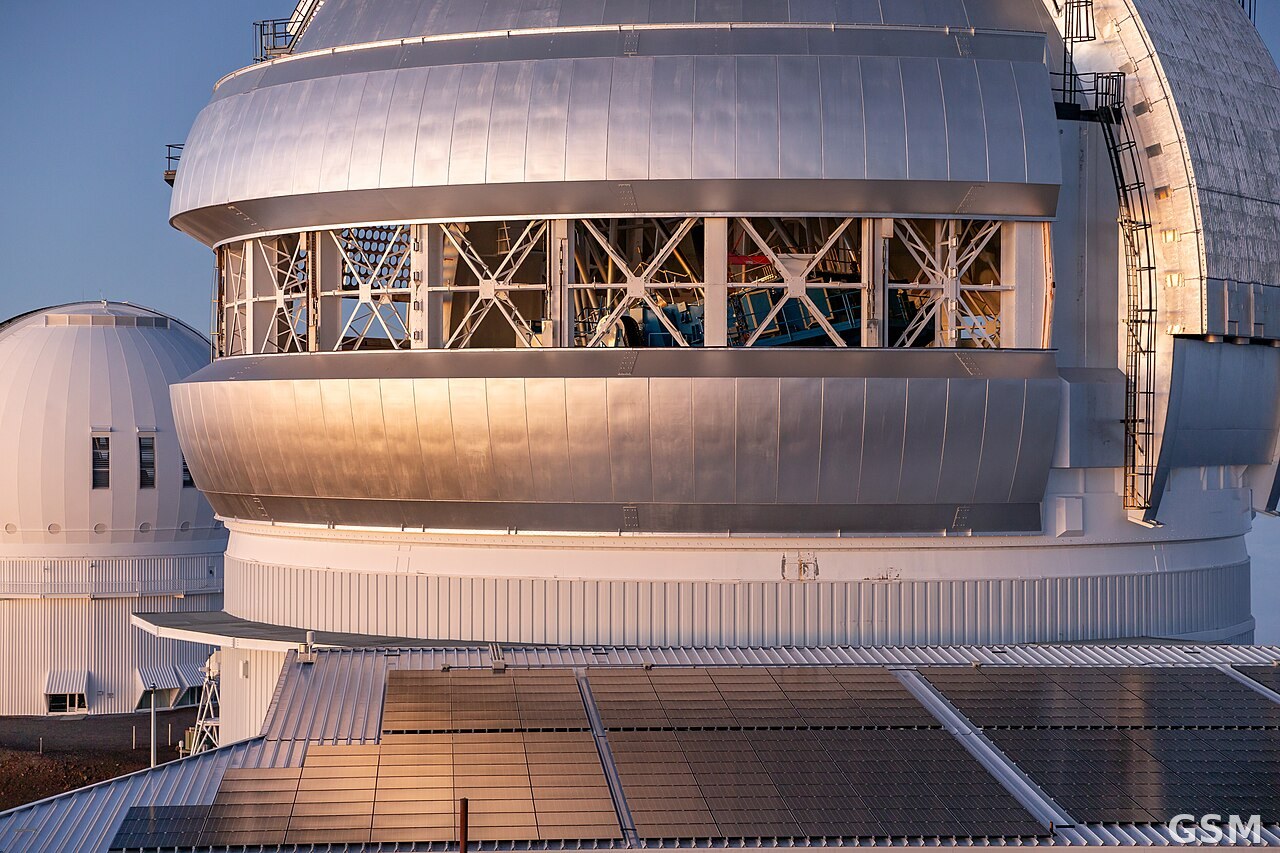
图片来源:夏威夷毛纳基亚山的国际双子天文台北座望远镜,NSF NOIRLab 摄,CC BY 4.0,经 Wikimedia Commons
GSM Global · 本篇英文版 English edition of this story