IBM发布量子处理器Nighthawk r3:520个量子比特执行1万次运算 2027年组1040量子比特系统
纽约州 Yorktown Heights — IBM 11月11日宣布,下一代量子处理器 IBM Quantum Nighthawk r3 将在520个量子比特上准确执行1万次量子运算,处理更大、更复杂的计算问题,同时保持现款 Nighthawk 已展现的速度与质量。IBM 计划2027年把两台 Nighthawk r3 处理器连接成一个系统,量子比特总数超过1000个。
IBM 研究院院长、IBM 院士 Jay Gambetta 表示,有用的量子计算取决于能否既准确又快速地给出结果,这两点都是根本,Nighthawk 已经展现了今天能做到的样子,随着这一架构扩展到更大、更强的量子计算机,并与经典计算资源更紧密地结合,量子计算的能力将达到新的水平,并继续向容错量子计算推进。
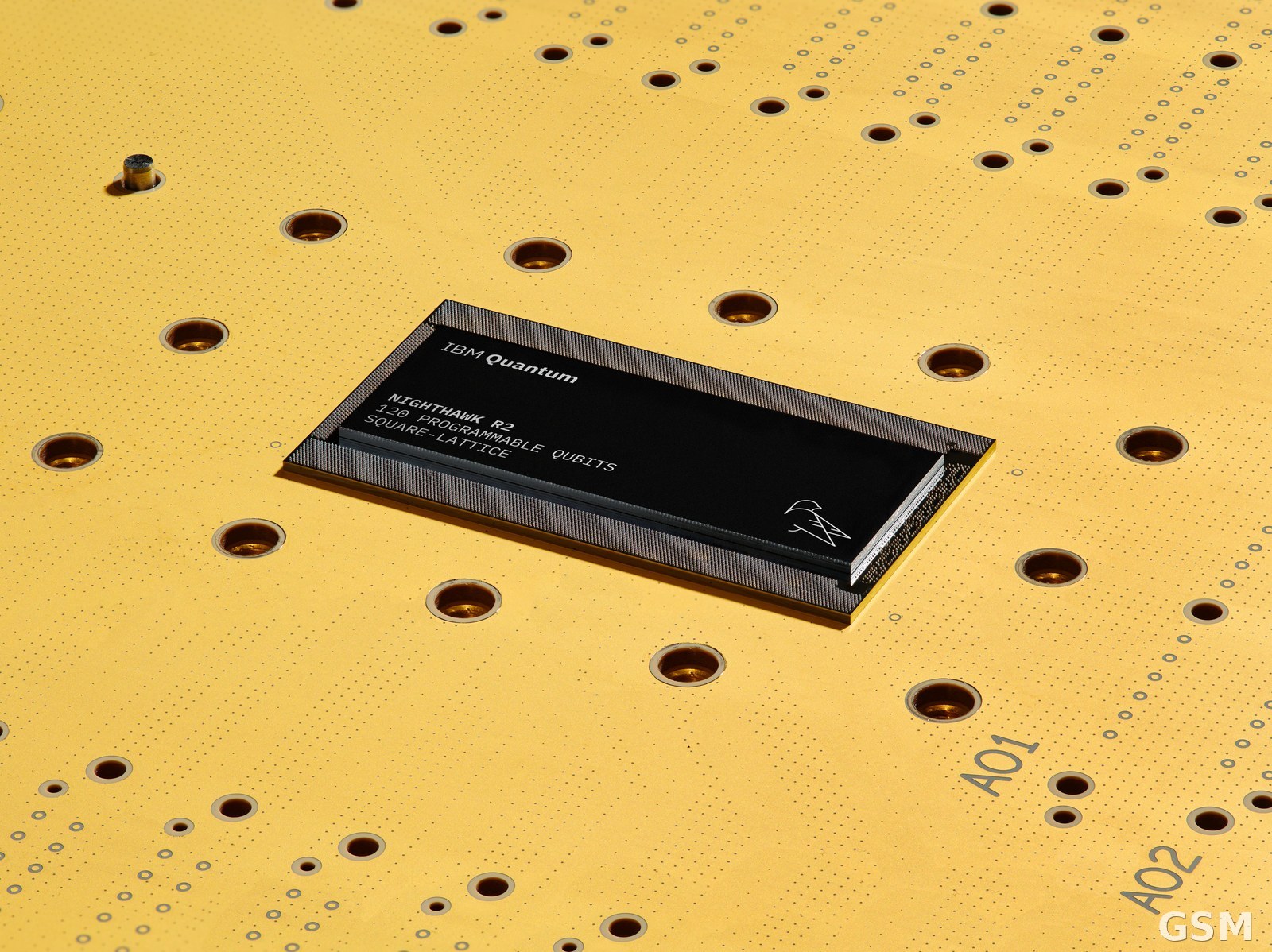
现款 Nighthawk r2 于今年9月推出,每秒可给出多达10万个采样结果,支持在120个量子比特上准确执行7500多次量子运算。其高速量子比特重置技术大幅缩短了电路两次执行之间的间隔。E.ON、Algorithmiq 与 Q-CTRL 等客户与伙伴迄今已在 Nighthawk r2 上运行了超过340亿个电路,报告的性能提升最高达19倍。E.ON 报告其用于电网优化的量子机器学习在 r2 上提速15倍,IBM 与橡树岭国家实验室的磁性材料模拟实验在 r2 上提速12倍,结果与中子散射实验一致。Algorithmiq 的异质量子材料模拟实验改在 r2 上运行后,速度比最初在 IBM Quantum Heron 上的实验快8倍,而新电路对经典计算机的模拟难度显著提高,用领先的经典张量网络方法达到同等精度,估计需要240倍的内存。
Nighthawk r3 把同样的高速架构扩展到更大的量子计算机:设计支持在520个可编程量子比特上执行1万次量子运算,物理量子比特总数为2034个,保留 r2 的方形晶格连接与快速运算,并新增10个名为 l-couplers 的芯片间互连部件,用来把处理器连接成更大的系统。IBM 今年已用4个 l-couplers 连接 Nighthawk r1 处理器,量子态传输保真度达到99.3%,正向99.9%的目标推进;IBM 还首次把两个低温模块连接成一个系统,在不到5天内达到工作温度,冷却到15毫开尔文以下。IBM 计划2027年把两台 Nighthawk r3 连接成一个1040量子比特的系统。
IBM 同步升级了 IBM Quantum Platform,把高性能经典计算与量子计算整合到同一个托管环境中,用户可以把量子工作流直接与笔记本电脑、超级计算机或平台新提供的经典计算资源结合使用。IBM 与日本理化学研究所(RIKEN)的科学家在新环境中重跑样本量子对角化工作流,速度约为原来的5倍,计算量达到原来的100倍;Cleveland Clinic 与 RIKEN 借助该平台自动处理了6.08亿个采样,为生物相关结构建模,速度比没有工作流自动化时快33倍。IBM 近期还与橡树岭国家实验室和 AMD 推出量子纠错协同设计平台,把 Nighthawk 与橡树岭的 Umbra 高性能计算系统实地并置,该系统搭载 AMD Instinct MI355X 图形处理器与第五代 AMD EPYC 中央处理器。
(来源:IBM)
IBM Unveils Quantum Nighthawk r3: 10,000 Operations on 520 Qubits, Scaling to a 1,040-Qubit System in 2027
YORKTOWN HEIGHTS, New York — IBM announced on November 11 that its next-generation processor, IBM Quantum Nighthawk r3, will be built to accurately execute 10,000 quantum operations across 520 qubits to tackle larger, more complex problems, while maintaining the speed and quality demonstrated by the current-generation Nighthawk available today. In 2027, IBM plans to link two Nighthawk r3 processors into a single system with more than 1,000 qubits.
Jay Gambetta, Director of IBM Research and an IBM Fellow, said useful quantum computing hinges on whether results can be delivered with accuracy and speed, that both are fundamental, and that Nighthawk is already showing what that looks like today. As IBM scales the architecture to larger and more powerful quantum computers and integrates more closely with classical resources, he said, the capabilities of quantum computation will reach new levels on the path to fault tolerance.
The current Nighthawk r2, introduced in September, delivers up to 100,000 samples per second while supporting accurate computations with more than 7,500 quantum operations on 120 qubits, and its high-speed qubit reset technology dramatically reduces the time between circuit executions. Clients and partners including E.ON, Algorithmiq and Q-CTRL have executed 34 billion circuits on Nighthawk r2 to date, reporting performance improvements of up to 19 times over previous IBM quantum processors. E.ON reported a 15-fold speedup in quantum machine learning for energy grid optimization, and IBM achieved a 12-fold speedup on Nighthawk r2 in an experiment with Oak Ridge National Laboratory that simulated real magnetic materials and produced results consistent with neutron scattering experiments. An Algorithmiq experiment simulating a heterogeneous quantum material now runs eight times faster on Nighthawk r2 than the original experiment on IBM Quantum Heron, while the new circuits are far harder for classical computers to simulate, requiring an estimated 240 times more memory with leading classical tensor-network methods.
Nighthawk r3 extends the same high-speed architecture to larger systems. It is designed to support 10,000 quantum operations on 520 programmable qubits, with 2,034 total physical qubits, retains the square-lattice connectivity and fast operations of r2, and introduces 10 chip-to-chip interconnects, called l-couplers, to connect processors into larger systems. IBM has connected Nighthawk r1 processors using four l-couplers, achieving 99.3 percent quantum state transfer fidelity and progressing toward its 99.9 percent target, and has connected two cryogenic modules into a single system for the first time, reaching operating temperature in under five days and cooling below 15 millikelvin. In 2027, IBM plans to connect two Nighthawk r3 processors into a single 1,040-qubit system.
IBM is also bringing high-performance classical and quantum computing together in a single managed environment on the IBM Quantum Platform. Using the new environment, IBM and RIKEN scientists executed their sample-based quantum diagonalization workflow roughly five times faster while performing 100 times more computations than in the original study, and Cleveland Clinic and RIKEN automatically processed 608 million samples for modeling biologically relevant structures, 33 times faster than without workflow automation. IBM recently launched a quantum error correction co-design platform with Oak Ridge National Laboratory and AMD that physically co-locates Nighthawk with the laboratory's Umbra high-performance computing system, powered by AMD Instinct MI355X GPUs and 5th Gen AMD EPYC CPUs.
(Source: IBM)
来源:IBM
发布:GSM·美国(发布链接)
图片来源:图:IBM Quantum Nighthawk R2 量子处理器(IBM 官方新闻室供图)。 / Photo: The IBM Quantum Nighthawk R2 quantum processor. Photo courtesy of IBM Newsroom.
GSM Global · 本篇英文版 English edition of this story