单季营收170亿美元、算力承诺9000亿:Anthropic 上市路演里的增长与豪赌
一家公司在走进公开市场之前,会先给机构投资者看一本册子。这本册子是它最想让市场相信的那个版本自己。Anthropic 的路演材料,就是这样一本自画像:使命写在第一页,数字写在后面,而真正的故事,藏在两组数字的缝隙里。
先看增长。Anthropic 的营收曲线陡得罕见:2023 财年全年营收 4,100 万美元,2024 财年 3.86 亿美元,2025 财年 45.85 亿美元。进入 2026 年,季度营收从第一季度的 47.31 亿美元跳到第二季度的 115.55 亿美元,第三季度达到 169.56 亿美元,单季约合 170 亿美元。公司称,截至 2026 年 10 月,其年化运行率营收约为 810 亿美元,第三季度营收同比增速超过 12 倍。从 4,100 万到 810 亿运行率,不到四年。
再看利润,这里有两本账。按公司调整口径(剔除股权激励、非现金慈善捐赠与 Bartz 和解金),经营利润率在 2026 年第二季度转正为 19%,第三季度为 15%,调整后经营利润单季超过 22 亿美元。也就是说,它的核心经营业务在上市前夜跨过了盈亏线。但按美国通用会计准则,同一季度它录得经营亏损 5.67 亿美元,净亏损高达 232.91 亿美元。差额的大头不是经营烧钱,而是可转债与 SAFE 等工具的公允价值变动:估值涨得越快,这笔非现金账面损失越大,2026 年第二季度单季就记了 595.97 亿美元。这类账面亏损在上市、工具转股之后将基本消失。读者看这家公司,必须把经营的账和估值的账分开看。
真正的豪赌在算力。材料显示,截至 2026 年 9 月 30 日及之后,Anthropic 的算力承诺总额约为 9,000 亿美元,其中约 4,516 亿美元将在 2030 年底前发生,约 707 亿美元在截至 2027 年 9 月的一年内到期,其余分布在 2031 至 2045 年。对照它的家底:现金及等价物约 960 亿美元、短期投资约 360 亿美元、累计融资约 1,410 亿美元,另有 150 亿美元授信额度可用。算力承诺约为其当前年化营收的 11 倍。这既是护城河,也是资产负债表上最大的风险敞口:增长一旦不及预期,承诺不会跟着缩小。
公司给出的对冲叙事是效率。材料称,其算力效率(营收除以算力与基础设施成本)从 2025 年第一季度到 2026 年第三季度提升超过 4 倍,靠的是算力乘数研究与多芯片架构:同一套系统同时跑在亚马逊 Trainium、谷歌 TPU、英伟达与 AMD 的 GPU 上,并通过三大云厂商分销。但材料自己也留了一句实话:2026 年第三季度包含 50 亿美元短期采购的算力,价格显著高于多年期合约。抢时间,就要付溢价。
客户一侧是典型的先落地、再扩张。过去十二个月营收达到 10 万美元以上的客户超过 1.19 万家,较 2025 年第四季度增长约 8 倍;百万美元级客户超过 1,900 家,千万美元级约 250 家。全球 2000 强中超过三成、《财富》500 强中超过五成已经是它的付费客户,而材料称《财富》500 强客户平均花在 Claude 上的钱不到其总开支的 0.1%,前十大客户也不到 1%。公司据此讲增长空间,并称企业客户净收入留存率约为 900%。这两个数字都是公司口径,但方向一致:它卖的不是一次性工具,而是会随使用量滚大的工作流入口。材料还披露,2026 年 9 月,Claude 写了该公司代码库九成以上的贡献,人均年化营收超过 660 万美元,七位联合创始人全部在职。这是它对人才密度与自我加速最直白的注脚。
治理结构是公开投资者必须自己定价的一课。Anthropic 是公益公司(PBC),其使命本身就是法定公益目的;长期利益信托(LTBT)由四名无财务利益的受托人组成,有权选举董事会多数席位。这意味着公众买到的 A 类股,买的是经济利益,不是控制权。使命锁定能挡住短视,也能挡住股东。市场愿意为这种结构付多少溢价或折价,要等定价那天才见分晓。
材料里还藏着两笔学费。一笔是 Bartz 诉 Anthropic 案的 15 亿美元和解金,记在 2025 年第三季度,版权是生成式人工智能绕不开的成本线。另一笔是不断抬升的股权激励,2026 年第三季度单季 10.7 亿美元,它不在调整利润里,但真实摊薄股东。
总结这本自画像:Anthropic 讲的故事是,智能第一次可以被规模化生产,而它站在生产端最前面,知识工作的全球薪酬盘子超过 40 万亿美元,它只要切下薄薄一片,就是一家巨型公司。这个故事的前半段已经被营收验证,后半段要靠 9,000 亿美元算力承诺去兑现。路演材料按惯例附了整页前瞻性陈述免责:计划可能达不成,数字可能对不上。投资者最终要判断的,不是 Claude 今天够不够聪明,而是这条指数曲线在承诺到期之前,能不能一直陡下去。
关联:Anthropic下调IPO估值目标至1.5万亿至1.6万亿美元,三季度营收约170亿美元
Anthropic上市估值遇阻:机构投资者称1.5万亿美元过高 路演下周启动
$17 Billion in a Single Quarter, $900 Billion in Compute Commitments: Growth and the Big Bet Inside Anthropic's IPO Roadshow
Before a company enters the public markets, it hands institutional investors a book. The book is the version of itself it most wants the market to believe. Anthropic's roadshow presentation is such a self-portrait: the mission on the first page, the numbers behind it, and the real story in the gap between two sets of figures.
Start with growth. Anthropic's revenue curve is unusually steep: $41 million for fiscal 2023, $386 million for fiscal 2024, and $4.585 billion for fiscal 2025. In 2026, quarterly revenue jumped from $4.731 billion in the first quarter to $11.555 billion in the second and $16.956 billion in the third, roughly $17 billion in a single quarter. The company says its run-rate revenue stood at about $81 billion as of October 2026, with third-quarter revenue up more than 12 times year over year. From $41 million to an $81 billion run rate in under four years.
Then look at profit, where there are two sets of books. On the company's adjusted basis, which excludes stock-based compensation, non-cash charitable contributions and the Bartz settlement, its operating margin turned positive in 2026, at 19 percent in the second quarter and 15 percent in the third, with adjusted operating income above $2.2 billion in each. Its core operations crossed the break-even line on the eve of the offering. Under U.S. GAAP, however, the same third quarter shows an operating loss of $567 million and a net loss of $23.291 billion. The bulk of that gap is not operating burn. It is the change in fair value of convertible notes and SAFEs: the faster the valuation rises, the larger this non-cash paper loss grows, reaching $59.597 billion in the second quarter of 2026 alone. These paper losses largely disappear once the instruments convert at the IPO. Anyone reading this company has to keep the operating ledger and the valuation ledger apart.
The real bet is compute. The presentation shows total compute commitments of about $900 billion as of and subsequent to September 30, 2026, of which roughly $451.6 billion is expected before the end of 2030, about $70.7 billion falls due in the twelve months after September 30, 2026, and the rest runs from 2031 to 2045. Against that stand about $96 billion of cash, $36 billion of short-term investments, roughly $141 billion of capital raised, and $15 billion of availability under its credit facility. The commitments are about eleven times current run-rate revenue. They are both the moat and the largest risk on the balance sheet: if growth disappoints, the commitments do not shrink with it.
The company's hedge, in its telling, is efficiency. It says compute efficiency, defined as revenue divided by compute and infrastructure costs, improved more than fourfold from the first quarter of 2025 to the third quarter of 2026, driven by compute-multiplier research and a multi-chip architecture spanning AWS Trainium, Google TPUs and NVIDIA and AMD GPUs, with distribution through all three major clouds. The deck is also candid about the price of speed: the third quarter of 2026 included $5.0 billion of compute under short-term commitments, at costs significantly above its multi-year deals.
On the customer side, the pattern is land and expand. More than 11,900 customers generated at least $100,000 of revenue over the trailing twelve months, about eight times the level of late 2025; more than 1,900 customers are at $1 million or more, and about 250 at $10 million or more. Over 30 percent of the Global 2000 and over 50 percent of the Fortune 500 already pay for Claude, yet the company says the average Fortune 500 customer spends less than 0.1 percent of its total expenses on Claude, and even its top ten spend under 1 percent. It cites enterprise net revenue retention of about 900 percent. These are company figures, but they point the same way: what is being sold is not a one-off tool but a workflow entry point that grows with usage. The deck adds that in September 2026 Claude wrote more than 90 percent of the contributions to Anthropic's own codebase, that trailing revenue per employee exceeded $6.6 million, and that all seven co-founders remain at the company, its footnote on talent density and self-acceleration.
Governance is the lesson public investors must price for themselves. Anthropic is a public benefit corporation whose mission is its statutory public benefit purpose, and the Long-Term Benefit Trust, made up of four financially disinterested trustees, generally has the authority to elect a majority of the board. The Class A shares on offer carry economics, not control. A mission lock can fend off short-termism; it can also fend off shareholders. How much premium or discount the market assigns to that structure will only be known on pricing day.
Two tuition bills are buried in the statements. One is the $1.5 billion Bartz settlement recorded in the third quarter of 2025, a reminder that copyright is a standing cost line for generative AI. The other is rising stock compensation, $1.07 billion in the third quarter of 2026 alone, excluded from adjusted profit but a real dilution to shareholders.
The self-portrait, in sum, argues that intelligence can now be produced at scale, that Anthropic stands at the front of that production, and that with global knowledge work representing more than $40 trillion of economic value, even a thin slice makes a giant company. The first half of that story has been validated by revenue. The second half must be earned against $900 billion of compute commitments. As the deck's own full page of forward-looking disclaimers concedes, plans may not be achieved and numbers may not hold. What investors are really judging is not whether Claude is smart enough today, but whether the exponential curve stays steep until the commitments come due.
Related: Anthropic Cuts IPO Valuation Target to $1.5-1.6 Trillion as Q3 Revenue Reaches About $17 Billion
Anthropic IPO Valuation Faces Pushback: Investors Call $1.5 Trillion Too High as Roadshow Nears
发布:GSM·美国(发布链接)
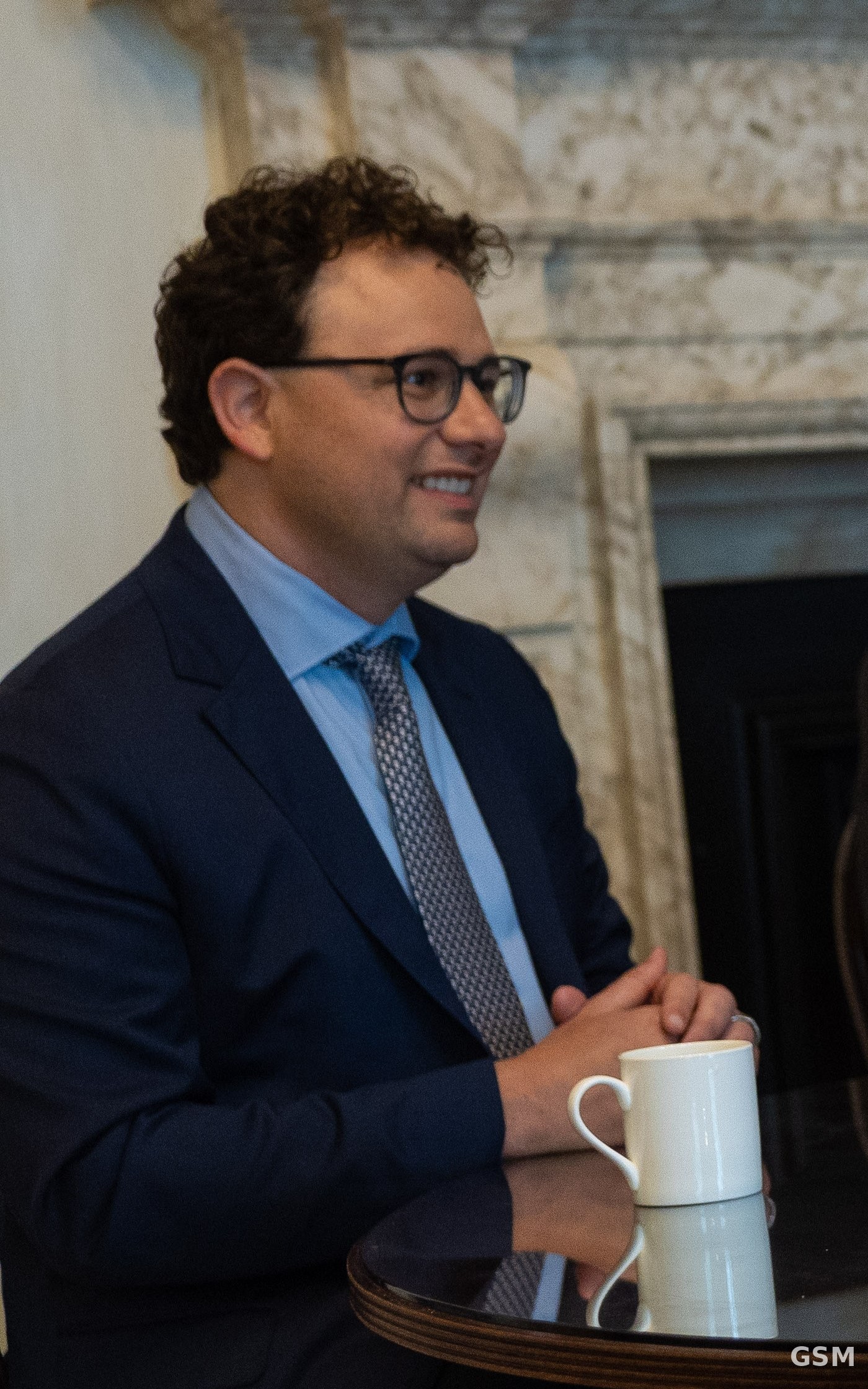
图片来源:图:Anthropic 联合创始人兼首席执行官 Dario Amodei 2023 年在英国出席超级智能(SI)开发者会面时的肖像。英国首相府 摄,CC BY 2.0,经 Wikimedia Commons / Photo: Anthropic co-founder and CEO Dario Amodei at a meeting with SI developers in the United Kingdom in 2023. By UK Prime Minister, CC BY 2.0, via Wikimedia Commons
GSM Global · 本篇英文版 English edition of this story