威特沃特斯兰德大学在多模光纤中证实横向法拉第效应:0.24 特斯拉横向磁场下散斑图样相似度降至约 84%,成果发表于 Optics Letters
南非约翰内斯堡威特沃特斯兰德大学 11 月 11 日报道,工程师证实普通玻璃光纤中存在一个被沿用 50 多年的简化描述所掩盖的磁光效应:把磁体放在多模光纤侧旁、而非沿光纤方向,也能改变在其中传播的光。研究发表于 Optics Letters 期刊。
报道称,光纤除传输互联网光信号外,也可作传感器,数十年来被用于测量磁场,包括电力线路与变电站电流产生的磁场。这类传感器依赖法拉第效应,即磁场沿光纤方向时,会轻微扭转光的偏振;横向磁场则一直被认为不会产生法拉第效应。
硕士生 Mohammed Raiyan Sharif 与教授 Mitchell Cox 在该校电气与信息工程学院的光通信实验室演示了这一横向法拉第效应。他们用相机观察多模光纤末端由多路光叠加形成的散斑图样,在固定光纤旁重新布置强磁体时,图样发生了变化。
解释这一现象需要回到基本原理。报道称,光在光纤中的电场几乎全部横向振荡,但有一小部分沿传播方向振荡,自 1970 年代沿用的弱导引近似忽略了这一纵向分量;在纤芯与包层折射率阶跃较大的阶跃型光纤中,该分量在纤芯边缘变得显著,横向磁场正是作用于它。
研究者还把新效应与背景效应区分开来:横向磁场也会产生 Cotton-Mouton 效应,其强度随场强平方增长,而横向法拉第效应随场强线性增长,研究者据此分离信号并证实了理论的四项预测,包括该效应在没有强折射率阶跃时消失、随入射角增大而增强等。
在 0.24 特斯拉磁场下,偏振方向与磁场垂直的光所形成的图样变化清晰,与原图样的相似度只剩约 84%。研究者表示,现有法拉第传感器须缠绕在载流导体上,横向传感器原则上可直接置于场源旁边,例如沿沟槽中的电缆铺设,但实际电缆附近的磁场远弱于实验所用磁场,实用传感器的灵敏度仍有待确立。
Cox 说,在如此熟悉的技术中找到被忽视且有用的相互作用令人意外,团队还在研究以电流线圈代替永磁体、电控调节光纤内光图样的可能性,指向光计算等应用方向。
University of the Witwatersrand Demonstrates Transverse Faraday Effect in Multimode Fiber: Speckle Similarity Falls to About 84 Percent at 0.24 Tesla, Published in Optics Letters
Engineers at the University of the Witwatersrand in Johannesburg, South Africa, have shown that a convenient shortcut used for more than 50 years hides a small but real effect in ordinary glass fiber, the university reported on November 11. A magnet placed beside a multimode fiber, rather than along it, can change the light traveling inside. The research was published in the journal Optics Letters.
Optical fibers also act as sensors and have been used for decades to measure magnetic fields, including those produced by electrical currents in power lines and substations. Such sensors rely on the Faraday effect, in which a magnetic field pointing along a fiber slightly twists the polarization of the light. A magnetic field pointing across the fiber was not expected to produce a Faraday effect.
MSc student Mohammed Raiyan Sharif and professor Mitchell Cox at the Wits Optical Communication Lab demonstrated this transverse Faraday effect in multimode fiber. They watched the speckle pattern at the far end of the fiber with a camera while rearranging strong magnets beside the stationary fiber, and the pattern changed.
Explaining the observation took the researchers back to first principles. The electric field of light in a fiber oscillates almost entirely across the fiber, but a tiny part oscillates along it. The standard weak-guidance approximation ignores this longitudinal component. In step-index fibers, where the refractive index changes in a single sharp step at the edge of the core, that component becomes significant near the edge of the core, and a sideways field acts on it.
The researchers separated the new effect from the Cotton-Mouton effect, which grows with the square of the field strength, whereas the transverse Faraday effect grows in direct proportion to the field. By measuring how much the speckle pattern changed, they isolated the proportional signal and confirmed four predictions of their theory.
Under a field of 0.24 tesla, light polarized across the field changed the pattern clearly, leaving it only about 84 percent similar to the original, according to the report. Existing Faraday sensors must be wrapped around the conductor carrying the current, while a transverse sensor could in principle sit beside the source of the field, although how sensitive a practical sensor could be remains to be established, the researchers said.
Cox said it is surprising to find an overlooked, useful interaction in such a familiar technology. The lab is also studying whether the effect could one day be controlled electrically with a current-carrying coil, with implications for optical computing, according to the report.
发布:GSM·美国(发布链接)
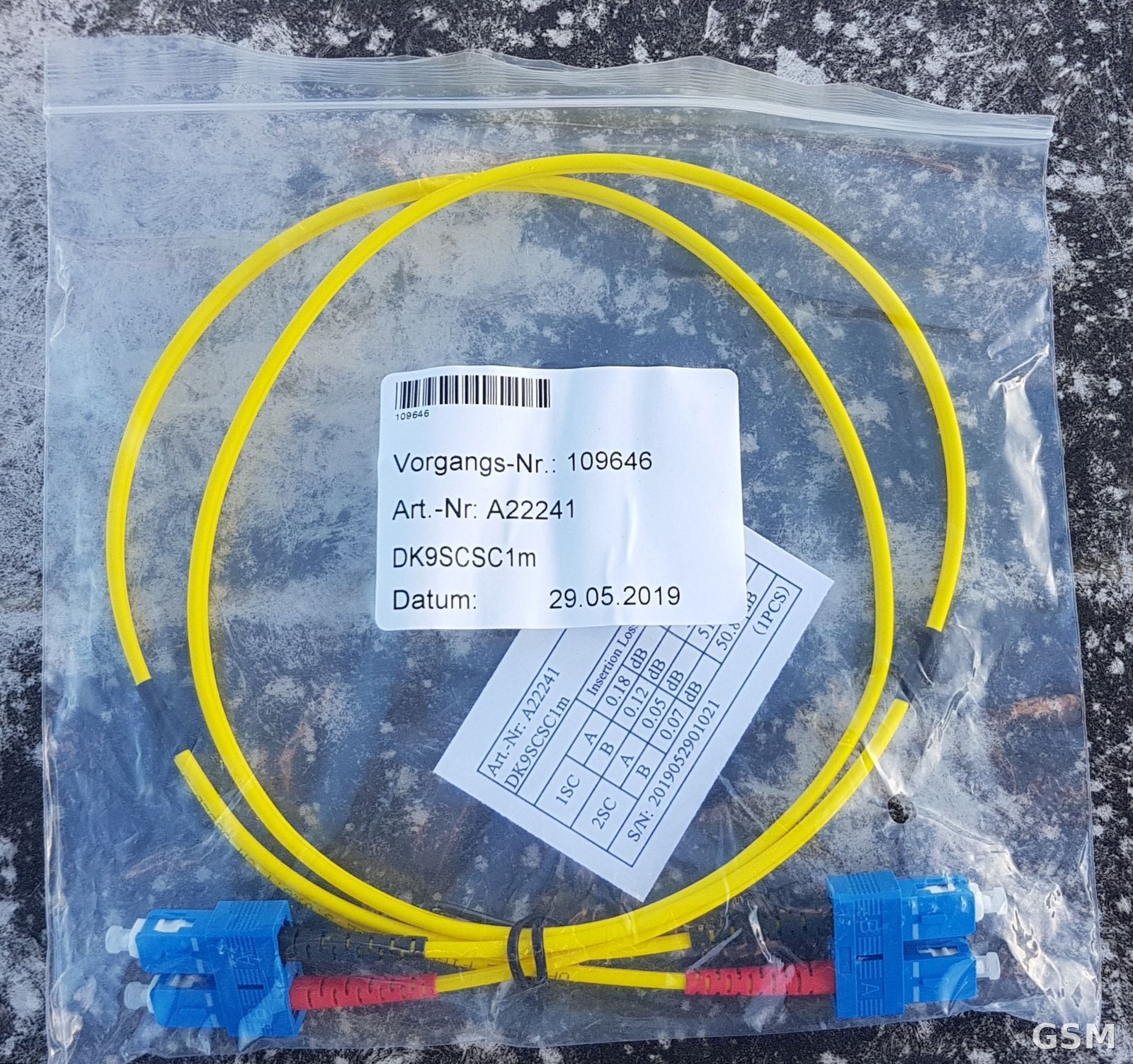
图片来源:图:数条黄色护套的光纤跳线及其连接器特写。Asurnipal 摄,CC BY-SA 4.0,经 Wikimedia Commons / Photo: Optical fiber connectors-optical patch cable-01ASD. By Asurnipal, CC BY-SA 4.0, via Wikimedia Commons
GSM Global · 本篇英文版 English edition of this story