Q.ANT与IONOS在德国启动光子计算商业试点:第二代光子处理器进驻IONOS数据中心,开发者可免费在真实硬件上跑AI模型
德国斯图加特与卡尔斯鲁厄消息—光子计算公司 Q.ANT 与云服务商 IONOS 11月9日宣布启动联合试点计划,首次把光子计算带入商业裸金属服务器环境。软件开发者可借此在真实光子处理器上测试与评估自己的 AI 模型,而不再只是在软件开发工具包中仿真。
按两家公司发布,经批准的申请者可通过 IONOS 网站,访问部署在德国境内 IONOS 数据中心裸金属服务器上的 Q.ANT 第二代原生处理单元(Native Processing Unit,NPU)。该处理器基于薄膜铌酸锂(TFLN)光子集成电路,直接在光中执行数学运算,擅长矩阵乘法与复杂非线性函数;发布称,这类运算在光中原生计算可用更少的参数与运算量得到相当或更好的结果。试点于2026年11月开始,向有限数量的入选参与者免费开放,申请者须经 IONOS 网站提交具体用例,并具备独立管理裸金属服务器的技术能力;工业图像处理、时间序列预测、科学仿真与机器人被列为特别适合的评估方向。参与者将获得 Q.ANT 与 IONOS 的技术导入、项目支持与负载评审,并以结项研讨会评估结果。
IONOS 首席执行官 Achim Weiss 在发布中表示,试点中 Q.ANT 的光子处理器运行在德国司法辖区内的 IONOS 数据中心,用户可在自己的负载上探索用光进行处理,结果将直接用于后续开发。Q.ANT 创始人兼首席执行官 Michael Förtsch 表示,公司9月推出开源 SDK 后开发者只能构建与仿真应用,如今可把应用真正跑在处理器上。发布还称,Q.ANT 的光子处理器此前已在高性能计算环境受测:莱布尼茨超级计算中心(LRZ)2026年3月收到其第二代处理器进行测试,于利希超级计算中心(JSC)亦有其系统运行。Q.ANT 成立于2018年,总部位于斯图加特,在慕尼黑与美国德克萨斯州奥斯汀市设有办公室;IONOS 称其服务约700万客户,业务覆盖欧洲与北美17个市场。
Q.ANT and IONOS Launch Photonic Computing Pilot in Germany: Second-Generation Photonic Processor Runs in an IONOS Data Centre as Developers Test AI Models on Re
STUTTGART and KARLSRUHE, Germany — Photonic computing company Q.ANT and cloud provider IONOS announced on November 9 the launch of a joint pilot programme bringing photonic computing to commercial bare-metal server environments for the first time. Software developers can test and evaluate their AI models on real photonic processors running on dedicated hardware, rather than only simulating applications in a software development kit.
Under the announcement, approved applicants will gain access through the IONOS website to Q.ANT's second-generation Native Processing Unit (NPU) via a bare metal server in a German IONOS data centre. The NPU performs mathematical operations directly on thin-film lithium niobate (TFLN) photonic integrated circuits and is suited to operations such as matrix multiplication and complex nonlinear functions, which the companies said can be computed natively in light with fewer parameters and operations for comparable or better results. The pilot begins in November 2026 and is free of charge to a limited number of selected participants; applicants must submit a concrete use case through the IONOS website and have the expertise to administer a bare metal server independently. Industrial image processing, time-series prediction, scientific simulation and robotics were listed as particularly suitable evaluation areas, and participants will receive technical onboarding, project support and workload review, ending with a workshop to evaluate results.
IONOS Chief Executive Achim Weiss said in the release that in the pilot, Q.ANT's photonic processor runs in an IONOS data centre under German jurisdiction, and that results will feed directly into future development work. Q.ANT founder and Chief Executive Dr. Michael Förtsch said that after the company's open-source SDK launch in September, developers could build and simulate applications, and can now run those applications on the real processor. The release also said Q.ANT's photonic processor has been evaluated in operational high-performance computing environments: the Leibniz Supercomputing Centre (LRZ) received its second-generation processors for testing in March 2026, and Q.ANT systems are also operating at the Jülich Supercomputing Centre (JSC). Q.ANT was founded in 2018, is headquartered in Stuttgart, and has further offices in Munich and a U.S. office in Austin, Texas. IONOS said it serves about 7 million customers across 17 markets in Europe and North America.
—-
来源:Q.ANT 与 IONOS(公司
发布:GSM·美国(发布链接)
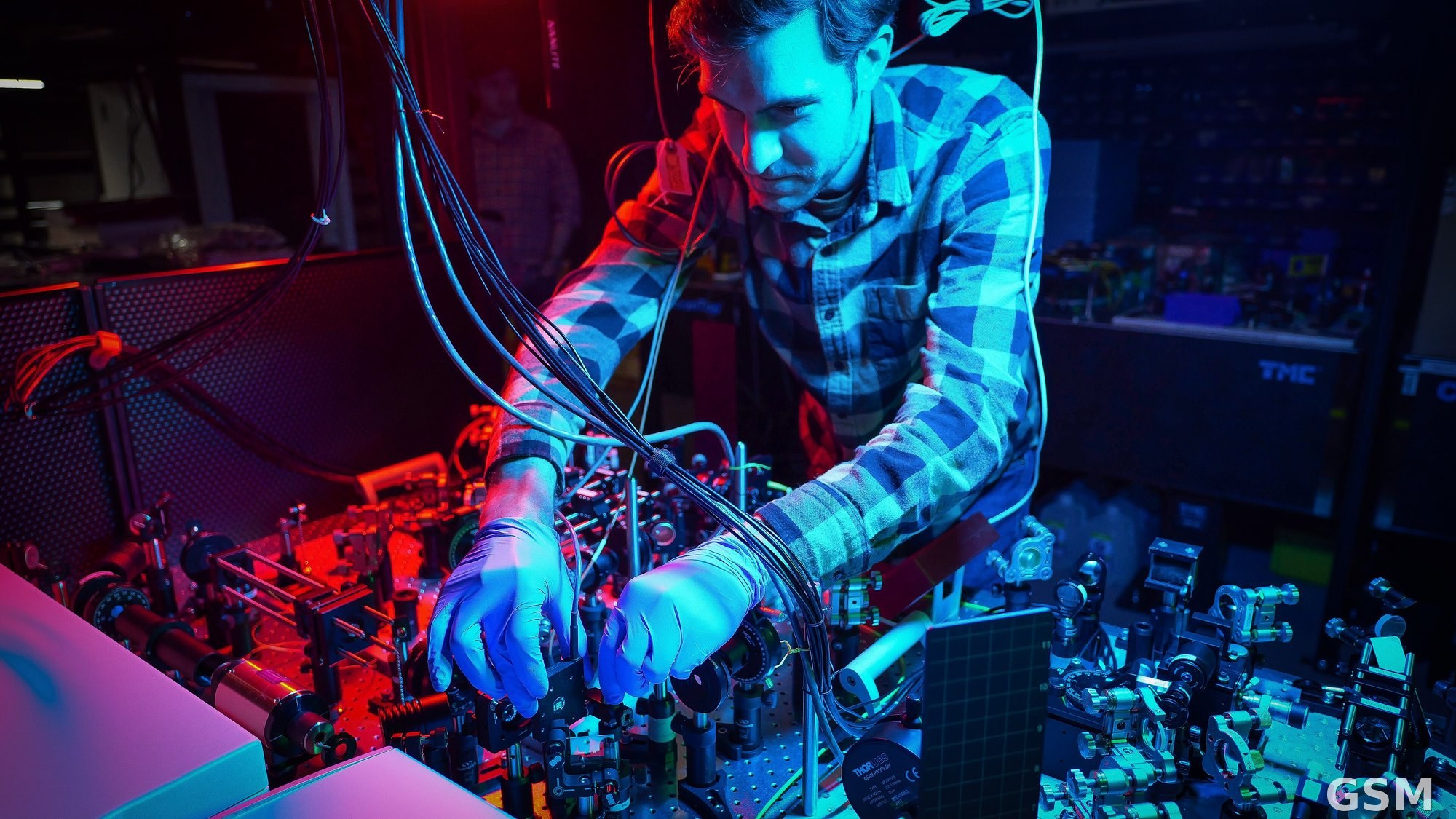
图片来源:量子计算实验室(资料图)。(Wikimedia Commons/公共领域)|A quantum computing laboratory (file photo). (Wikimedia Commons / public domain)
GSM Global · 本篇英文版 English edition of this story