秘鲁皮斯科组出土630万至560万年前新物种矮抹香鲸:体长约2.7米,头骨不对称程度为鲸类之最、吻部下弯31度贴海底觅食
一个国际研究团队描述了一种此前未知的已灭绝矮抹香鲸新物种,其头骨不对称程度达到前所未有的水平。相关论文发表于《通讯生物学》期刊,Phys.org 于11月9日作了报道。新物种学名为 Scaphokogia huachafo,化石头骨年代为距今约630万至560万年的晚中新世,所属个体体长约2.7米(约8.9英尺),其面部不对称为已知所有鲸类之最,可能也是所有哺乳动物之最。
齿鲸的头骨本就不对称,以容纳用于回声定位与发声的特化器官。论文第一作者 Aldo Benites-Palomino 表示,在这一新物种身上,不对称远远超出气孔周围区域:两个骨质鼻孔完全移到了头骨左侧,面部骨骼的大小与位置差异巨大,整个头骨看起来完全歪斜。种名 huachafo 取自秘鲁西班牙语口头词,意为浮夸、怪异、难以归类;Benites-Palomino 表示,当团队看到其面部强烈左偏、吻部粗大且向下弯曲的比例时,这一名字显得恰如其分。该化石于1990年代中期出土于秘鲁南部皮斯科组(Pisco Formation),该地层的沙漠露头以保存极佳的海洋化石闻名;Benites-Palomino 2015年在利马自然历史博物馆做本科论文时首次接触到它,其博士研究在苏黎世大学古生物学系完成,现为埃尔朗根-纽伦堡弗里德里希-亚历山大大学助理教授。他表示,头骨缝线已完全闭合、且无骨折、病变或其它变形,不对称是真实的生物特征、而非埋藏压扁的结果。
解剖结构显示,这与现生抹香鲸在深海捕食鱿鱼的生活方式不同:新物种的吻部形成由致密骨与骨化软骨强化的粗管状结构,起天然压载作用,使重心前移下沉,吻部相对头骨其余部分下弯31度;颈关节重建显示其头部可向下弯曲多达55度,整个头颈复合体都为把吻部指向海底而改造。共同作者、苏黎世大学的 Gabriel Aguirre-Fernández 表示,这一组合使它能贴着海底移动、在沉积物附近觅食。团队推测,它没有其它底栖海洋哺乳动物的触须或视觉特化,而是用其不对称的生物声呐扫描浅海软质沉积物找寻猎物;这一特化的海底觅食生态位随中新世末海洋条件变化而消失。
New Extinct Pygmy Sperm Whale From Peru's Pisco Formation, 6.3–5.6 Million Years Old: At About 2.7 Metres, Its Skull Shows the Most Extreme Asymmetry Known in A
An international research team has described a previously unknown extinct species of pygmy sperm whale in which skull asymmetry reached unprecedented levels. The study was published in Communications Biology and reported by Phys.org on November 9. The new species, Scaphokogia huachafo, is known from a fossil skull dating from between 6.3 and 5.6 million years ago in the Late Miocene; the animal was around 2.7 metres (8.9 feet) long, and its facial asymmetry is the most extreme known in any cetacean — and possibly in any mammal.
Toothed whales have asymmetrical skulls that accommodate specialized organs used for echolocation and sound production, but lead author Aldo Benites-Palomino said that in this species the asymmetry went far beyond the area around the blowhole: both bony nostrils are shifted entirely to the left side of the skull, the facial bones differ dramatically in size and position, and the skull looks completely crooked. The species name huachafo is a Peruvian Spanish term for something extravagant, bizarre or difficult to categorize; Benites-Palomino said that when the team looked at the proportions — the face strongly shifted to the left and an oversized, downward-curving snout — the name seemed perfect. The skull was found in the mid-1990s in the Pisco Formation of southern Peru, whose desert outcrops are known for exceptionally well-preserved marine fossils; Benites-Palomino first came across it in 2015 while working on his bachelor's thesis at the Museo de Historia Natural in Lima, studied it during doctoral research at the University of Zurich, and is now an assistant professor at Friedrich-Alexander-Universität Erlangen-Nürnberg. He said the sutures are fully closed and there are no fractures, pathologies or deformations elsewhere on the skull, so the asymmetry was genuine biology rather than a result of burial distortion.
The anatomy points to a specialized bottom-feeding lifestyle in shallow coastal environments, unlike living sperm whales, which hunt squid in deep waters. The snout formed a thick, tubular structure reinforced by dense bone and ossified cartilage that acted as natural ballast, shifting the centre of gravity forward and downward; the snout was angled downward by 31 degrees relative to the rest of the skull, and reconstructions of the neck joint show the head could bend downward by as much as 55 degrees. Co-author Gabriel Aguirre-Fernández of the University of Zurich said the entire cranio-cervical complex is modified to point the snout directly toward the bottom, letting the animal move directly above the seabed and feed close to the sediment. Because the species lacked the facial whiskers or visual specializations of other bottom-feeding marine mammals, the researchers suspect it used its asymmetrical biosonar system to scan soft coastal sediments for prey. That specialized seafloor-feeding niche disappeared as oceanic conditions changed at the end of the Miocene.
—-
来源:《通讯生物学》期刊论文(经 Phys.org 报道
发布:GSM·美国(发布链接)
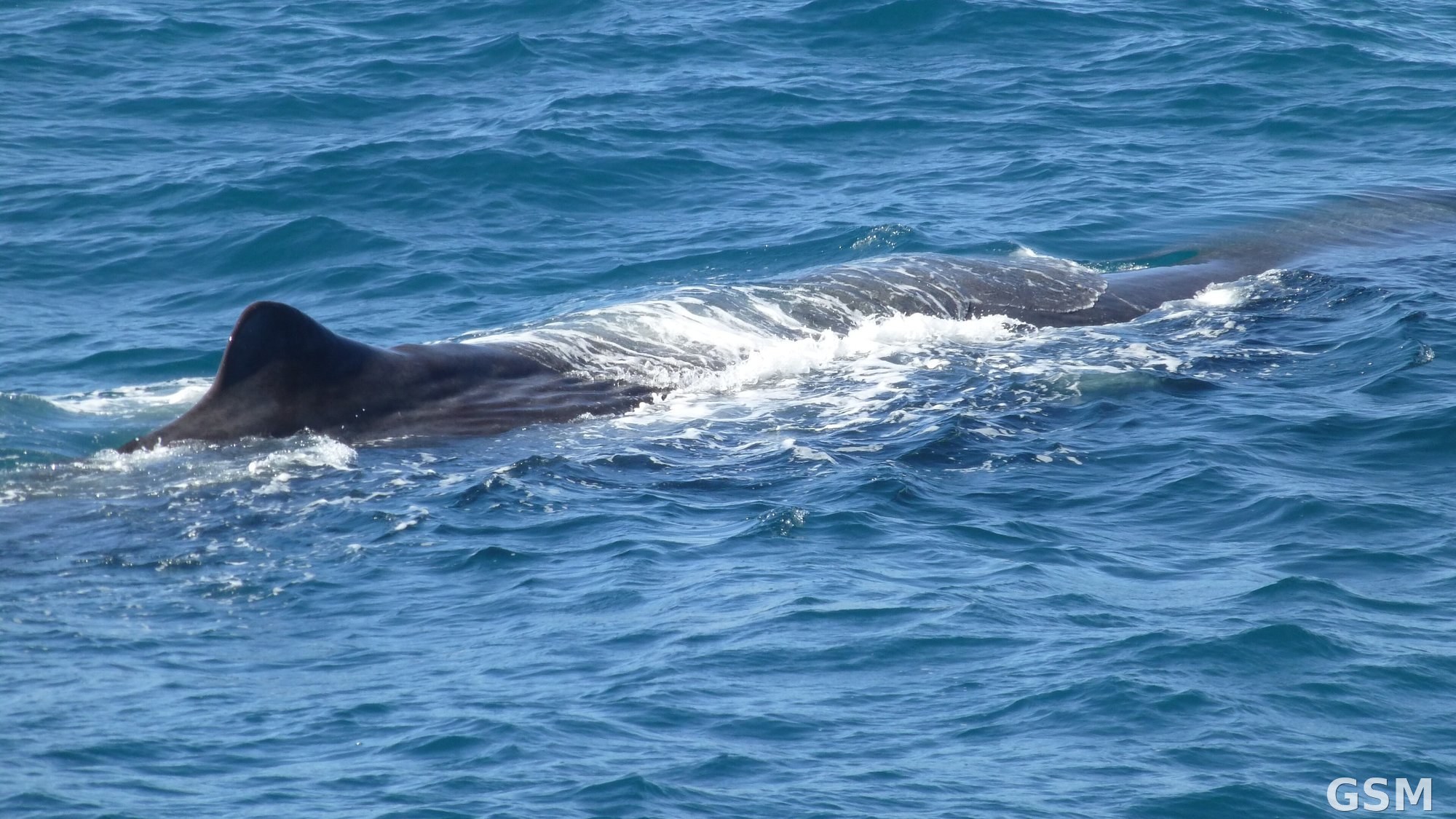
图片来源:抹香鲸(资料图;非本次报道的矮抹香鲸化石物种)。(Wikimedia Commons/CC0)|A sperm whale (file photo; not the fossil pygmy species in the story). (Wikimedia Commons / CC0)
GSM Global · 本篇英文版 English edition of this story