《科学》论文:挥发性共晶法令钙钛矿薄膜载流子寿命达约295微秒,太阳能电池效率26.5%、发光二极管外量子效率26.1%
韩国成均馆大学先进纳米技术研究所(SAINT)申成植(Seong Sik Shin)教授领衔、与韩国化学研究院、美国加利福尼亚大学圣迭戈分校及普林斯顿大学合作的团队,在《科学》期刊发表一种大幅减少钙钛矿半导体薄膜缺陷的晶体生长方法,并用同一材料平台同时做出了高性能太阳能电池与发光二极管(LED)。Phys.org 于11月8日报道了该研究。
钙钛矿因制造成本低、工艺相对简单被视为下一代电子器件的关键材料,既可做把光转成电的太阳能电池,也可做把电转成光的 LED;但前驱体溶液固化成薄膜时,微小晶粒拼接处与表面会形成大量缺陷,捕获或消灭光生载流子,拉低器件性能与寿命。团队的解法来自共晶现象:两种单独熔点较高的材料—氯化甲铵(MACl)与卤化锌(ZnX₂)—混合后熔化温度大幅降低。把薄膜温和加热到约100摄氏度时,位于晶界的混合物变成一层薄液膜,液态下原子扩散速度约为固态的1万倍,小晶粒得以快速合并长大为缺陷更少的大晶粒;助长晶体的 MACl 随后在退火中挥发,残余的锌偏聚到晶界处帮助抑制缺陷。
团队称,所得薄膜质量为钙钛矿薄膜迄今所报告的最高水平:载流子寿命达约295微秒,为历来最长之列;反映表面缺陷致载流子损失的表面复合速度降至每秒0.3厘米,为卤化铅钙钛矿所报告的最低值,与经钝化处理的硅的最佳值相当。用新薄膜制作的太阳能电池光电转换效率达26.5%(认证值25.9%),开路电压1.208伏,为同类 n-i-p 结构太阳能电池的认证纪录;与太阳能电池同一器件结构的 LED 外量子效率达26.1%,显示同一结构可兼作发电与发光器件。共同第一作者 Seongsik Nam 表示,该方法已证明溶液工艺可达到与硅相当的表面质量,且在大面积上同样表现良好;申成植表示,这是首个基于挥发性共晶混合物的晶体生长方法,工艺不需要昂贵的专用设备。
Science Study: Volatile Eutectic Method Gives Perovskite Films a Carrier Lifetime of About 295 Microseconds, With Solar Cells at 26.5% Efficiency and LEDs at 26
A team led by Professor Seong Sik Shin of the SKKU Advanced Institute of Nanotechnology (SAINT) at Sungkyunkwan University in South Korea, working with the Korea Research Institute of Chemical Technology, the University of California, San Diego, and Princeton University, has published in Science a crystal-growth method that dramatically reduces defects in perovskite semiconductor thin films, and demonstrated both high-performance solar cells and light-emitting diodes (LEDs) on the same material platform. Phys.org reported the study on November 8.
Perovskites are regarded as a key material for next-generation electronics because of their low manufacturing costs and relatively simple processing, serving both in solar cells that convert light into electricity and in LEDs that convert electricity into light. But when a liquid precursor solidifies into a thin film, microscopic crystal grains join together and create numerous defects at grain boundaries and surfaces, which trap or eliminate photogenerated charge carriers and reduce device performance and lifetime. The team's solution came from the eutectic phenomenon, in which a mixture melts at a substantially lower temperature than its components: methylammonium chloride (MACl) and a zinc halide (ZnX₂), each with a relatively high melting point on its own, begin to melt much lower when combined. When the film was gently heated to around 100 °C (212 °F), the mixture at the grain boundaries turned into a thin liquid layer in which atoms diffuse roughly 10,000 times faster than in a solid, letting small grains rapidly merge into larger, cleaner crystals. The MACl then evaporates during thermal annealing, while the remaining zinc segregates toward the grain boundaries and helps suppress defects.
The team said the resulting films showed the highest quality reported to date for perovskite thin films: a charge-carrier lifetime of approximately 295 microseconds, among the longest ever reported, and a surface recombination velocity of 0.3 cm/s, the lowest reported value for lead halide perovskites and comparable to the best values reported for passivated silicon. Solar cells made with the new films achieved a power conversion efficiency of 26.5% (certified 25.9%) with an open-circuit voltage of 1.208 V, a certified record for solar cells with the same n-i-p architecture. An LED with the same device architecture as the solar cell reached an external quantum efficiency of 26.1%, showing that a single device structure can function both as a power-generating device that absorbs light and as a light-emitting device. Co-first author Seongsik Nam said the work reduced surface recombination velocity to the lowest reported for perovskite films and showed strong performance over large areas, while Professor Shin said the study is the first to develop a crystal-growth method based on a volatile eutectic mixture and that the process requires no expensive specialized equipment.
—-
来源:《科学》期刊论文(研究团队
发布:GSM·美国(发布链接)
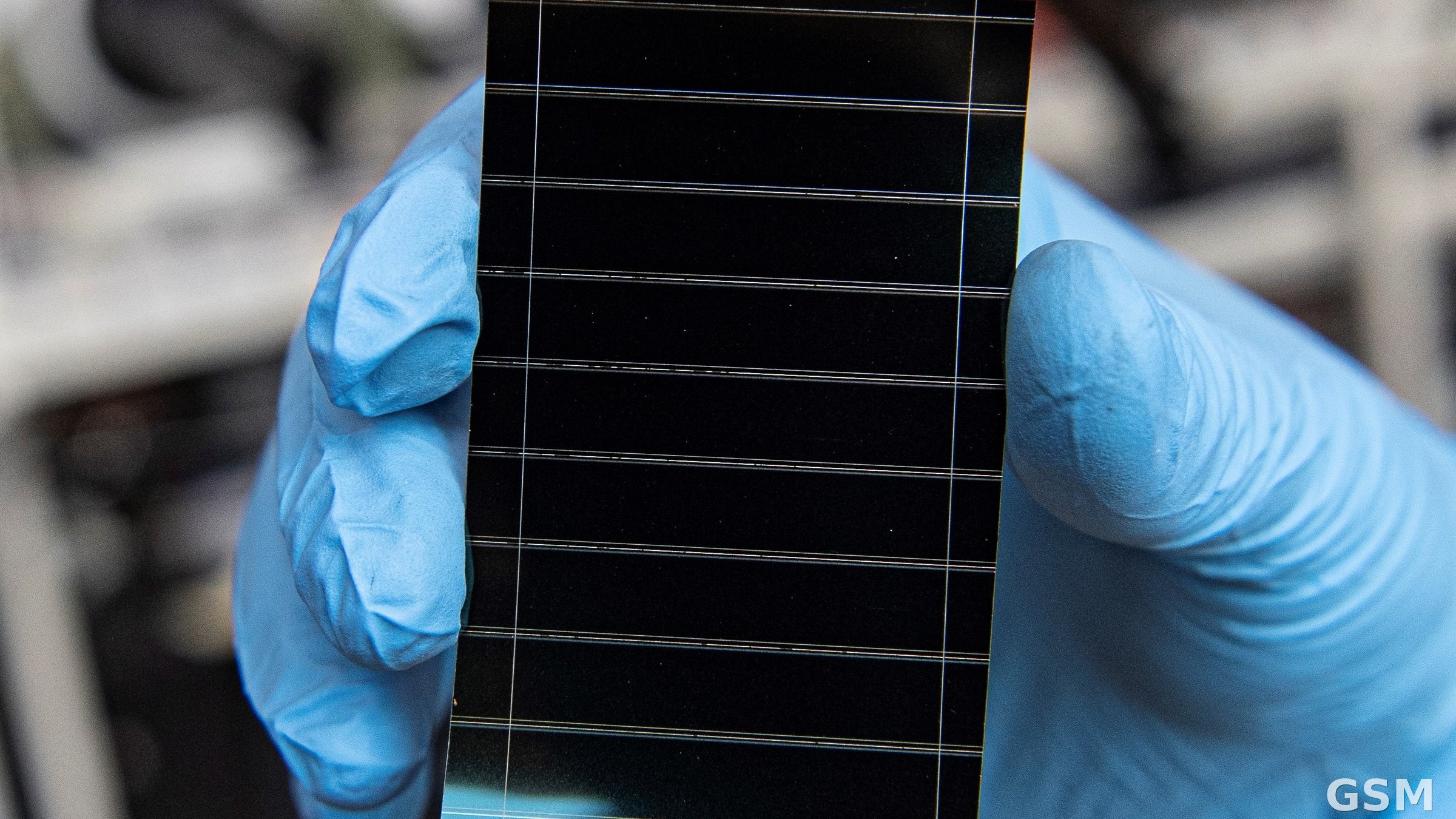
图片来源:钙钛矿太阳能电池片特写(资料图)。(Wikimedia Commons/公共领域)|A perovskite solar cell close-up (file photo). (Wikimedia Commons / public domain)
GSM Global · 本篇英文版 English edition of this story