韦布望远镜在距地球约65亿光年的「巨龙」星系记录104个被放大恒星事件:为此前同一星系纪录44个的两倍以上
天文学家利用詹姆斯·韦布空间望远镜,在距地球约65亿光年的「巨龙」(Dragon)星系中识别出104个被引力透镜放大的恒星事件,为此前在同一星系创下的44个探测纪录的两倍以上。相关论文由西班牙坎塔布里亚物理研究所的 José María Palencia 领衔,已于9月30日发表于《天文学与天体物理学》期刊,Phys.org 于11月8日作了报道。
据论文介绍,「巨龙」星系位于红移0.725处,其光被前景大质量星系团 Abell 370 拉伸放大,星系的一部分被拉成著名的「巨龙弧」。透镜效应在名为焦散线的区域最强;星系团自身的恒星、以及可能存在的暗物质,会把焦散线打碎为「微焦散」,背景星系中的单颗恒星缓慢漂过微焦散时亮度可骤增至正常水平的数百至数千倍,数天至数周后又恢复暗淡。团队比对了韦布望远镜在2022年至2024年间拍摄的影像,校正拍摄角度差异、剔除无关亮源后合并跨滤镜与跨观测的重复探测,最终得到104个独立事件,团队称这是迄今在单个星系中识别出的最大规模高放大恒星候选样本。
能够以这种方式被看见的几乎都是最明亮的超巨星,分蓝超巨星与红超巨星两类。团队的颜色分析显示两类数量大致相当、比例约为1,论文称这与「相对演化过、仍在形成恒星」的系统预期相符。团队还统计了临界曲线两侧的事件数量:远离曲线处两侧相同,靠近曲线处一侧数量下降、另一侧不变,这一形态与「模糊暗物质」模型相符;团队同时注明,该形态也可能源于透镜模型中临界曲线位置不准,结论尚待更多强透镜星系的重复观测与更精确的透镜模型检验。
Webb Telescope Records 104 Magnified Stellar Events in the Dragon Galaxy About 6.5 Billion Light-Years Away, More Than Doubling the Previous Record of 44 in the
Using the James Webb Space Telescope (JWST), a team of astronomers has identified 104 magnified stellar events in a galaxy known as the Dragon, located around 6.5 billion light-years away — more than doubling the previous record of 44 such detections in the same galaxy. The paper, led by José María Palencia of the Institute of Physics of Cantabria, was published on September 30 in Astronomy & Astrophysics and reported by Phys.org on November 8.
The light from the Dragon galaxy, at redshift 0.725, is stretched and magnified by the massive galaxy cluster Abell 370, with part of the galaxy drawn into the Dragon arc. Along caustics, where lensing is strongest, stars of the cluster — and possibly dark matter — break the caustic into microcaustics; as individual stars in the background galaxy drift across them, their brightness can rise to hundreds or thousands of times normal levels before fading again within days to weeks. Comparing JWST images collected from 2022 to 2024, correcting for slightly different viewing angles and removing unrelated bright objects and other contaminants, the team merged repeated detections across filters and observations into a catalog of 104 unique caustic crossing events, which it described as the largest sample of highly magnified star candidates identified in a single galaxy.
Only the most luminous stars can be caught this way, which means the detections are almost always supergiants, in blue and red varieties. The team's color analysis showed roughly equal numbers of the two, a ratio of 1, which the paper said agrees with expectations for a relatively evolved, still star-forming system. Counting events on each side of the critical curve, the team found both sides the same far from the curve, but close to it the count dropped on one side while staying the same on the other — a pattern that fit the "fuzzy" dark matter model. The team noted the pattern could also arise from an incorrect location of the critical curve in the lens model, and that applying the method to other strongly lensed galaxies with repeated observations and better lens models can turn it into a tool for studying both ordinary stars and dark matter.
—-
来源:《天体物理学杂志》论文(
发布:GSM·美国(发布链接)
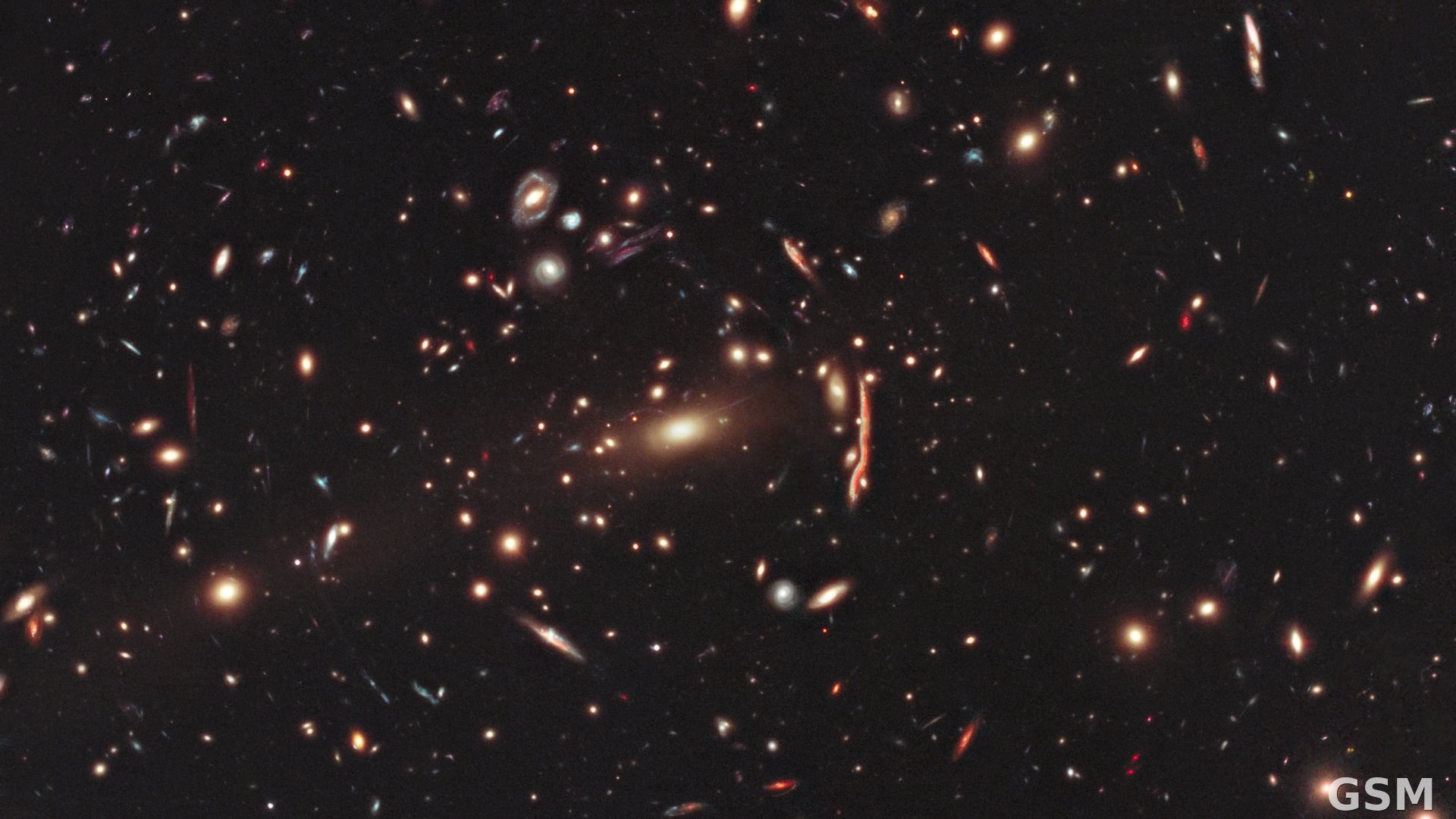
图片来源:引力透镜星系深空影像(资料图)。(Wikimedia Commons/公共领域)|A gravitationally lensed galaxy (file photo). (Wikimedia Commons / public domain)
GSM Global · 本篇英文版 English edition of this story