康奈尔大学团队做出带隙超7电子伏特的半导体并制成晶体管,刷新纪录
康奈尔大学11月3日通过校方媒体《Cornell Chronicle》报道,该校工程师做出了一种带隙超过7电子伏特的半导体材料,并用它制成了可工作的器件,包括一只场效应晶体管。相关研究已发表于《自然》杂志(10月7日)。
这种材料是掺硅的铝镓氧化物。此前的带隙纪录约为6电子伏特;带隙越宽,材料越容易表现得像绝缘体而非半导体,因此跨过7电子伏特一直是难题。研究由材料科学与工程系 Tisch 大学教授 Darrell Schlom 领衔,其博士生 Jacob Steele 为论文第一作者,使用分子束外延方法生长材料薄膜。
器件方面,William L. Quackenbush 教授 Huili Grace Xing 与 David E. Burr 教授 Debdeep Jena 团队制成了一只可工作的二极管与一只场效应晶体管,团队将其命名为 AlphaFET。
这项工作得到空军研究实验室与康奈尔外延解决方案中心、美国国家科学基金会的支持,并使用了康奈尔纳米尺度设施等共享平台。宽带隙半导体可用于更高电压、更高温度环境下的电力电子器件。
Cornell Team Builds Working Transistor From Semiconductor With Record Bandgap Above 7 Electron Volts
Cornell University reported on November 3, through the Cornell Chronicle, that its engineers have made a semiconductor with a bandgap exceeding 7 electron volts and turned it into working devices, including a field-effect transistor. The study was published in Nature on October 7.
The material is silicon-doped aluminum gallium oxide. The previous record was about 6 electron volts, a threshold that has been hard to pass because materials with wider bandgaps tend to behave more like insulators than semiconductors. The work was led by Darrell Schlom, the Tisch University Professor in the Department of Materials Science and Engineering, and his doctoral student Jacob Steele, the study's lead author, grew thin films of the material using molecular beam epitaxy.
On the device side, a team overseen by Huili Grace Xing, the William L. Quackenbush Professor, and Debdeep Jena, the David E. Burr Professor, built a working diode and a field-effect transistor named the AlphaFET.
The work was supported by the Air Force Research Laboratory-Cornell Center for Epitaxial Solutions and the National Science Foundation, and used the Cornell NanoScale Facility and other shared facilities. Wide-bandgap semiconductors can serve power electronics that operate at higher voltages and temperatures.
来源:康奈尔大学
发布:GSM·美国(发布链接)
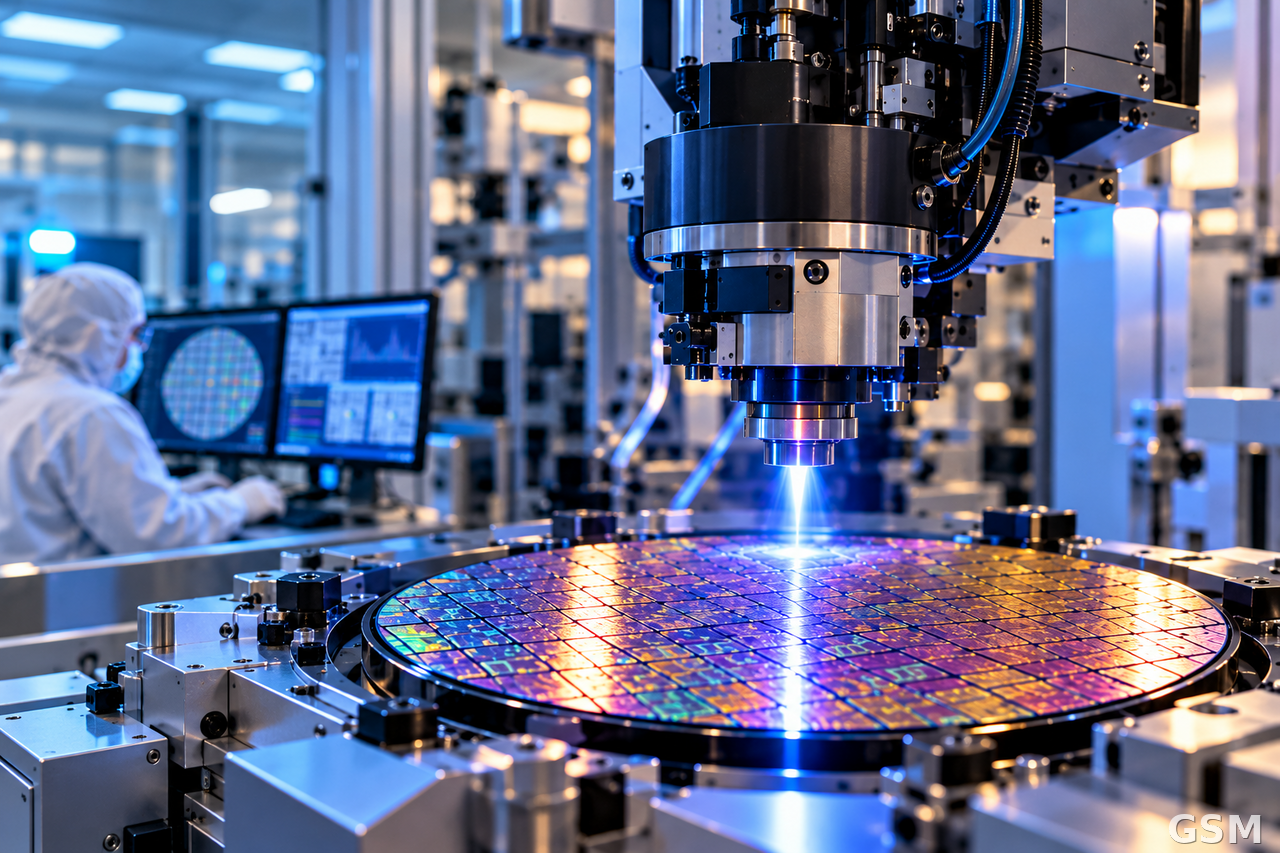
图片来源:图:洁净室内的晶圆加工资料图。Wikimedia Commons,CC BY 4.0,作者 ResearchFrontier。 / Photo: wafer processing in a cleanroom. Wikimedia Commons, CC BY 4.0, by ResearchFrontier.
GSM Global · 本篇英文版 English edition of this story