鲁宾天文台发现新的矮行星候选天体:个头或为同类最大之一
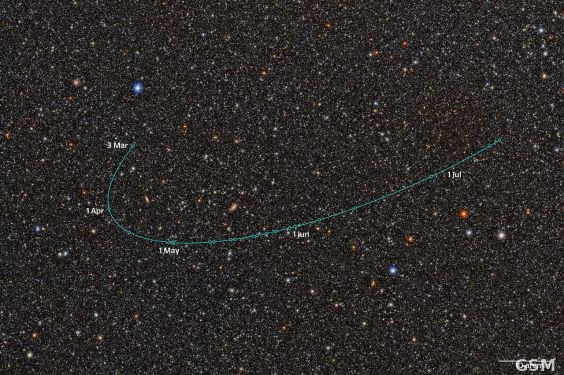
位于南美洲智利科金博大区帕穹山的维拉·鲁宾天文台近日宣布,科学家在一片靠近银河平面的拥挤星场中发现了一个此前从未被记录的大型天体,并已将其识别为矮行星候选者。国际天文学联合会小行星中心为它编予临时编号2026 ED138。
据美国国家科学基金会(NSF)发布的消息,初步数据分析显示,这个天体运行在冥王星轨道之外的太阳系外缘,体积可能位列迄今发现的矮行星候选者前列。如果后续观测证实其身份,它将成为继冥王星、谷神星、阋神星、妊神星和鸟神星之后,第六颗获得确认的矮行星。
鲁宾天文台由美国国家科学基金会与美国能源部科学办公室共同资助,其搭载的相机是人类有史以来建造的最大天文相机。科学家表示,正因为该天体藏身于布满数百万颗恒星的银河平面附近,它才长期躲过了以往巡天的眼睛;鲁宾天文台的高速重复监测与数据算法,最终捕捉到了它在星场中的缓慢移动。
美国国家科学基金会鲁宾天文台项目主任 Edward Ajhar 表示,鲁宾天文台的「超能力」在于能清晰捕捉海量天体与现象的运动和变化,这大大扩展了人类认识太阳系、银河系乃至数十亿个其他星系的能力。能源部鲁宾天文台项目经理 Kathy Turner 也指出,从暗能量研究到这次矮行星候选者的发现,都显示了该天文台的独特优势。
发现只是第一步。其他天文台的科学家现在可以对2026 ED138展开后续跟踪观测,测定它的轨道、大小与表面性质。鲁宾天文台今年已陆续提交了超过11,000颗新发现小行星的观测数据,公众与师生还可以通过其互动工具 Orbitviewer 在线探索包括这颗候选矮行星在内的太阳系天体。(来源:美国国家科学基金会)
Rubin Observatory Finds New Dwarf Planet Candidate Beyond Pluto
The Vera C. Rubin Observatory, located on Cerro Pachón in Chile's Coquimbo Region, has found a large, previously unrecorded object that scientists have identified as a possible dwarf planet, the U.S. National Science Foundation (NSF) announced. The International Astronomical Union's Minor Planet Center has given the object the provisional designation 2026 ED138.
A preliminary data analysis shows the object is orbiting in the outer reaches of the solar system beyond Pluto and may be one of the largest dwarf planet candidates ever found. If confirmed, it would join the five known dwarf planets: Pluto, Ceres, Eris, Haumea, and Makemake.
Rubin Observatory is jointly funded by the NSF and the U.S. Department of Energy's Office of Science, and it carries the largest camera ever built for astronomy. The object was found in a region of sky close to the plane of the Milky Way, visually filled with millions of stars, which is likely why it escaped discovery until now. Rubin's regular monitoring and powerful data algorithms allowed scientists to spot ED138 moving within the crowded field.
"Rubin Observatory's superpower is the ability to clearly capture movement and change among a vast number of objects and phenomena that humans have never seen before," said Edward Ajhar, NSF Program Director for Rubin Observatory. Kathy Turner, the Department of Energy's program manager for Rubin, said the observatory's unique strengths make it an incredible tool for investigating phenomena from dark energy to this dwarf planet candidate.
Scientists using other observatories can now make follow-up observations of ED138 to learn more about its nature. Earlier this year Rubin submitted observations of more than 11,000 new asteroids, and the public, including students and teachers, can explore the discovery through the interactive Orbitviewer web app. (Source: U.S. National Science Foundation)
来源:美国国家科学基金会
发布:GSM·美国(发布链接)
图片来源:图:鲁宾天文台巡天影像中矮行星候选天体2026 ED138的轨道弧迹。美国国家科学基金会/NOIRLab。 / Photo: The orbital arc of dwarf planet candidate 2026 ED138 in Rubin Observatory survey imagery. NSF/NOIRLab.
GSM Global · 本篇英文版 English edition of this story