「格里芬-1」号月球着陆器在喷气推进实验室完成近三个月环境测试 将运回匹兹堡总装
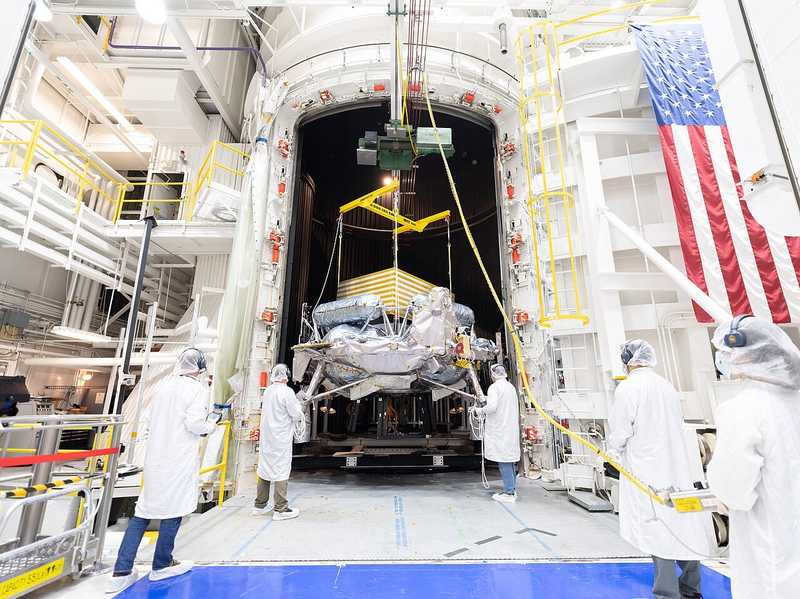
据NASA喷气推进实验室发布的图片说明,Voyager Technologies公司的「格里芬-1」号月球着陆器已在位于南加州的该实验室完成近三个月的环境测试,测试于2026年9月下旬结束,证明这艘飞船已能承受发射、奔月航行和月面着陆的严苛条件。
最后一项试验在其历史悠久的「25英尺空间模拟器」热真空舱内进行——该设施曾支持「游侠」「勘测者」「水手」和「旅行者」等历史任务,已列入美国国家历史名胜名录。8月31日,工程师用起重机将飞船吊入舱内,着陆器在模拟器中交替经受最高75摄氏度(167华氏度)的烘烤和最低零下100摄氏度(零下148华氏度)的严寒。着陆器顶部带黄色条纹的盒体模拟的是今后将搭载的载荷——Astrolab公司的FLIP(FLEX月球创新平台)月球车。
此前的测试包括:7月20日在特制转台上高速旋转以测量质量特性、排查意外晃动;7月29日在电波暗室中进行电磁干扰与电磁兼容测试;8月12日进行声学测试,由压缩氮气驱动的巨型号角在密闭声学舱内以最高153分贝的声浪模拟发射轰鸣。着陆器还接受了振动测试,数百个传感器监测其在「振动台」上沿三个方向、强度递增的晃动,以模拟搭乘火箭升空的过程。
完成测试后,「格里芬-1」已运回Voyager Lunar Systems位于匹兹堡的设施进行总装。该任务属NASA「商业月球有效载荷服务」(CLPS)计划、归于其「月球基地计划」之下,预计2026年底由SpaceX的「猎鹰重型」火箭发射,将把超过1,100磅(455公斤)货物——来自六个国家的10件载荷——送往月球南极附近的诺比尔环形山。喷气推进实验室由加州理工学院为NASA管理。(GSM 据NASA喷气推进实验室图片说明)
Voyager's Griffin-1 Lunar Lander Completes Nearly Three Months of Environmental Testing at NASA's Jet Propulsion Laboratory
Voyager Technologies' Griffin-1 lunar lander has completed nearly three months of environmental testing at NASA's Jet Propulsion Laboratory (JPL) in Southern California, according to a NASA JPL photo feature published on October 18. The tests, which ended in late September 2026, demonstrate that the spacecraft is prepared to face the harsh conditions of launch, its journey to the Moon and landing on the surface.
Its final trial was in JPL's historic 25-Foot Space Simulator, a thermal vacuum chamber listed on the National Register of Historic Places for its role in supporting historic missions including Ranger, Surveyor, Mariner and Voyager. On August 31, engineers used a crane to position the spacecraft in the chamber, where Griffin-1 alternately baked at up to 167 degrees Fahrenheit (75 degrees Celsius) and froze at temperatures as low as minus 148 F (minus 100 C). The yellow-striped box atop the lander simulates a payload that will later be attached: Astrolab's FLIP (FLEX Lunar Innovation Platform) rover.
Earlier trials included a mass-properties measurement on July 20, when the lander rotated rapidly on a special table so engineers could look for unexpected wobbles; electromagnetic interference and electromagnetic compatibility testing in an anechoic chamber on July 29; and acoustic testing on August 12, in which giant horns powered by compressed gaseous nitrogen blasted the spacecraft with up to 153 decibels inside a sealed chamber to mimic the roar of launch. Griffin-1 also endured vibration testing, during which hundreds of sensors monitored the spacecraft as a shaker table rattled it in three directions with increasingly intense force.
After the campaign, Griffin-1 was shipped back across the country to Voyager Lunar Systems' Pittsburgh facility for final assembly. Part of NASA's Commercial Lunar Payload Services (CLPS) initiative within the Moon Base Program, Griffin-1 is expected to launch in late 2026 aboard a SpaceX Falcon Heavy rocket, delivering more than 1,100 pounds (455 kilograms) of cargo — 10 payloads from six countries — to Nobile Crater near the lunar South Pole. Caltech in Pasadena, California, manages JPL for NASA. (GSM, from NASA JPL photo feature PIA26708)
来源:GSM·美国(原文链接)
图片来源:图:「格里芬-1」号月球着陆器在NASA喷气推进实验室接受环境测试。照片:NASA/JPL-Caltech,公共领域。Photo: the Griffin-1 lunar lander during environmental testing at NASA's Jet Propulsion Laboratory. Photo by NASA/JPL-Caltech, public domain.
GSM Global · 本篇英文版 English edition of this story