跟进:NASA罗曼太空望远镜通过关键稳定度测试 指向精度相当240公里外稳锁一枚硬币 日冕仪首度睁眼
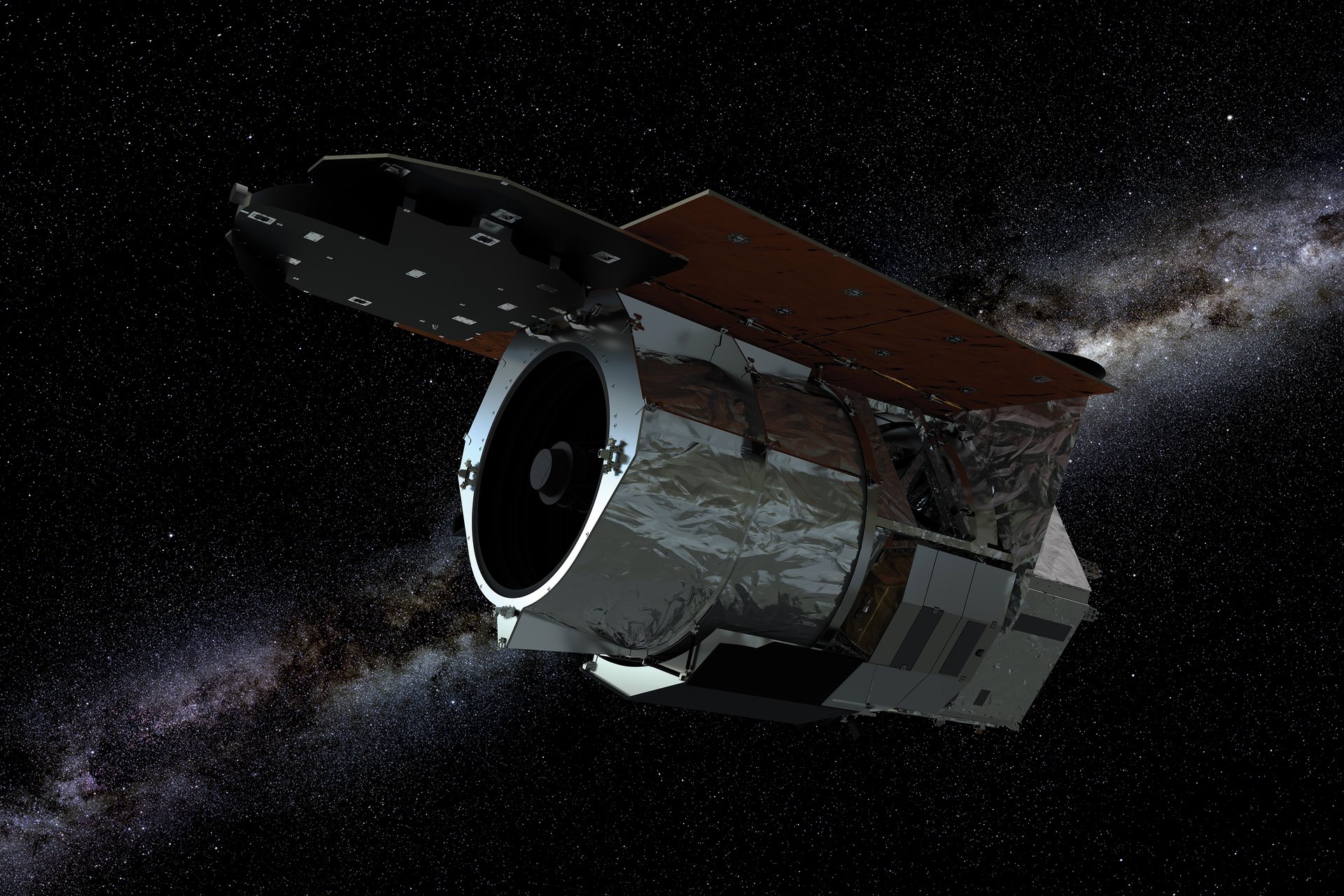
华盛顿报道——美国国家航空航天局 NASA 通报,南希·格雷斯·罗曼太空望远镜的精细导引系统已在轨通过一系列关键测试:望远镜指向稳定度优于十万分之一度。随后,望远镜搭载的日冕仪于9月22日首次接收到来自宇宙的星光。罗曼望远镜于今年8月30日发射升空,正飞往距离地球约150万公里的日地第二拉格朗日点(L2)。
9月15日至21日,任务团队对精细导引系统进行了密集测试。结果显示,在广域仪器观测时,望远镜可连续半小时保持优于十万分之一度的稳定度;在耗时更长的日冕仪观测时,可连续保持八小时。NASA 打了个比方:这样的稳定度,相当于从约150英里(240公里)外,把一束激光稳稳聚焦在一枚一角硬币上;团队还将继续调校导引系统,目标是把这个比方拉长到约230英里(370公里)。
这套系统的工作方式颇为特别。航天器的姿态控制系统先负责把望远镜对准目标方向,精细导引系统再持续修正漂移:团队把罗曼主仪器广域仪器的18个探测器各划出一小块区域,分别快速追踪一颗位置精确已知的恒星作为参照,系统每秒约四次把导星的位置报告给姿态控制系统,由其作出微小修正。NASA 戈达德航天飞行中心罗曼导引仪器系统负责人 Begoña Vila 说:「罗曼的每一次观测,都依赖于它能足够长久地精确指向正确的天区,一次深空曝光成像可能需要几分钟到几小时。我们的测试证实,我们能让望远镜为科学观测保持非常稳定。」
罗曼还将验证一种从未尝试过的导引方式。Vila 介绍,罗曼不像其他太空望远镜那样配备单独的导引仪器,它将改用恒星的光谱——光线中详细的波长图样——来精确导引定位;罗曼本身就为科学观测配备了测量光谱的能力,可以一机两用。团队期待在接下来几周内验证这一光谱导引模式。
稳定度达标后,日冕仪接续登场。这台仪器9月1日在轨唤醒,9月中旬完成各系统自检;团队确认精细导引系统能将其稳稳固定后,科学家调整了它的焦距。9月22日,日冕仪首次接收到宇宙光,拍到邻近星系大麦哲伦云中的一颗暗弱恒星——由于探测器当时刻意保持在高于最终工作温度的状态,以免污染物附着,图像带有噪声。9月27日,团队将探测器冷却后观测大麦哲伦云的另一处天区,一幅图像中出现多颗恒星,确认了仪器的指向。NASA 喷气推进实验室 JPL 罗曼日冕仪科学家 Vanessa Bailey 说:「这次观测证实,这台仪器能够生成聚焦的图像。」
日冕仪由 JPL 在南加州设计建造,是一台技术验证仪器:它要演示如何遮挡恒星的强光,从而直接观测恒星周围暗弱得多的行星与尘埃盘。日冕仪自身还带有一套内部稳定流程,稳定程度甚至高于广域仪器——这至关重要,因为哪怕极微小的振动或指向误差,都会让恒星光泄漏进来,淹没科学家想看的暗弱行星。这项技术被视为未来直接拍摄类地行星任务的探路者。
罗曼望远镜以 NASA 首位首席天文学家南希·格雷斯·罗曼命名,搭载2.4米主镜与3亿像素的广域仪器,巡天视场远大于哈勃太空望远镜,未来将开展暗物质、暗能量与系外行星等大型巡天观测。日冕仪完成首光只是调试的起点,团队将按计划推进一系列难度递增的测试。(GSM 据 NASA 报道)
Follow-Up: NASA's Roman Telescope Passes Key Stability Tests, Steady Enough to Hold a Laser on a Dime 240 Kilometers Away
WASHINGTON — NASA's Nancy Grace Roman Space Telescope has passed a key in-flight milestone: its fine-guidance system, which locks the observatory steadily onto its targets, cleared a series of tests from Sept. 15 to 21, holding the telescope's pointing stable to better than 1/100,000 of a degree. On Sept. 22, the telescope's Coronagraph Instrument then opened its eyes to cosmic light for the very first time. Roman launched on Aug. 30 and is traveling toward the Sun-Earth second Lagrange point (L2), about 1.5 million kilometers from Earth.
The tests showed Roman can hold that stability for half an hour at a time during Wide Field Instrument observations, and for eight hours at a time during the longer Coronagraph Instrument observations. NASA likens the steadiness to focusing a laser beam on a U.S. dime from about 150 miles (240 kilometers) away, and engineers plan to tune the guidance system further, which would stretch the analogy to about 230 miles (370 kilometers).
The system works in an unusual way. The spacecraft's attitude control system first points the observatory in the right direction, and the fine-guidance system then keeps it from drifting. The team assigned a small part of each of the 18 detectors in Roman's primary instrument, the Wide Field Instrument, to rapidly observe a separate guide star whose position is precisely known. The system reports the guide stars' positions to the attitude control system about four times each second, allowing tiny corrections as needed. "Every Roman observation relies on its ability to stay precisely pointed at the correct region of space long enough to collect an image, which can take from minutes to hours for a deep exposure," said Begoña Vila, Roman's guiding instrument systems lead at NASA's Goddard Space Flight Center in Greenbelt, Maryland. "Our tests confirmed that we are able to keep the observatory very stable for science operations."
Roman will also validate a guiding method that has never been attempted before. Unlike other space telescopes, Roman carries no separate guider instrument; instead, it will guide on stars' spectra — the detailed wavelength patterns in their light — using the same spectroscopic capability it already carries for science. The team looks forward to validating this spectral guiding mode in the coming weeks.
With stability confirmed, the Coronagraph Instrument took its turn. The instrument woke up on Sept. 1 and completed checks of its digital, electronic and mechanical systems mid-month. After engineers confirmed the fine-guidance system was holding it steady, scientists adjusted its focus. On Sept. 22 it captured a faint star in the Large Magellanic Cloud, a neighboring galaxy; the image carried noise because the detectors are being kept warmer than their final operating temperature so that contamination does not stick to them. On Sept. 27, with the detectors cooled for better sensitivity, the team observed a new location in the Large Magellanic Cloud and saw many stars in a single image, confirming the pointing. "This observation confirms that the instrument can produce a focused image," said Vanessa Bailey, a Roman Coronagraph Instrument scientist at NASA's Jet Propulsion Laboratory (JPL) in Southern California. "It's a very limited test that kicks off a methodical process of increasingly complex tasks that help us prepare for the instrument's future observations."
Designed and built by JPL, the coronagraph is a technology-demonstration instrument that will show how to block a star's glare so that the far fainter planets and dusty disks around nearby stars can be seen directly. It carries its own internal stability process, making it even more stable than the Wide Field Instrument, because even tiny vibrations or pointing errors could let starlight leak through and wash out the faint planets scientists hope to see. The technology is considered a pathfinder for future missions that would image Earth-like planets directly.
Named for NASA's first chief astronomer, Nancy Grace Roman, the telescope carries a 2.4-meter primary mirror and a 300-megapixel Wide Field Instrument whose field of view is far larger than the Hubble Space Telescope's. Roman will conduct sweeping surveys of dark matter, dark energy and exoplanets. The coronagraph's first light is only the start of commissioning, with a methodical sequence of increasingly demanding tests still ahead. (GSM, based on NASA reporting)
发布:GSM·美国(发布链接)
图片来源:图:南希·格雷斯·罗曼太空望远镜在轨飞行示意图。美国国家航空航天局 NASA 官方发布,公共领域。Image: Artist's concept of NASA's Nancy Grace Roman Space Telescope in orbit. Credit: NASA (public domain).
GSM Global · 本篇英文版 English edition of this story
- 2026-08-25 11:02【视频】NASA罗曼太空望远镜即将启程 开启探索宇宙新视野
- 2026-08-30 11:13【视频】NASA成功发射罗曼太空望远镜
- 2026-10-17 22:10跟进:NASA罗曼太空望远镜通过关键稳定度测试 指向精度相当240公里外稳锁一枚硬币 日冕仪首度睁眼本篇