谷歌Willow芯片首证「魔态培养」:T态逻辑保真度达99.99%、错误降约40倍
谷歌量子SI(Google Quantum AI)团队10月15日在《科学》杂志发表论文《Magic state cultivation on a superconducting quantum processor》,首次在该公司的Willow超导量子处理器上以真实硬件实现了「魔态培养」(magic state cultivation)。据《量子计算报告》(Quantum Computing Report)对论文的梳理,实验取得约40倍的错误下降,培养出的T态逻辑保真度达99.99(1)%(错误率不高于0.0001)。
「魔态」是执行通用、容错量子计算所必需的一类特殊量子态:它使超越经典计算的操作集成为可能,但用一次即消耗、不可回收。自2004年以来研究界即预见其制备成本将成为核心瓶颈:传统「蒸馏」方案据估计要吃掉量子计算机90%至95%的物理量子比特资源(《量子计算报告》;谷歌官方博客称最高可达整机容量的95%)。「培养」路线由谷歌研究人员克雷格·吉德尼(Craig Gidney)、诺亚·沙蒂(Noah Shutty)与科迪·琼斯(Cody Jones)于2024年提出:先在芯片上一小块区域用小的颜色码(color code)培育并逐轮测量筛选,再把纯化后的态「嫁接」进可扩展的表面码(surface code)——本次实验即完成了从距离-3颜色码到距离-5表面码的嫁接。
实验的局限同样写在报道中:据《新科学家》(New Scientist)引述团队成员罗森菲尔德(Rosenfeld),Willow的运行中只有约8%产出了可供后续使用的高质量魔态,其余尝试在质量筛选中被丢弃;据《科学美国人》,本次实验用了Willow全部105个物理量子比特中的54个。未参与该研究的杜克量子中心主任肯尼思·布朗(Kenneth Brown)表示,实验表明「培养」的概念在实践中行得通;帝国理工学院的蔡振宇(Zhenyu Cai)则向《新科学家》表示,这是重要一步,但Willow的错误率还需进一步降低,才能处理真正有用的问题。谷歌方面表示,该技术仍需在更大规模上验证其有效性。
Google's Willow Chip Demonstrates "Magic State Cultivation" for the First Time: 99.99% Logical Fidelity for T States, Errors Cut About 40-Fold
Google Quantum AI published a paper in Science on October 15, "Magic state cultivation on a superconducting quantum processor," demonstrating magic state cultivation in physical hardware for the first time on the company's Willow superconducting processor. According to Quantum Computing Report's summary of the paper, the experiment achieved a roughly 40-fold error reduction, producing T states with a logical fidelity of 99.99(1)% — an error rate of no more than 0.0001.
Magic states are the special quantum states required to run the error-corrected operations needed for universal, fault-tolerant quantum computing, and each can be used only once. Since 2004, researchers have foreseen their production cost as a core bottleneck: traditional distillation protocols were projected to consume 90% to 95% of a quantum computer's physical qubit footprint (Quantum Computing Report; Google's official blog puts the figure at up to 95% of total capacity). Cultivation, proposed in 2024 by Google researchers Craig Gidney, Noah Shutty and Cody Jones, grows the states in a small patch of the chip using small color codes, filters them through repeated measurements, and then grafts the purified states into surface codes; the new experiment grafted states from a distance-3 color code into a distance-5 surface code.
The limits were reported alongside the result: only about 8% of Willow's runs produced high-quality magic states usable downstream, with the rest discarded in quality screening, team member Rosenfeld told New Scientist, and the experiment used 54 of Willow's 105 physical qubits, according to Scientific American. Kenneth Brown, director of the Duke Quantum Center, who was not involved in the study, said the experiment shows the cultivation concept works in practice. Zhenyu Cai of Imperial College London told New Scientist it is a significant step, but that Willow's errors will need to be reduced further before it can tackle truly useful problems. Google said the technology still needs further validation at larger scale.
发布:GSM·美国(发布链接)
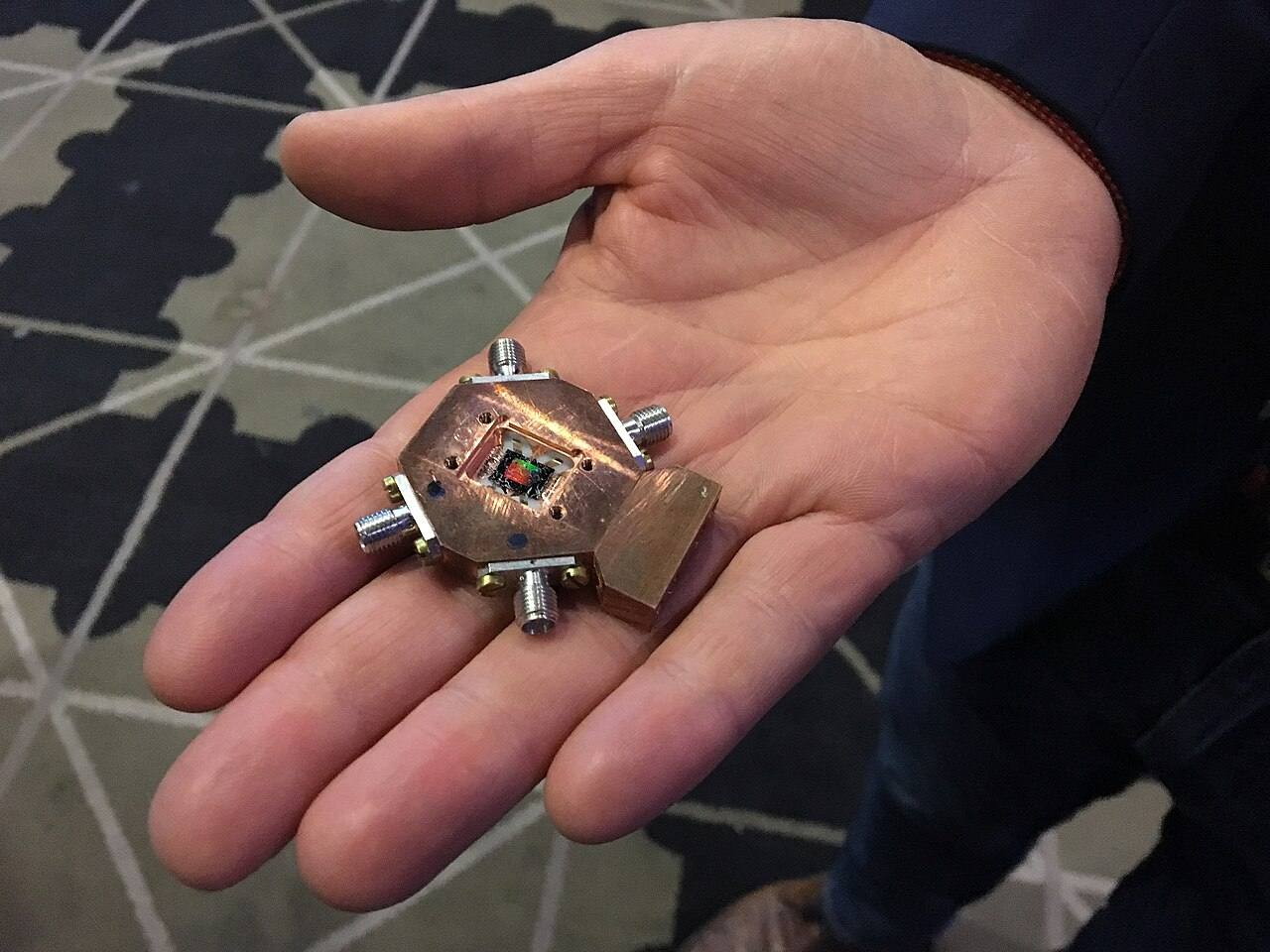
图片来源:图:量子处理器资料图(2017年摄于瑞典查尔姆斯理工大学纳米制造实验室,为三量子比特处理器,非Willow本体)。图片来源:Anita Fors (Chalmers),Wikimedia Commons,CC BY-SA 4.0。Photo: A quantum processor (three-qubit device, Chalmers University of Technology, 2017; file photo, not the Willow chip itself). Image: Anita Fors (Chalmers), via Wikimedia Commons, CC BY-SA 4.0.
GSM Global · 本篇英文版 English edition of this story