中国裁军大使李驰江在联大第一委员会发言:核武器用不得、核战争打不得 反对歪曲抹黑中国核政策
联合国——据新华社10月17日报道,中国裁军事务大使李驰江10月16日在联合国大会第一委员会作关于核问题的专题发言,呼吁国际社会携手应对核领域风险挑战;同日,他还在该委员会作关于核问题的答辩发言,就中国核政策作出阐明。
李驰江在专题发言中说,一年来,全球安全形势更加复杂严峻,多边核军控机制对抗进一步加剧,国际社会对核军备竞赛、核战争担忧普遍上升。冷战思维是国际战略安全环境恶化的最大来源,双重标准是国际核不扩散机制的最大挑战,单边主义是核领域全球治理的最大障碍。国际社会应秉持共同、综合、合作、可持续的安全观,携手应对核领域风险挑战。
李驰江强调,核武器用不得,核战争打不得。有关核武器国家应放弃以打赢核战争、首先使用核武器为基础的核威慑政策,尽早谈判缔结「互不首先使用核武器条约」和无核安保国际法律文书。有关国家应停止部署全球反导系统,停止抵近其他核武器国家部署战略攻防武器,停止推进核试验准备和实战核武器研发。《不扩散核武器条约》依然是国际核裁军与核不扩散体系的基石、二战后国际安全秩序的关键支柱。禁核试国际共识不容挑战,「暂停核试验」承诺应得到信守。所有核武器国家应公开承诺不寻求永远拥有核武器,循序渐进推进核裁军。拥有最大核武库的国家应该切实履行核裁军特殊、优先责任,进一步大幅、实质削减核武库。
李驰江还说,防止核武器扩散的努力不应损害发展中国家和平利用核能的权利,和平利用核能不能用作核扩散的幌子;个别无核武器国家囤积大量没有可信民用用途的钚材料,推动修改「无核三原则」,公开鼓吹自主拥核,国际社会必须提高警惕、严加管束。他表示,中国倡导全面禁止和彻底销毁核武器的立场坚定不移,恪守不首先使用核武器政策一以贯之,维护全球战略安全和稳定的努力从未停歇。中方将继续践行全球发展倡议、全球安全倡议、全球文明倡议和全球治理倡议,践行真正的多边主义,与各方一道共同推进国际核军控进程,不断完善核领域全球治理,推动构建人类命运共同体。
在答辩发言中,李驰江表示,中方坚决反对一些国家歪曲抹黑中国核政策和国防力量建设的错误言论。他强调,中国在核武器问题上历来采取极其慎重、负责的态度。从拥有核武器第一天起,中国就倡导全面禁止和彻底销毁核武器,承诺在任何时候和任何情况下都不首先使用核武器,无条件承诺不对无核武器国家和无核武器区使用或威胁使用核武器,始终把核力量维持在国家安全需要的最低水平。中国核力量同美俄完全不在一个量级,现阶段要求中方参加所谓中美俄三边核裁军谈判不公平、不合理、也不可行。
李驰江说,中国不首先使用核武器的政策高度负责、高度稳定,是落实《不扩散核武器条约》义务、降低核武器在国家安全政策中作用、有益于减少战略风险的务实举措,受到国际社会普遍欢迎。这一政策没有改变,也不会改变。他说,核透明应有助于增进战略互信,充分考虑各国安全环境和安全利益,根据国情自愿实施,不存在普遍适用的模板。各方应理性看待核武器国家在核力量、核政策、安全环境等方面的客观差异,尊重各国在核透明问题上的正当合理安全关切。当前国际安全形势下,意图和政策的透明最有现实意义。中国坚定走和平发展道路,奉行自卫防御的核战略,不会首先使用核武器,这是最具现实意义的透明举措。
李驰江说,享受「核保护伞」的「核联盟」国家声称支持核裁军、核不扩散,实际上不断提高对核武器的依赖,推高核战争风险。北约「核共享」「延伸威慑」是在无核武器国家之间制造不平等的歧视性安排,本身就是持续的核扩散行为,违反《不扩散核武器条约》宗旨和目标。中方再次敦促有关国家停止散布虚假叙事,停止破坏国际核不扩散体系,停止升级「核联盟」、为核裁军制造障碍。
China's Disarmament Ambassador at UN First Committee: Nuclear Weapons Must Not Be Used and Nuclear War Must Not Be Fought; Beijing Rejects Distortion of Its Nuclear Policy
United Nations — China's Ambassador for Disarmament Affairs, Li Chijiang, delivered a thematic statement on nuclear issues to the First Committee of the UN General Assembly on October 16 and, on the same day, a statement in exercise of the right of reply on the same subject, Xinhua reported on October 17.
In his thematic statement, Li said the global security situation had grown more complex and severe over the past year, confrontation within multilateral nuclear arms-control mechanisms had intensified further, and international concern over a nuclear arms race and nuclear war had generally risen. He said the Cold War mentality is the biggest source of the deterioration of the international strategic security environment, double standards are the biggest challenge to the international nuclear non-proliferation regime, and unilateralism is the biggest obstacle to global governance in the nuclear field. The international community should uphold a common, comprehensive, cooperative and sustainable vision of security and work together to address risks and challenges in the nuclear field, he said.
Li stressed that nuclear weapons must not be used and a nuclear war must not be fought. Nuclear-weapon states concerned should abandon nuclear deterrence policies based on winning a nuclear war and on first use of nuclear weapons, and negotiate and conclude at an early date a treaty on mutual no-first-use of nuclear weapons and an international legal instrument on negative security assurances, he said. The countries concerned should stop deploying global missile defence systems, stop deploying strategic offensive and defensive weapons close to other nuclear-weapon states, and stop advancing nuclear-test preparations and the development of nuclear weapons for actual combat, he said. The Treaty on the Non-Proliferation of Nuclear Weapons (NPT) remains the cornerstone of the international nuclear disarmament and non-proliferation regime and a key pillar of the post-war international security order, he said, adding that the international consensus against nuclear testing must not be challenged and that moratorium commitments on nuclear testing should be honoured. All nuclear-weapon states should publicly commit to not seeking to possess nuclear weapons forever and should advance nuclear disarmament step by step; the states with the largest nuclear arsenals should earnestly fulfil their special and priority responsibility for nuclear disarmament and further reduce their arsenals substantially and substantively, he said.
Li also said efforts to prevent nuclear proliferation should not harm developing countries' right to the peaceful use of nuclear energy, and that peaceful use must not serve as a pretext for proliferation. A certain non-nuclear-weapon state is stockpiling large quantities of plutonium with no credible civilian use, pushing to revise the "three non-nuclear principles" and openly advocating acquiring nuclear weapons of its own, which the international community must guard against and strictly control, he said. China's position of advocating the complete prohibition and thorough destruction of nuclear weapons is unwavering, its adherence to the no-first-use policy has been consistent, and its efforts to safeguard global strategic security and stability have never stopped, he said. China will continue to act on the Global Development Initiative, the Global Security Initiative, the Global Civilization Initiative and the Global Governance Initiative, practise true multilateralism, and work with all parties to advance the international nuclear arms-control process, improve global governance in the nuclear field and build a community with a shared future for humanity, he said.
In his right-of-reply statement, Li said China firmly opposes erroneous statements by certain countries that distort and smear China's nuclear policy and its national defence development. China has always adopted an extremely prudent and responsible attitude on the nuclear weapons issue, he said. From the first day it possessed nuclear weapons, China has advocated the complete prohibition and thorough destruction of nuclear weapons, has committed to not being the first to use nuclear weapons at any time and under any circumstances, has unconditionally committed not to use or threaten to use nuclear weapons against non-nuclear-weapon states and nuclear-weapon-free zones, and has always kept its nuclear forces at the minimum level required for national security. China's nuclear forces are not on the same order of magnitude as those of the United States and Russia, and it is unfair, unreasonable and infeasible at this stage to demand that China join so-called trilateral nuclear disarmament talks among China, the United States and Russia, he said.
Li said China's no-first-use policy is highly responsible and highly stable, is a pragmatic measure for fulfilling NPT obligations, reducing the role of nuclear weapons in national security policy and lowering strategic risks, and is widely welcomed by the international community. This policy has not changed and will not change, he said. Nuclear transparency should help enhance strategic mutual trust, should fully take into account each country's security environment and security interests, and should be implemented voluntarily in light of national conditions; there is no universally applicable template, he said. Parties should view objectively the differences among nuclear-weapon states in nuclear forces, nuclear policies and security environments, and respect each country's legitimate and reasonable security concerns on nuclear transparency. In the current international security situation, transparency of intentions and policies carries the most practical significance, he said. China firmly follows a path of peaceful development and pursues a nuclear strategy of self-defence; it will not be the first to use nuclear weapons, which is the most practically significant transparency measure, he said.
Li said that "nuclear umbrella" and "nuclear alliance" states claim to support nuclear disarmament and non-proliferation while in reality continually increasing their reliance on nuclear weapons and raising the risk of nuclear war. NATO's "nuclear sharing" and "extended deterrence" are discriminatory arrangements creating inequality among non-nuclear-weapon states, are themselves continuing acts of nuclear proliferation, and violate the purposes and objectives of the NPT, he said. China once again urges the countries concerned to stop spreading false narratives, stop undermining the international nuclear non-proliferation regime, and stop upgrading "nuclear alliances" and creating obstacles to nuclear disarmament, he said.
发布:GSM·美国(发布链接)
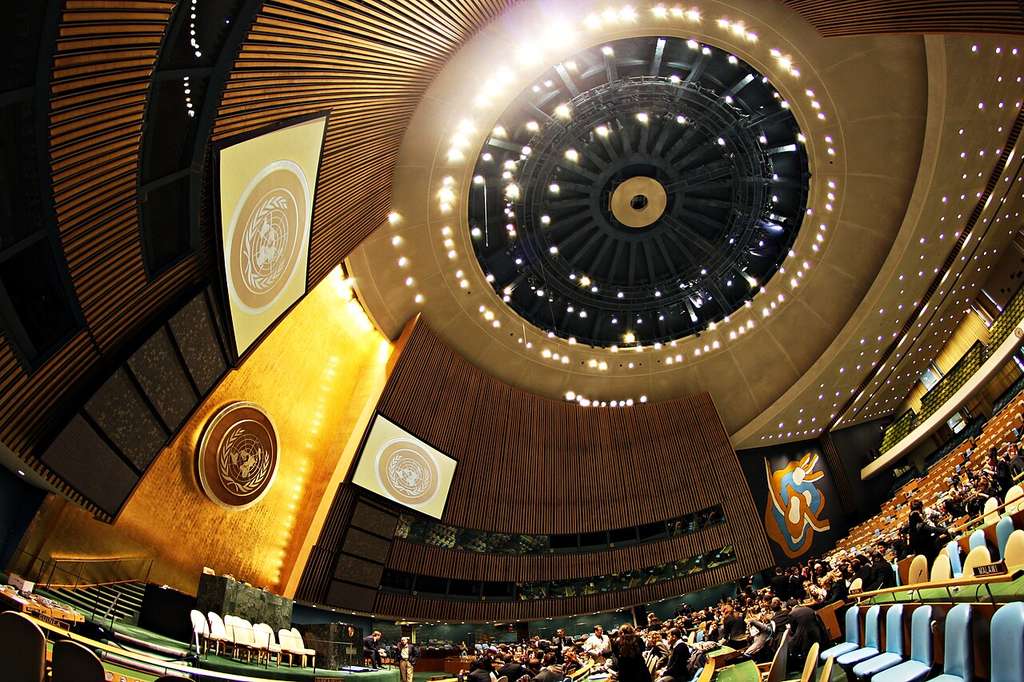
图片来源:图:纽约联合国总部大会堂资料照片。照片:Wikimedia Commons。File photo: the General Assembly Hall at UN Headquarters in New York. Photo via Wikimedia Commons.
GSM Global · 本篇英文版 English edition of this story
- 2026-10-16 01:47中国裁军大使李驰江在联大第一委员会发言:核武器用不得、核战争打不得 反对歪曲抹黑中国核政策本篇
- 2026-10-21 20:19跟进:中国裁军大使李驰江在联大第一委员会谈外空安全:防止外空军备竞赛和武器化是最紧迫任务,提出四点主张