JAMA ISCHEMIA-EXTEND 随访 5179 人最长 13 年:稳定型冠心病早期介入未带来长期生存优势,11 年死亡率 25.8% 对 26.9%
《美国医学会杂志》(JAMA)2026 年 11 月 7 日在线发表 ISCHEMIA-EXTEND 长期随访研究:在 5179 名慢性冠心病合并中重度缺血的患者中,最初采用介入策略(药物治疗加冠状动脉造影及可行时血运重建)与最初采用保守策略(仅指南指导药物治疗、治疗失败时再介入)相比,约十年随访未显示总体生存优势。
研究为随机试验的长期随访,5179 名随机患者全部纳入意向治疗分析,中位年龄 64 岁,女性 1168 人(23%)、男性 4011 人(77%),在 37 个国家的 320 个中心开展。入选者左心室射血分数不低于 35%,且无左主干冠心病、不可接受的心绞痛或近期急性冠脉综合征。死亡随访最长 13 年,主要报告 11 年估计值。
11 年全因死亡率:介入组 25.8%,保守组 26.9%,差异无统计学意义;11 年限制平均生存时间的估计差异为 14 天,同样无统计学意义。心血管死亡率分别为 15.8% 与 17.1%,非心血管死亡率分别为 9.1% 与 8.1%,两项差异均无统计学意义。研究期间共记录 1071 例死亡。
JAMA 研究摘要指出,该随访只聚焦死亡,未收集后期的非致死事件、用药、症状与生活质量数据,延长随访期的死因亦未经判定。研究结论支持医患共同决策:治疗选择宜由患者偏好与照护目标引导,而非基于预期生存优势。本稿只报道研究事实与官方资源信息,不作个体诊疗建议。
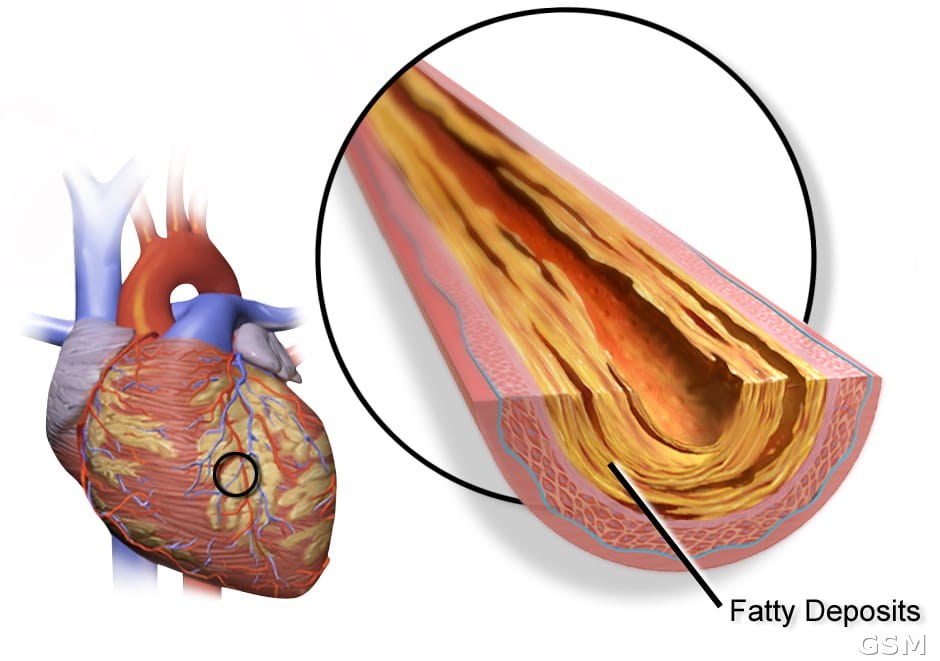
图中是冠状动脉粥样硬化斑块的医学示意图。
ISCHEMIA-EXTEND in JAMA: Early Invasive Strategy Did Not Improve Long-Term Survival in 5,179 Patients With Stable Coronary Disease
The ISCHEMIA-EXTEND long-term follow-up, published online in JAMA on November 7, 2026, found that among 5,179 patients with chronic coronary disease and moderate or severe ischemia, an initial invasive strategy — guideline-directed medical therapy plus coronary angiography and revascularization when feasible — did not improve overall survival over about a decade compared with an initial conservative strategy of medical therapy alone, with invasive management reserved for treatment failure.
All 5,179 randomized patients were included in the intention-to-treat analysis. The median age was 64 years; 1,168 participants (23%) were female and 4,011 (77%) male. The international trial ran at 320 sites in 37 countries. Eligible patients had a left ventricular ejection fraction of at least 35% and no left main coronary artery disease, unacceptable angina, or recent acute coronary syndrome. Mortality was assessed through 13 years, with main estimates reported at 11 years; 1,071 deaths were recorded in the follow-up reporting.
All-cause mortality at 11 years was 25.8% with invasive management versus 26.9% with conservative management, a difference that was not statistically significant. Restricted mean survival at 11 years also did not differ significantly, with an estimated difference of 14 days. Cardiovascular mortality was 15.8% versus 17.1%, and noncardiovascular mortality 9.1% versus 8.1%, respectively; neither difference was statistically significant.
JAMA's summary notes the follow-up focused on mortality and did not collect later data on nonfatal events, medication use, symptoms, or quality of life, and cause of death was not adjudicated during extended follow-up. The findings support shared decision-making guided by patient preferences and goals of care rather than an expected survival advantage. This report presents study facts only and makes no individual treatment recommendation.
来源:美国医学会杂志
发布:GSM·美国(发布链接)
图片来源:图中是冠状动脉粥样硬化斑块的医学示意图。BruceBlaus, via Wikimedia Commons
GSM Global · 本篇英文版 English edition of this story