京都大学与核融合科学研究所在LHD实现数字孪生预测控制:远程超算最高动用1万个CPU核心
Kyoto University 与日本核融合科学研究所(NIFS)等机构的研究团队2026年11月15日在《Scientific Reports》报告:在大型螺旋装置(LHD)上首次以数据同化型数字孪生实现了聚变等离子体的预测控制。论文由 Yuya Morishita、Sadayoshi Murakami 等人撰写。
该系统把数据同化与基于物理的综合建模结合,数字孪生与实验观测动态同步,再根据其预测优化加热与燃料注入,把等离子体驱动到目标状态。实时适应与控制估计在一台距实验装置约1000公里的远程超级计算机上完成,最高动用1万个CPU核心。
团队在五个代表性目标案例中演示了电子密度、电子温度与离子温度的多变量控制,建立起自适应数字孪生与真实聚变等离子体之间的闭环。研究者表示,这是基于数据同化的数字孪生预测控制在聚变等离子体上的首次演示,预期将成为聚变反应堆控制的基础方法之一。
Japan: Digital Twin Achieves Predictive Control of Fusion Plasma on the LHD, Using Up to 10,000 CPU Cores on a Supercomputer 1,000 km Away
A team from Kyoto University, Japan's National Institute for Fusion Science and partner institutes demonstrated predictive control of a fusion plasma on the Large Helical Device using an adaptive digital-twin system, in a paper published in Scientific Reports on November 15, 2026, by Yuya Morishita, Sadayoshi Murakami and colleagues.
The system combines data assimilation with physics-based integrated modeling: the digital twin was dynamically synchronized with experimental observations, while heating and fueling inputs were optimized from its predictions to drive the plasma toward target states. Real-time adaptation and control estimation were performed on a remote supercomputer located approximately 1,000 km from the experimental device, using up to 10,000 CPU cores.
Multivariate control of electron density, electron temperature and ion temperature was demonstrated in five representative target cases, establishing a closed loop between an adaptive digital twin and a physical fusion plasma. The researchers said the result is the first demonstration of predictive control of a fusion plasma by a data-assimilation digital twin, and that the approach is expected to become fundamental to fusion reactor control.
来源:京都大学
发布:GSM·美国(发布链接)
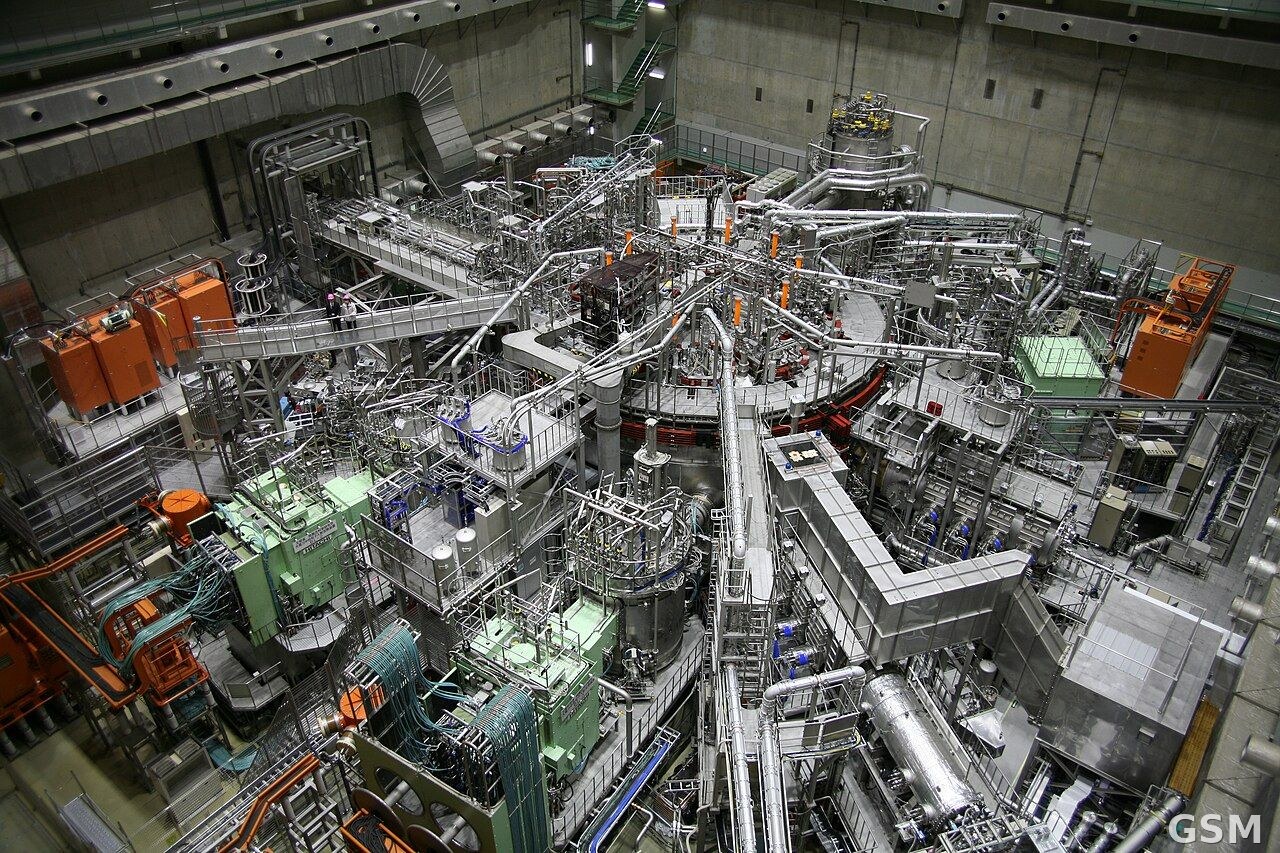
图片来源:图中是日本核融合科学研究所的大型螺旋装置(LHD),本研究的数字孪生预测控制正是在这台装置上完成的。来源:Wikimedia Commons, File:Large Helical Device 2014.jpg, National Institute for Fusion Science, CC BY-SA 4.0。
GSM Global · 本篇英文版 English edition of this story