代尔夫特理工大学团队《Nature Communications》论文11月15日报道:射频波直接驱动单个钛原子核自旋,核跃迁频率50至85兆赫
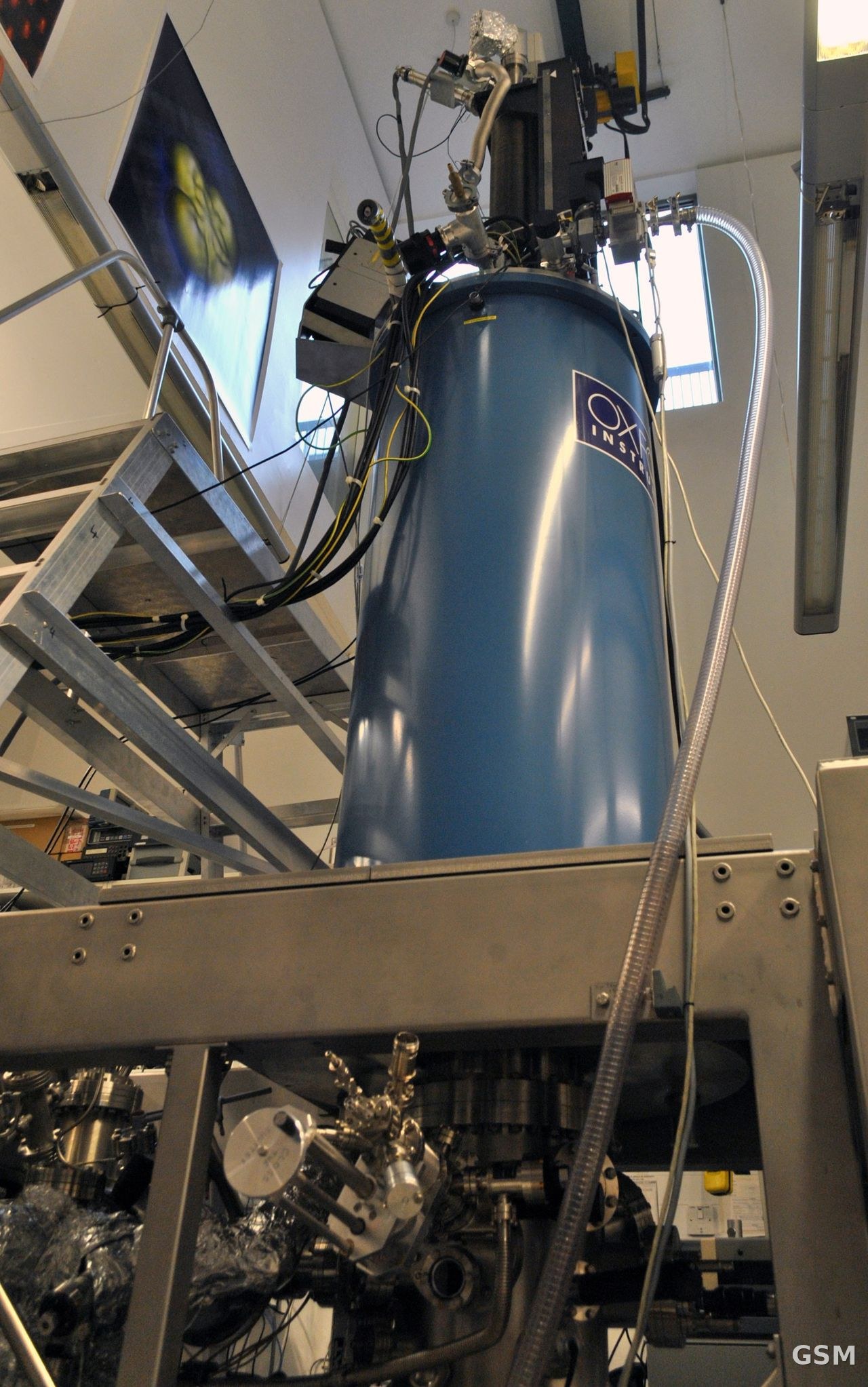
荷兰代尔夫特理工大学 Kavli 纳米科学研究所 Sander Otte 团队在《Nature Communications》发表论文,11月15日对外报道。团队用扫描隧道显微镜(STM)在单个钛原子上实现了核磁共振,对象是吸附在双层氧化镁表面上的钛-47同位素原子,其核自旋为 I = 5/2。
团队采用电子—核双共振(ENDOR)测量方案,分辨出单个钛-47原子的核自旋跃迁,驱动核自旋的本地射频场频率在50至85兆赫之间。实验在外加磁场200毫特斯拉至1.4特斯拉的高场条件下进行,电子自旋与核自旋之间的杂化被压低约10倍。
核自旋子能级之间原有的简并由四极分裂解除,测得的四极分裂参数为 −2.8 ± 0.8 兆赫,使团队可以分别寻址不同的核自旋子能级。实验在0.4开尔文的超低温下完成。
研究人员表示,核自旋因受屏蔽、寿命长而被视为量子信息存储的候选载体,但这次实验中让电学探针得以驱动原子核的耦合机制本身尚未完全弄清。该工作是单原子层面的基础物理实验,尚无可用的量子存储器件问世。
TU Delft Team in Nature Communications, Reported November 15: Radio Waves Directly Drive a Single Titanium Atom's Nuclear Spin, With Nuclear Transitions at 50 to 85 MHz
A team led by Sander Otte at the Kavli Institute of Nanoscience, Delft University of Technology, in the Netherlands has published a paper in Nature Communications, reported on November 15. Using scanning tunnelling microscopy (STM), the team demonstrated nuclear magnetic resonance on a single titanium atom, working with a titanium-47 isotope atom adsorbed on a bilayer magnesium oxide surface, whose nuclear spin is I = 5/2.
The team used an electron-nuclear double resonance (ENDOR) measurement scheme and resolved nuclear spin transitions of the single titanium-47 atom, driving the nuclear spin with a local radio-frequency field between 50 and 85 MHz. The experiments were carried out at high magnetic fields, from 200 millitesla to 1.4 tesla, where hybridization between the electron and nuclear spins was suppressed by roughly a factor of 10.
A quadrupole splitting of −2.8 ± 0.8 MHz lifted the degeneracy of the nuclear spin sublevels, allowing the team to address individual sublevels separately. The measurements were performed at an ultra-low temperature of 0.4 kelvin.
The researchers say nuclear spins are candidates for storing quantum information because they are shielded and long-lived, but the coupling mechanism that let the electrical probe drive the nucleus in this experiment is not yet fully understood. The work is a single-atom basic physics experiment, and no working quantum memory device has resulted from it.
发布:GSM·美国(发布链接)
图片来源:Wikimedia Commons, File:Scanning tunnelling microscope (11797091876).jpg — Author: UCL Mathematical and Physical Sciences from London, UK. Licensing: CC BY 2.0.
GSM Global · 本篇英文版 English edition of this story