西蒙斯天文台在智利全面上线:斯坦福与SLAC助建6.3万个传感器的宇宙相机
斯坦福大学11月12日发布消息,位于智利阿塔卡马沙漠的西蒙斯天文台(Simons Observatory)经过两年校准后已全面上线,正式开展科学观测。斯坦福大学与 SLAC 国家加速器实验室的研究人员参与了这座天文台从仪器建造到科学规划的几乎每一个环节。
天文台坐落在海拔约5,200米(17,000英尺)的高原上,共有四台望远镜。它们观测的对象是宇宙微波背景辐射,也就是宇宙中最古老的光,以及这束光前方银河系内的毫米波天空。这些数据将帮助科学家弄清星际尘埃的成分、磁场如何塑造恒星形成区、恒星爆发等暂现事件发生在哪里,还将描绘星系与暗物质在宇宙中的分布,为暗能量研究提供线索。斯坦福表示,早期数据已经能与欧洲空间局 Planck 卫星的最佳宇宙微波背景图相媲美。
斯坦福与 SLAC 的核心贡献,是6米大口径望远镜(LAT)的接收机,也就是它的「相机」。这台相机现装有6.3万个超导传感器,是迄今最大的宇宙学低温相机。团队2024年2月部署了首批3.1万个探测器,今年早些时候装完最后3.2万个。让这些传感器工作的 SMuRF 读出电子学系统,由粒子物理与天体物理副教授 Zeesh Ahmed 带领的 KIPAC 与 SLAC 团队研制,SLAC 工程师 Gunther Haller、Ryan Herbst 与 Larry Ruckman 参与设计建造,多名博士后、学生与 staff 科学家曾在智利现场驻扎数月组装部署。
在银河系研究方面,大口径望远镜已经产出迄今最完整的银河系偏振微波光图像。这些图像揭示银河系磁场的结构,对理解恒星形成与星系演化至关重要。物理学助理教授 Susan Clark 共同主导的两篇预测论文塑造了天文台的银河科学规划,她的研究生 Kaitlyn Karpovich 是绘制和分析银河中心偏振辐射的核心成员之一。Clark 说,这些波长的偏振光能揭示恒星之间看不见的磁场,西蒙斯天文台给了人们一个看银河系的新视角。
在宇宙大尺度结构方面,粒子物理与天体物理助理教授 Emmanuel Schaan 参与制定了天文台最初的科学方案,他的团队研究运动学苏尼亚耶夫-泽尔多维奇效应(kSZ),即宇宙微波背景光被运动气体散射时产生的微小偏移。NASA 哈勃研究员 Frank Qu 主导天文台的宇宙微波背景引力透镜分析,他说,团队在天文台的头批观测中已经看到全宇宙物质在最古老的光上留下的微弱扭曲,这些图将以亚百分点的精度绘制宇宙的暗物质分布。
斯坦福介绍,本轮升级完成后,天文台另增设了由英国和日本资助的三台小口径望远镜,美国国家科学基金会资助的新仪器使大口径望远镜的测绘速度翻倍,天文台将定期向更广泛的天文学界发布数据。天文台共同主任 Mark Devlin 表示,未来几年将涌现大量科学发现,多到难以跟上。
Simons Observatory Fully Online in Chile: Stanford and SLAC Help Build 63,000-Sensor Camera to Map the Universe's Oldest Light
Stanford University announced on November 12 that the Simons Observatory in Chile's Atacama Desert is fully online and conducting science operations after two years of calibration. Researchers at Stanford and SLAC National Accelerator Laboratory, through the Kavli Institute for Particle Astrophysics and Cosmology (KIPAC), have had a hand in nearly every part of the observatory.
The observatory's four telescopes sit at 17,000 feet (5,200 meters), where they map the cosmic microwave background, the oldest light in the universe, and the millimeter-wave sky in front of it. The data will help reveal what interstellar dust is made of, how magnetic fields shape star-forming regions, and where stellar explosions and other transient events are occurring. It will also trace how galaxies and dark matter are arranged across the universe, the large-scale structure that holds clues to dark energy. Stanford said early data are already competitive with the best cosmic microwave background maps, including those from the European Space Agency's Planck satellite.
At the center of the Stanford and SLAC contribution is the receiver, or camera, of the 6-meter Large Aperture Telescope (LAT). It now holds 63,000 superconducting sensors, making it the largest cryogenic camera for cosmology to date. The team deployed the first 31,000 detectors in February 2024 and the final 32,000 earlier this year. The SMuRF readout electronics that make the detectors work were developed by the KIPAC and SLAC group led by Zeesh Ahmed, associate professor of particle physics and astrophysics, working with SLAC engineers Gunther Haller, Ryan Herbst and Larry Ruckman, while postdocs, students and staff scientists spent months at the site assembling and deploying the receiver.
The LAT has already produced the most comprehensive images of the Milky Way in polarized microwave light, revealing the structure of the galaxy's magnetic fields, which matter for understanding star formation and galactic evolution. Susan Clark, assistant professor of physics, co-led two forecasting papers that shaped the observatory's Galactic science plans, and her graduate student Kaitlyn Karpovich is one of the key people mapping and analyzing the polarized emission from the Galactic center. Clark said polarized light at these wavelengths helps reveal the invisible magnetic fields in the space between the stars, and that the observatory gives researchers a new view of the Milky Way.
KIPAC scientists are also preparing to study how matter is distributed across the cosmos. Emmanuel Schaan, assistant professor of particle physics and astrophysics, helped develop the observatory's initial science case, and his group focuses on the kinematic Sunyaev-Zel'dovich (kSZ) effect, a tiny shift in cosmic microwave background light as it scatters off moving gas. Frank Qu, a NASA Hubble Fellow who leads cosmic microwave background lensing for the observatory, said the team is already seeing, within the observatory's first observations, the faint distortions that all the matter in the universe imprints on the oldest light, and that the maps will chart the universe's dark matter to subpercent precision.
With the upgrade now complete, the observatory has added three more small-aperture telescopes funded by the United Kingdom and Japan, along with new National Science Foundation-funded instrumentation that doubles the LAT's mapping speed, and it will regularly release data to the broader astronomy community. Observatory co-director Mark Devlin said he expects so many scientific discoveries in the next few years that it will be hard to keep up.
来源:斯坦福大学
发布:GSM·美国(发布链接)
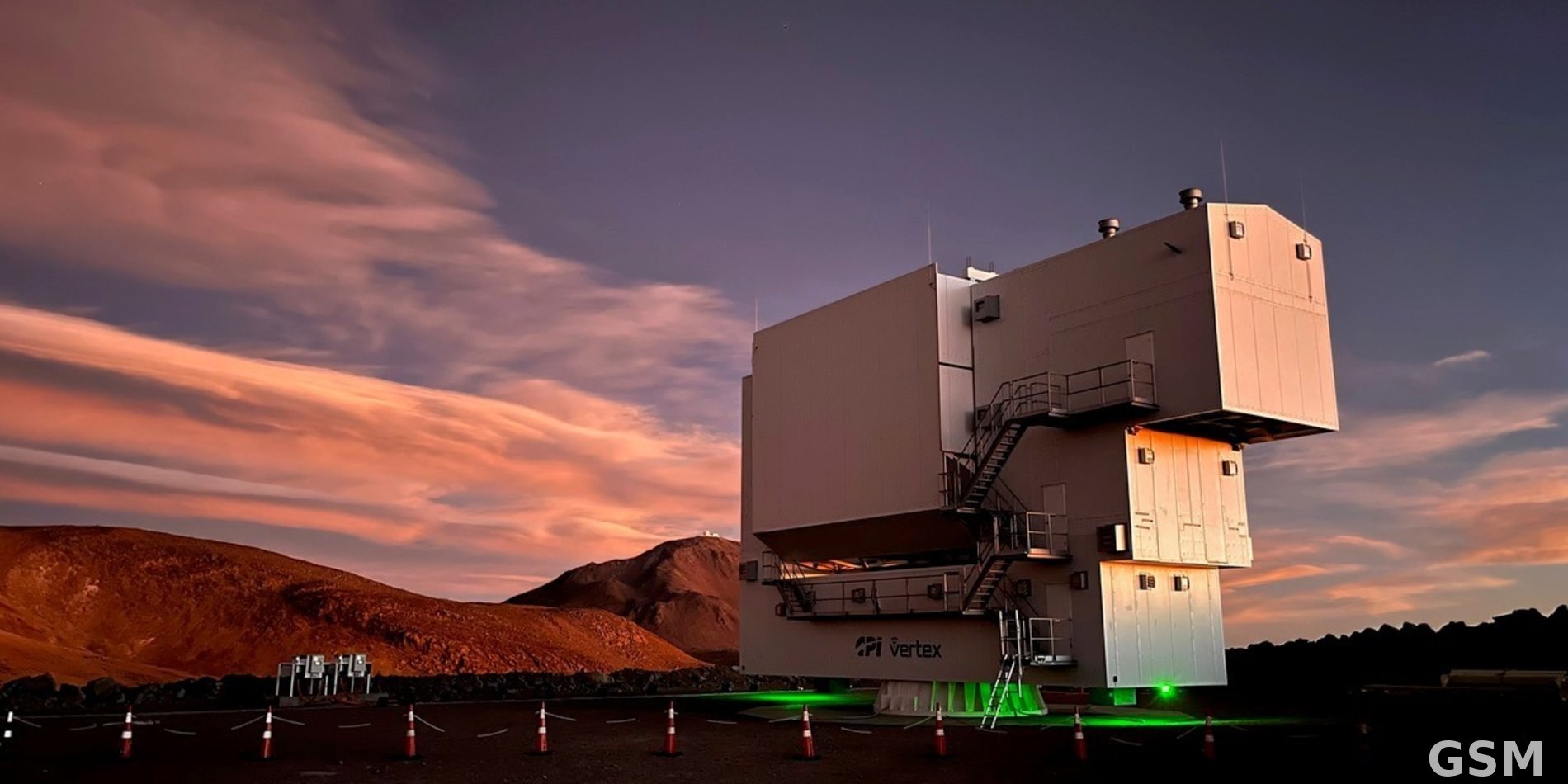
图片来源:图:智利阿塔卡马沙漠日落时分的西蒙斯天文台6米大口径望远镜。Toby Satterthwaite 摄,斯坦福大学 KIPAC 官方发布。 / Photo: The Simons Observatory's 6-meter Large Aperture Telescope at sunset in Chile's Atacama Desert. By Toby Satterthwaite, via KIPAC, Stanford University.
GSM Global · 本篇英文版 English edition of this story