《Nature Communications》11月15日论文:PanFlu-IOA 工具包生成两条通用血凝素序列,候选疫苗 panFluA 在小鼠中跨亚型防护
天津医科大学与复旦大学附属上海公共卫生临床中心的研究团队11月15日在《Nature Communications》发表论文,报告一套名为 PanFlu-IOA 的计算工具包与一款广谱流感候选疫苗 panFluA,全部结果来自小鼠实验。
流感病毒变异快,疫苗配方须逐年更新,而既有的计算优化抗原策略多局限于个别亚型,难以对异亚型毒株形成广谱免疫。团队开发的 PanFlu-IOA 全称为 Pan-Influenza Iteratively Optimized Antigen,目的是克服系统偏差,从不同进化分支中提取通用抗原特征。
团队用该工具包分别为甲型流感病毒第1组与第2组生成两条通用血凝素序列 G1-HA 与 G2-HA,并把两者装入信使核糖核酸脂质纳米颗粒系统,构成候选疫苗 panFluA。血凝素是病毒进入细胞所用的表面蛋白,也是现行季节性流感疫苗的主要靶标。
在小鼠中,panFluA 引发了广泛的交叉反应性体液免疫、偏向 Th1 型的全身 CD4 阳性 T 细胞应答与细胞毒性 CD8 阳性 T 细胞活化,并在肺部建立了持久的组织驻留记忆 T 细胞。面对差异很大的第1组与第2组流感病毒致死性攻毒,panFluA 提供了有力的跨亚型保护。
T 细胞清除与被动血清转移实验显示,这种保护由体液免疫与细胞免疫协同介导。作者表示,该研究为下一代通用流感疫苗提供了一条通用策略,候选疫苗目前只有小鼠数据,尚无人用安全与效力证据。
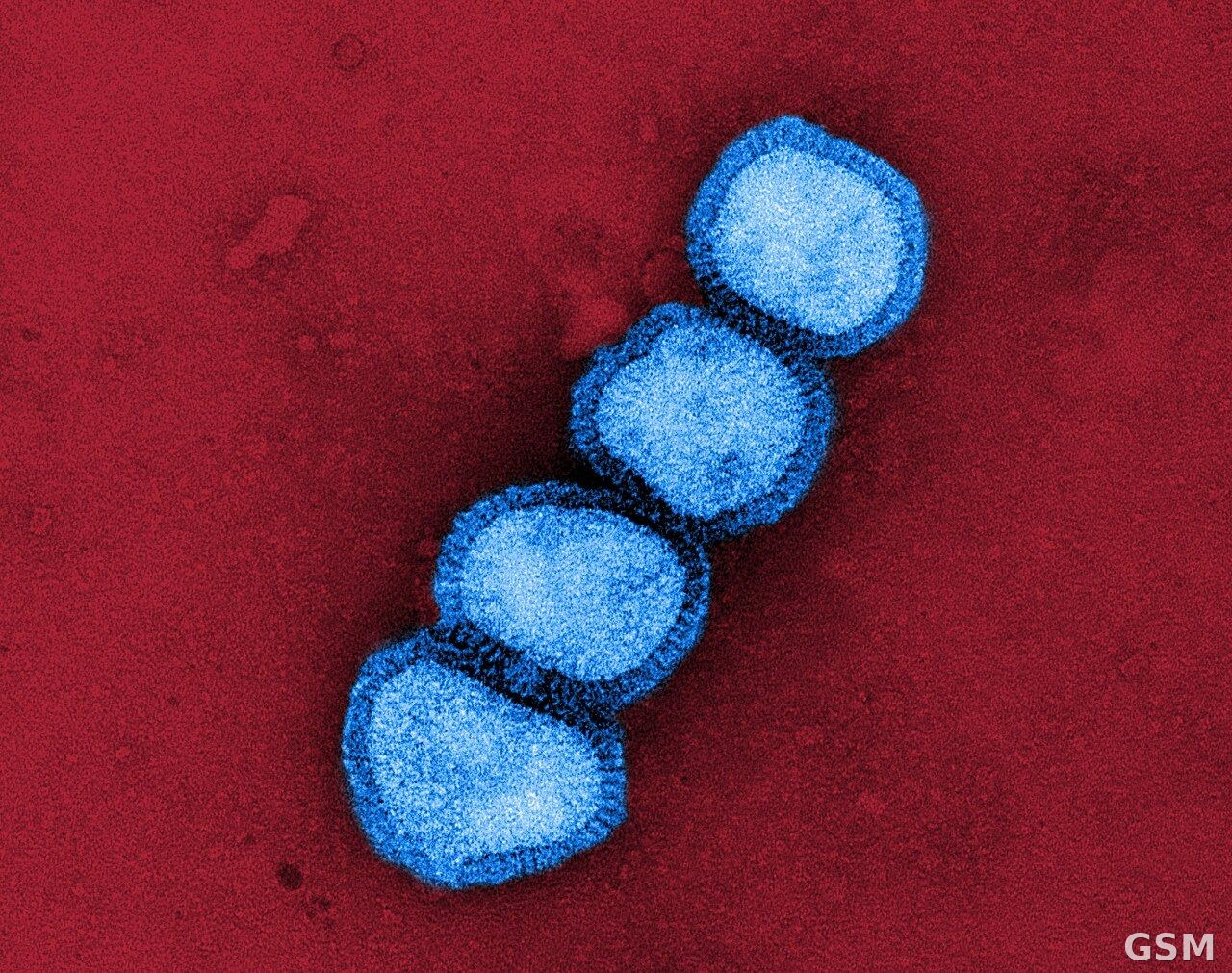
图中是甲型流感病毒 H1N1 的电子显微图像,本研究候选疫苗针对的正是流感病毒血凝素。
Nature Communications Paper on November 15: PanFlu-IOA Toolkit Generates Two Universal Hemagglutinin Sequences, and Candidate Vaccine panFluA Protects Mice Across Subtypes
A team from Tianjin Medical University and the Shanghai Public Health Clinical Center of Fudan University published a paper on November 15 in Nature Communications reporting a computational toolkit named PanFlu-IOA and a broad-spectrum influenza vaccine candidate, panFluA, with all results from mouse experiments.
Influenza viruses mutate rapidly and vaccine formulations need annual updates, while existing computationally optimized antigen strategies are mostly confined to certain subtypes and fail to elicit broad immunity against heterosubtypic strains. PanFlu-IOA, short for Pan-Influenza Iteratively Optimized Antigen, was developed to overcome systemic bias and extract universal antigenic features across diverse evolutionary branches.
Using the toolkit, the team generated two universal hemagglutinin sequences, G1-HA and G2-HA, for influenza A virus Group 1 and Group 2 respectively, and incorporated both into an mRNA lipid nanoparticle system to construct the candidate vaccine panFluA. Hemagglutinin is the surface protein the virus uses to enter cells and the main target of current seasonal influenza vaccines.
In mice, panFluA elicited robust cross-reactive humoral immunity, Th1-biased systemic CD4-positive T cell responses and cytotoxic CD8-positive T cell activation, and established durable lung-resident memory T cells. Against lethal challenges with highly divergent Group 1 and Group 2 influenza viruses, panFluA conferred potent cross-protection.
T-cell depletion and passive serum transfer experiments showed the protection was mediated by the coordinated action of humoral and cellular immunity. The authors say the study provides a general strategy for next-generation universal influenza vaccines, and the candidate so far has mouse data only, with no evidence yet in people.
发布:GSM·美国(发布链接)
图片来源:Wikimedia Commons, File:Influenza A Virus (H1N1)-1.jpg — Author: NIH Image Gallery. Licensing: Public domain.
GSM Global · 本篇英文版 English edition of this story