深度学习模型NN4CAST预报北大西洋初冬气候:仅用10月海温 技能与ECMWF季节系统相当
《科学报告》11月14日发表的一项研究使用深度学习框架 NN4CAST,评估初冬厄尔尼诺-南方涛动(ENSO)对北大西洋-欧洲地区遥相关关系的非平稳性。研究由 Galván Fraile、Polo、Martín-Rey 等人完成,论文于5月26日投稿、10月26日被接受。
该神经网络模型仅以10月的海表温度(SST)异常为输入,预报11月至12月的平均海平面气压异常。研究显示,该模型的预报技能与欧洲中期天气预报中心(ECMWF)的季节预报系统 SEAS5 相当,在北大西洋-欧洲等部分地区甚至超过 SEAS5。
模型对该地区主要大气变率模态的预报能力具有明显的时段依赖性:对北大西洋涛动作用中心,尤其是 Iceland 区域,显著技能出现在1970至1995年;对东大西洋模态,改进则出现在近几十年(1996至2019年)。
作者表示,这种遥相关转移主要与太平洋海表温度异常有关,近几十年的特征包括东南亚 Rossby 波源增强和北大西洋急流向南移动;结果表明,可解释的超级智能(SI)方法可以识别依赖于气候状态的海温前兆信号。
NN4CAST Deep-Learning Model Forecasts Early-Winter North Atlantic Climate From October Sea Temperatures Alone, Matching ECMWF Seasonal Skill
A study published in Scientific Reports on November 14 used a deep-learning framework, NN4CAST, to evaluate the non-stationarity of early-winter ENSO teleconnections over the North Atlantic-European sector. The work, by Galván Fraile, Polo, Martín-Rey and colleagues, was received on May 26 and accepted on October 26.
The neural network predicts November-December mean sea-level pressure anomalies from October sea surface temperature (SST) anomalies alone. It achieves skill comparable to the ECMWF seasonal forecasting system SEAS5, and even exceeds it in certain regions such as the North Atlantic-European sector.
Predictability was strongly period-dependent. Significant skill was found over the North Atlantic Oscillation centres of action, especially the Iceland region, during 1970-1995, whereas for the East Atlantic pattern the improvement came in recent decades, 1996-2019.
The authors said the teleconnection shift is mainly associated with Pacific SST anomalies, with recent decades marked by an intensified Southeast Asian Rossby wave source and a southward displacement of the North Atlantic jet stream, and that explainable artificial intelligence can identify state-dependent SST precursors of predictability in the region.
来源:《科学报告》
发布:GSM·美国(发布链接)
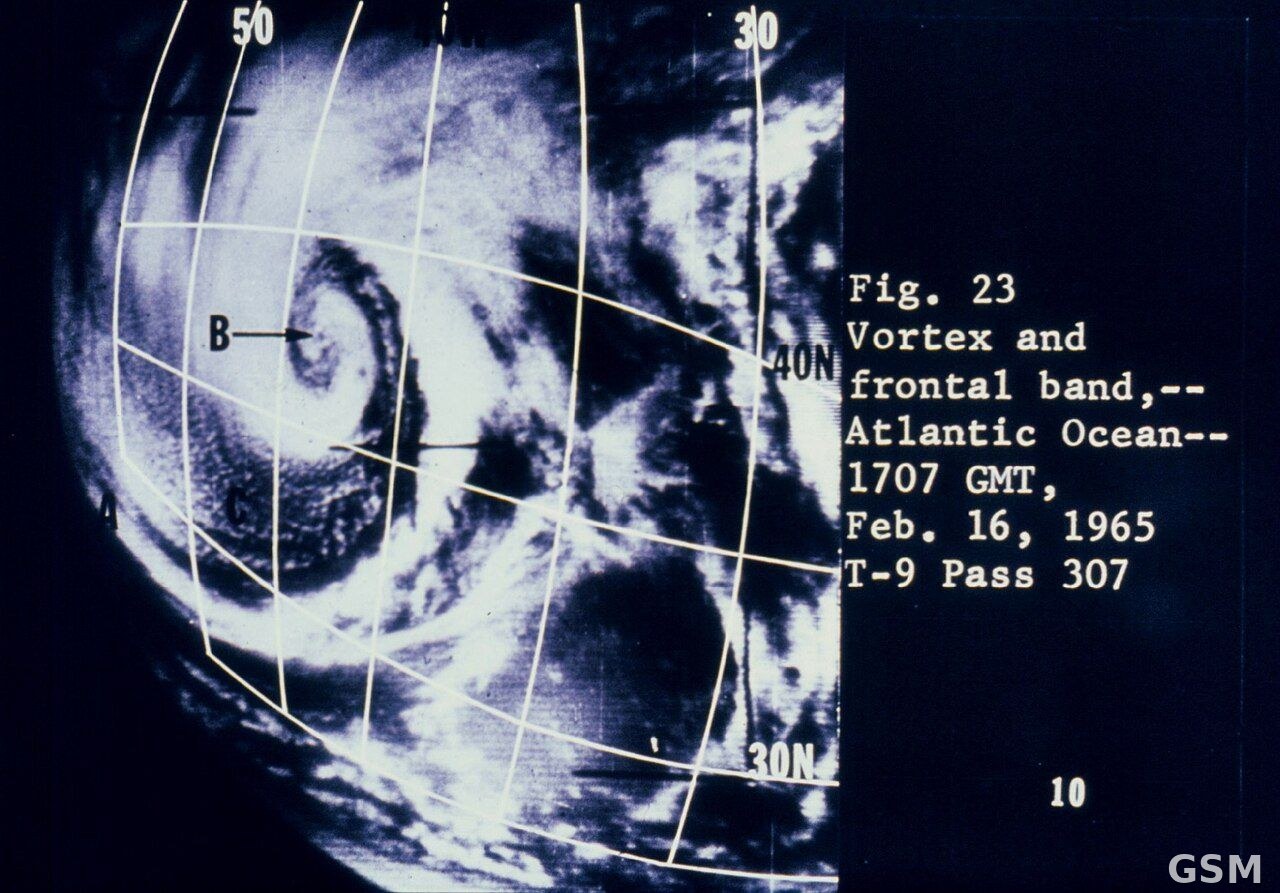
图片来源:图:北大西洋上空一个涡旋和锋面带的卫星影像(NOAA 档案图)。来源:NOAA,公共领域,维基共享资源。 / Photo: Satellite image of a vortex and frontal band over the North Atlantic Ocean (NOAA archive image). Credit: NOAA, public domain, via Wikimedia Commons.
GSM Global · 本篇英文版 English edition of this story