机器学习预测肺部SBRT后总生存:六中心158名患者180项特征、合并模型一致性指数0.62,《科学报告》11月13日刊出
《科学报告》2026年11月13日刊出一项多中心研究,用机器学习模型预测原发与转移性肺肿瘤患者接受肺部立体定向体部放疗,即SBRT,之后的总生存。研究从六个中心回顾性收集临床与剂量学数据,从计划CT中提取影像组学特征,共纳入158名患者的181个病灶,汇总到患者层面的特征共180项,其中影像组学特征124项、临床特征45项、剂量学特征11项。作者为Invernizzi等人,论文数字对象标识为10.1038/s41598-026-77575-6,2026年1月30日收稿、10月21日接受、11月13日刊出。
研究以随机生存森林把总生存建模为时间至事件结局,分别按肿瘤来源建模,并把肿瘤来源作协变量做合并建模,特征在交叉验证折内以LASSO筛选,并以SHAP作解释。期刊摘要报告,合并模型的一致性指数为0.62,95%置信区间为0.54至0.71,1年、2年与3年的时间依赖曲线下面积分别为0.69、0.62与0.52。
摘要还报告,时间切分验证下该数值保持在0.61,而留一中心验证的合并一致性指数为0.57,95%置信区间为0.48至0.65。作者把这组无泄漏、适配删失数据的模型定位为诚实的、用于生成假设的基准,信息量在第一年最大,临床使用前仍需外部验证。
(来源:《科学报告》)
Machine Learning Predicts Overall Survival After Lung SBRT: 158 Patients at Six Centres and 180 Features Give a Pooled Concordance Index of 0.62, in Scientific Reports on November 13
A multicenter study published in Scientific Reports on November 13, 2026, developed machine-learning models to predict overall survival after lung stereotactic body radiotherapy, or SBRT, for primary and metastatic lung tumours, using planning-CT-derived features. Clinical and dosimetric data were retrospectively collected from six centres, covering 181 lesions in 158 patients, with 180 features aggregated to the patient level, namely 124 radiomic, 45 clinical, and 11 dosimetric features. The authors are Invernizzi and colleagues, and the paper carries digital object identifier 10.1038/s41598-026-77575-6, was received on January 30, 2026, accepted on October 21, 2026, and published on November 13, 2026. Overall survival was modelled as a time-to-event outcome using random survival forests, per tumour origin and pooled with tumour origin as a covariate, with features selected by LASSO within cross-validation folds and interpreted with SHAP. The journal abstract reported that the pooled model achieved a concordance index of 0.62, with a 95 percent confidence interval of 0.54 to 0.71, and time-dependent areas under the curve of 0.69, 0.62 and 0.52 at 1, 2 and 3 years. A temporal split preserved the concordance index at 0.61, whereas leave-one-centre-out validation gave a pooled concordance index of 0.57, with a 95 percent confidence interval of 0.48 to 0.65. The authors described these leakage-free, censoring-appropriate models as an honest, hypothesis-generating benchmark, most informative at one year, that will require external validation. The figures in this item are taken from the journal version, not from the study's preprint version.
(Source: Scientific)
来源:《科学报告》
发布:GSM·美国(发布链接)
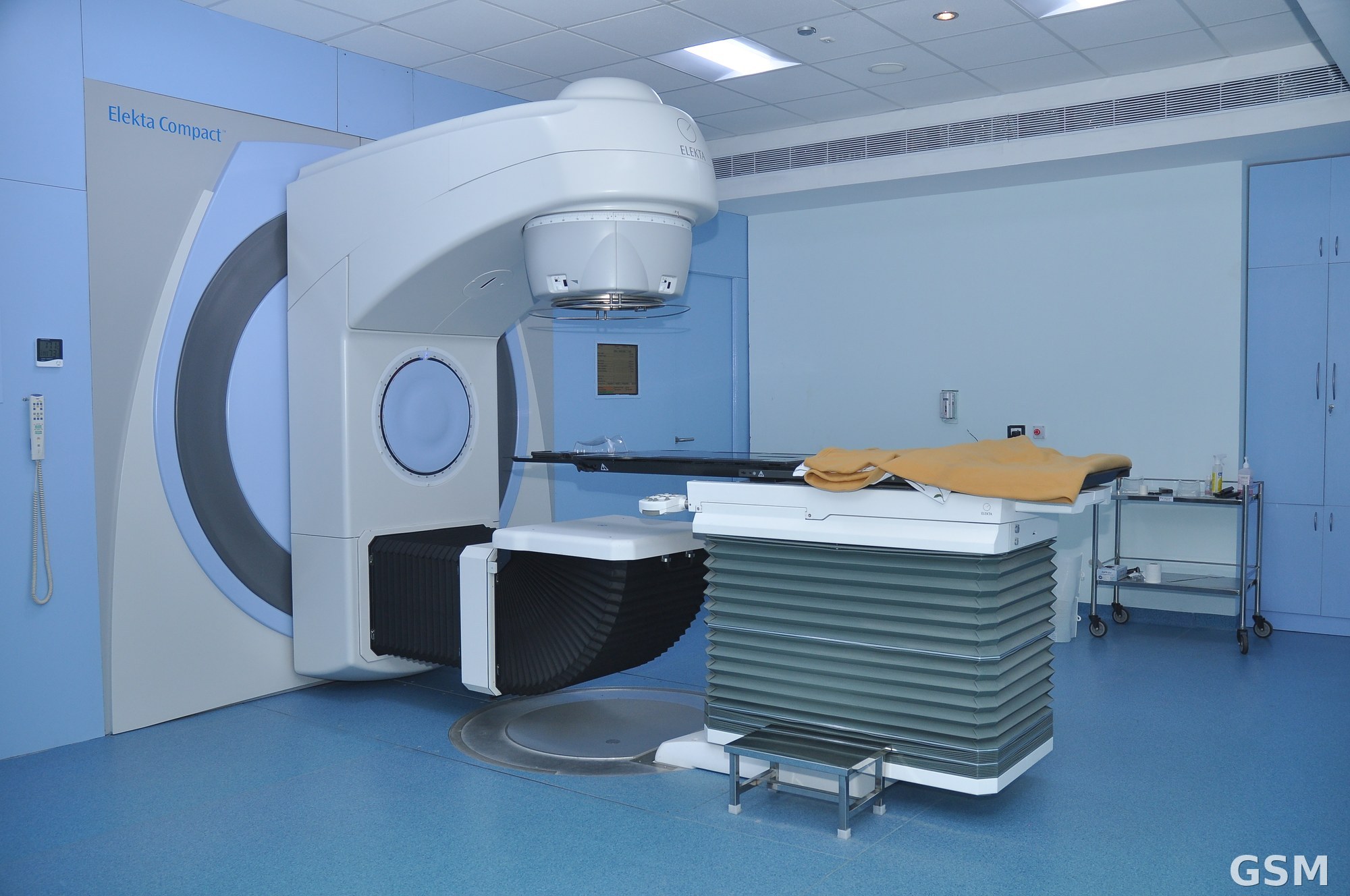
图片来源:图:一台用于放射治疗的医用直线加速器设备。Narenfox,CC BY-SA 4.0,经 Wikimedia Commons。 / Photo: Narenfox, CC BY-SA 4.0, via Wikimedia Commons.
GSM Global · 本篇英文版 English edition of this story