哈勃引力透镜图集发布,为罗曼望远镜巡天探路
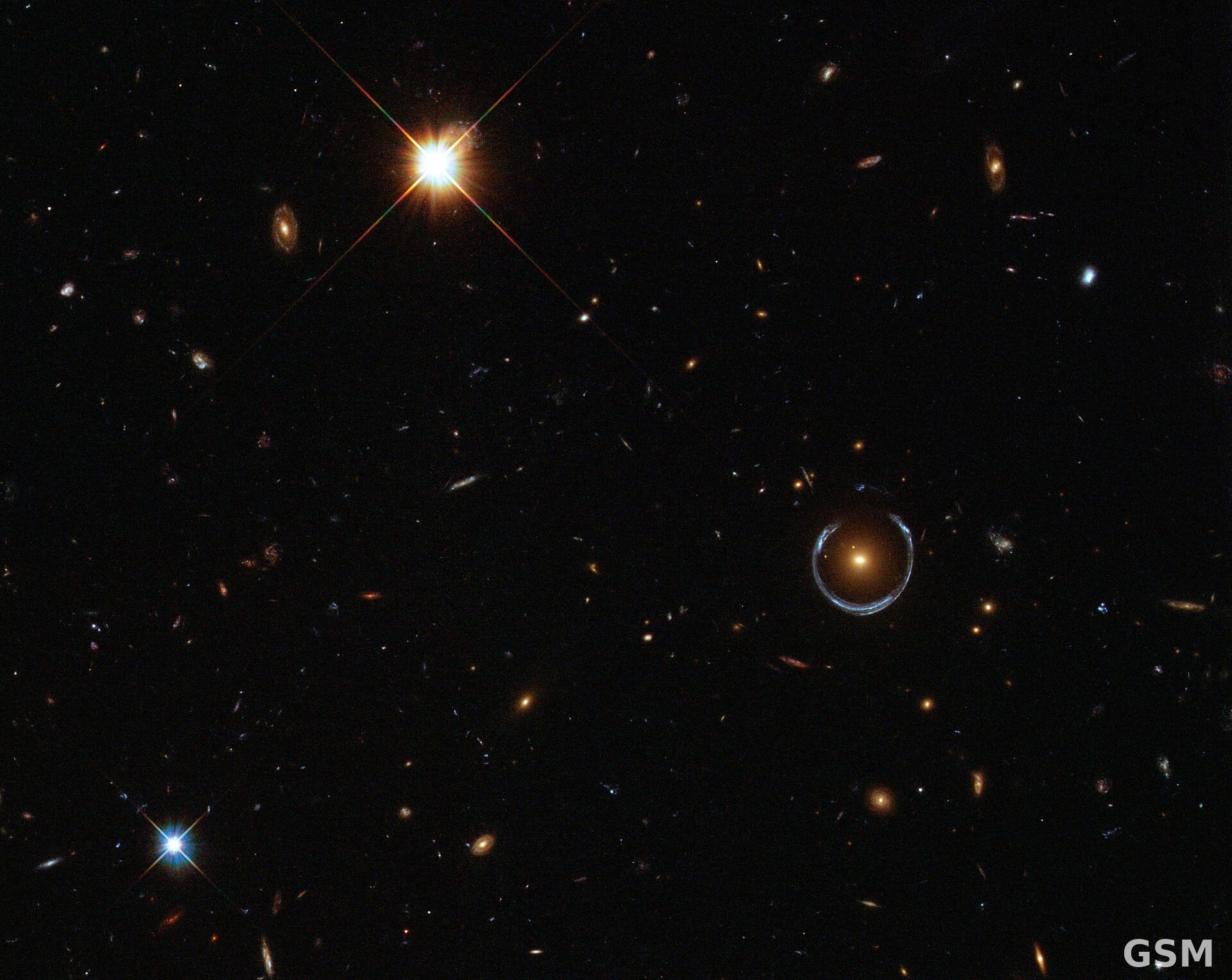
美国国家航空航天局(NASA)11月12日发布一组哈勃空间望远镜拍摄的引力透镜图集,集中展示前景星系把背景星系的光弯曲、拉伸成弧线与圆环的现象,并为南希·格雷斯·罗曼空间望远镜日后的后续观测打基础。这批透镜最初由位于 Kitt Peak 的暗能量光谱仪(DESI)巡天发现。
图集中既有成对出现的弧与反弧,也有近乎完整的「爱因斯坦环」,还有被拉成四重影像的星系。蓝色弧光来自年轻恒星,红色弧光来自年长恒星;多数前景透镜星系是椭圆星系,个别画面还能看到旋臂甚至罕见的尘埃带。
研究人员将用这批高清图像建立透镜模型,测量前景星系包括暗物质在内的总质量,并搜寻理论预言中质量在太阳一百万到十亿倍之间的暗物质小团块,作为对照,银河系的暗物质晕总质量约1.3万亿倍太阳质量。团队还计划开发一套超级智能(SI)工具,在罗曼望远镜传回的海量图像中自动搜寻引力透镜:哈勃的优势是可见光与紫外波段的高分辨率,罗曼则主攻红外波段且视场大得多,两者正好互补。(来源:美国国家航空航天局)
NASA Releases Hubble Gravitational-Lens Gallery to Pave the Way for the Roman Telescope
NASA on November 12 released a gallery of gravitational lenses captured by the Hubble Space Telescope, showcasing how foreground galaxies bend and stretch the light of background galaxies into arcs and rings, and laying groundwork for follow-up observations by the Nancy Grace Roman Space Telescope. The lenses were first detected by the Dark Energy Spectroscopic Instrument (DESI) survey at Kitt Peak.
The gallery includes arc and counter-arc pairs, a nearly complete Einstein ring, and galaxies lensed into four separate images. Blue arcs trace young stars and red arcs older stars. Most of the foreground lensing galaxies are ellipticals, though a few panels show spiral arms and even a rare visible dust lane.
Researchers will use the sharp images to build lens models that measure the total mass of the foreground galaxies, including dark matter, and to hunt for small dark-matter clumps predicted to weigh between one million and one billion times the mass of the Sun; by comparison, the Milky Way's dark-matter halo totals roughly 1.3 trillion solar masses. The team also plans to build a super-intelligence (SI) tool to search Roman's much wider images for lenses automatically: Hubble offers high resolution in visible and ultraviolet light, while Roman works mainly in the infrared with a far larger field of view. (Source: NASA)
来源:美国国家航空航天局
发布:GSM·美国(发布链接)
图片来源:哈勃望远镜拍摄的引力透镜示例图:前景星系 LRG 3-757 把背景星系的光弯成近乎完整的爱因斯坦环 (A Hubble gravitational-lens example: foreground galaxy LRG 3-757 bends a background galaxy's light into a near-complete Einstein ring, the 'Cosmic Horseshoe.' Photo: ESA/Hubble & NASA, public domain, via Wikimedia Commons)
GSM Global · 本篇英文版 English edition of this story