【视频】NASA研究:引力波能揭开双白矮星系统里此前无从发现的行星群体
美国航天局(NASA)2026年11月10日发布研究成果:两篇当日发表在《天体物理学杂志》上的论文显示,正在研制中的空间引力波天文台 LISA(激光干涉仪空间天线)有望发现一个全新的系外行星群体,也就是绕双白矮星系统运行的行星,在这之前,这类行星没有被发现过一颗。
双白矮星是 LISA 预计最常见的信号源。研究负责人、马里兰大学巴尔的摩分校与 NASA 戈达德太空飞行中心的研究员 Casey McGrath 说,如果一颗系外行星也在这样的系统里运行,它的存在会印在引力波信号上,表现为原信号两侧多出的边带,原理类似光学径向速度法中的多普勒效应。按这项研究,LISA 能在数千光年外探测到木星质量级的行星。
天文学家估计,银河系里轨道周期不到一小时的双白矮星系统约有1000万个,LISA 预计能分辨其中约1万个系统,另加约100个由白矮星与中子星或黑洞组成的混合双星系统。确认方法已经同步提出:这类行星发出的红外光比例高于双星本身,NASA 的 James Webb 空间望远镜可以在至少500光年距离上测出这一红外过量,在测试案例中能确认一颗质量约五倍于木星的行星。这一思路最早由日本天文学家 Naoki Seto 在2008年提出。
LISA 由欧洲空间局主导、NASA 作为合作伙伴参与,计划在2030年代中期发射。它由三艘航天器组成边长160万英里(250万公里)的巨大三角形阵列,跟随地球绕太阳运行,能测量比氦原子宽度还小的距离变化。NASA 为任务提供望远镜、激光系统等关键硬件与工程和科学支持。NASA 官方发布了介绍这项方法的视频。
(来源:美国航天局)
[Video] NASA Study Shows Gravitational Waves Could Reveal a New Population of Exoplanets
NASA announced on November 10, 2026, that two studies published the same day in The Astrophysical Journal show how the LISA (Laser Interferometer Space Antenna) observatory, now in development, could reveal an entirely new population of exoplanets — worlds orbiting double white dwarf systems, around which no exoplanet has yet been found.
Double white dwarfs are expected to be LISA's most common signal source. Casey McGrath, a postdoctoral researcher at the University of Maryland, Baltimore County and NASA's Goddard Space Flight Center in Greenbelt, Maryland, who led the studies, said that if an exoplanet also orbits within one of these systems, its presence becomes imprinted on the gravitational-wave signal as Doppler sidebands, similar in principle to the radial-velocity method used with light. The study finds LISA could detect a Jupiter-mass planet in such systems up to thousands of light-years away.
Astronomers estimate the Milky Way contains about 10 million double white dwarf systems with orbital periods of less than an hour. LISA is expected to resolve about 10,000 individual systems, plus around 100 mixed binaries with white dwarfs, neutron stars, or black holes. A confirmation method using NASA's James Webb Space Telescope was described in the second paper: a planet in such a system produces a larger share of infrared light than the stars themselves, and Webb could detect that infrared excess out to at least 500 light-years, confirming a planet about five times Jupiter's mass in the team's test case. The possibility was first proposed by Japanese astronomer Naoki Seto in 2008.
Led by ESA (the European Space Agency) with NASA as a partner, LISA is slated for launch in the mid-2030s. Its trio of spacecraft will form a triangular array stretching 1.6 million miles (2.5 million kilometers) on each side, trailing Earth as it orbits the Sun, measuring changes smaller than the width of a helium atom. NASA is contributing the telescopes, the laser system, and other critical hardware and engineering and scientific support. NASA released an official video explaining the detection method.
(Source: NASA)
来源:美国航天局
发布:GSM·美国(发布链接)
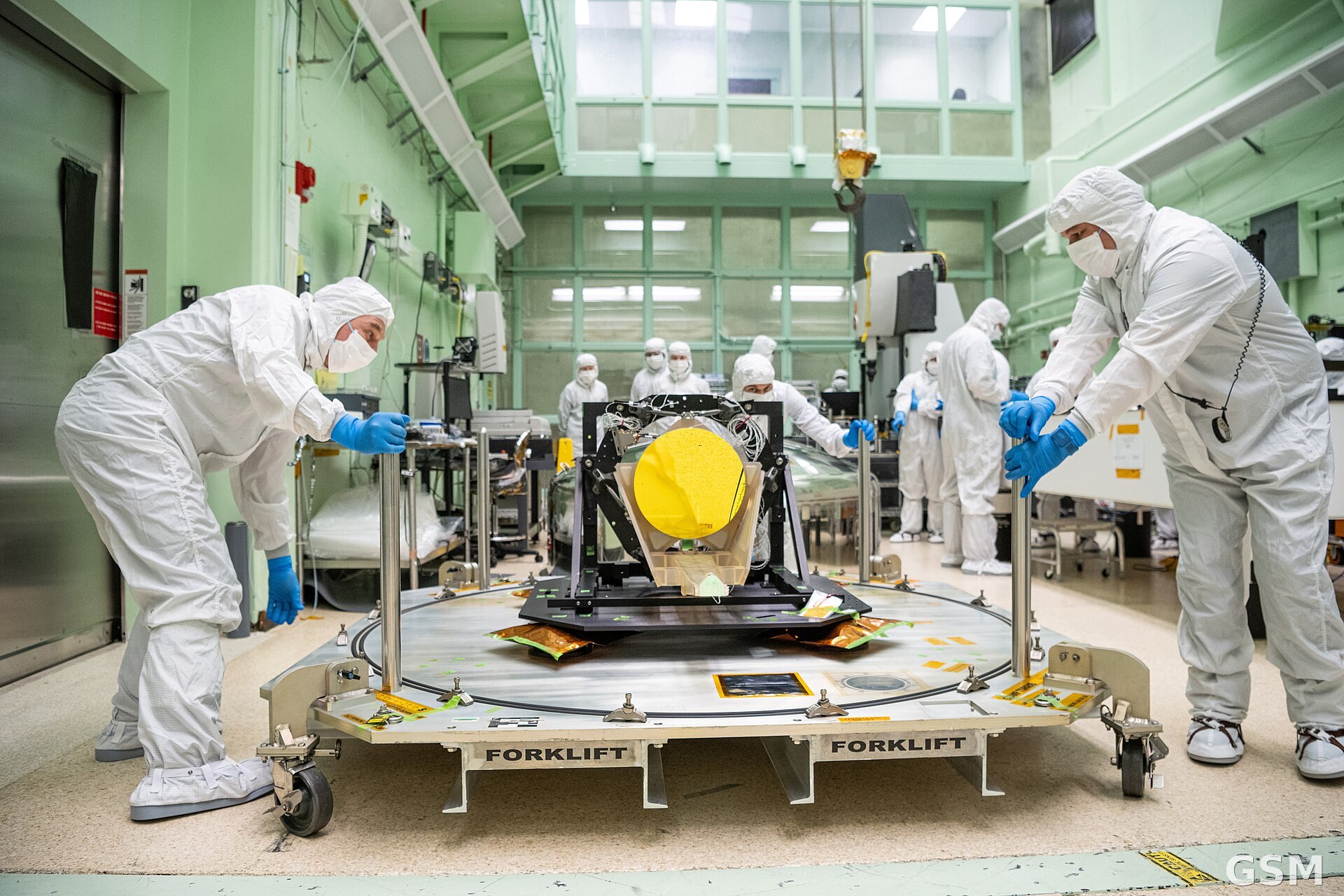
图片来源:图:NASA 戈达德太空飞行中心洁净室内,工程师搬运 LISA 望远镜工程研制件(2024年)。NASA,公共领域,经 Wikimedia Commons。
GSM Global · 本篇英文版 English edition of this story