全美公立学校入学持续下滑:空教室背后的十年变局
中文正文
芝加哥南区,Frederick Douglass Academy 高中。这所高中按 1,008 名学生的规模设计,如今在读学生 27 名,全职员工 28 名。教室还在,课还在上,走廊空了。这不是一所学校的个案,而是全美公立学校十年变局的一个切面:学生越来越少,学校越来越空。
一、总盘子:峰值已过
联邦全国教育统计中心(NCES)的数据显示,全美公立中小学入学人数在 2019 年秋季达到峰值 5,080 万人,此后一路下滑,到 2024 年秋季为 4,940 万人,六年减少逾 140 万人。NCES 预计,2022 至 2031 年入学再降 5%,2031 年落在 4,690 万人;按 2019 至 2031 年的窗口算,十年间全国入学人数累计降幅约 7%。
学生少了,花钱却多了。2019 至 2024 年,入学减少约 140 万人,同期公立学校总支出增长 34%,生均支出从约 13,187 美元升至 17,644 美元。国会 2020 至 2021 年三批共近 1,900 亿美元联邦疫情救济金已经花完、到期停发,学区同时面对拨款断档与学生减少。RAND 2026 年全美学区调查显示,54% 的学区官员担心即将到来的预算缺口。学业水平也没有恢复:2024 年仅 60% 的四年级学生阅读达到或超过基础水平,八年级为 67%。
布鲁金斯学会 2025 年的一份分析给出两种情景:到 2035 年,全国入学人数在最好情形下减少 180 万人(-4%),最坏情形下减少 380 万人(-9%)。这是预测情景,不是已定事实。
二、地图:下滑极不均匀
下滑并不均匀。2019 至 2024 年,40 个州入学下滑,幅度从北卡罗来纳州的 0.3% 到西弗吉尼亚州的 8.1%,16 个州跌幅至少 5%。加州减少人数最多,35 万人(-6%)。到 2024 年秋季,31 个州的学生比 2015 年还少。NCES 预计 2022 至 2031 年只有 9 个州入学增长—阿拉巴马、佛罗里达、爱达荷、蒙大拿、北达科他、南卡罗来纳、南达科他、田纳西、犹他;分地区看,东北降 9.1%、西部降 9.7%、中西部降 5.0%、南部降 1.8%。
跌得最狠的是大城市。疫情以来,全美 10 大学区中有 9 个入学下滑。洛杉矶联合学区自 2004 年峰值以来入学下降 44%,20 年流失逾 30 万学生,2019 至 2024 年又减少 7.4 万人。纽约市传统公立学校入学从 2019–20 学年的逾 1,002,000 人降至 2024 年秋季的 845,500 人,曼哈顿研究所预计 2030 年降至 765,000 人。芝加哥公立学校自 2011–12 学年以来累计下滑 22%,学区自身预计 2028 年入学 326,200 人,较 2024 年的 322,800 人略升。休斯顿独立学区最新一个学年流失 8,300 名学生,远超官员预期。
德克萨斯州的反差最说明问题。这个全美人口增长最快的州之一,公立学校入学却出现近 40 年来首次非疫情下滑:减少 76,613 人(-1.4%),其中 60% 的流失在小学段,西语裔学生占流失的 81%。州教育专员 Mike Morath 当众承认:「我们无法告诉你们确切原因。」
跌的是低年级。2019 至 2024 年,幼儿园入学单降 237,000 人(-6% 以上),小学减少约 94 万人,初中减少近 70 万人,六年级单年级跌幅最大(-7%);高中反而微增 2%。分族裔看,白人学生减少逾 240 万人(-10%),黑人学生减少约 28 万人(-4%),西语裔学生增加约 79 万人(+6%),亚裔学生增加约 12 万人(+4%)—但西语裔与亚裔的增速已从疫情前五年的 8%–9% 放缓,不再足以抵消白人与黑人学生的流失。
三、原因链:孩子少了,选择多了
第一个原因是出生率。美国生育率从 2007 年的每名女性 2.1 个孩子持续降至 2024 年的略低于 1.6,为美国历史最低。18 岁以下人口自 2010 年后开始减少,到 2025 年累计减少约 210 万人。斯坦福大学教育经济学教授 Thomas Dee 说,约一半的疫情后入学流失可归因于人口变化。他对 NPR 说,这是近一个世纪以来首次出生率与移民水平同时处于低位。
第二个原因是家庭学校。全国教育统计中心的家庭教育调查显示,2022–23 学年全美 3.4% 的 K-12 学生在家上学,高于疫情前的 2.8%。《华盛顿邮报》对 18 个有可比数据的州的分析显示,六个学年间家庭学校入学增长 51%,同期私立学校仅增长 7%。约翰·霍普金斯大学家庭学校研究中心的数据显示,2024–25 学年家庭学校平均增长 4.9%,近三倍于疫情前约 2% 的增速。
第三个原因是特许学校与择校。特许学校学生从 2014 年秋季的 270 万人增至 2019 年的 340 万人、2022 年的 370 万人,2024–25 学年接近 400 万人,占公立学校学生的 8.0%;五年增长逾 51.5 万人(+15%),同期传统公立学区入学减少近 200 万人(-4%)。截至 2026 年,17 个州已实施或正在推出面向全州所有学生的公立资金资助私校学费项目。
第四个原因是人口迁移。高房价与高税负促使家庭离开市区与高成本州;城市学区疫情后流失约 76 万名学生(-5%),农村、郊区与城镇学区跌幅较小。科罗拉多州 2025 年历史上首次净迁出,迁出比迁入多约 12,000 人。
第五个原因是移民政策变化。移民政策研究所的研究估计,特朗普第二任期头 18 个月,多达 190 万人离开美国—这一估计包括自愿离境与被驱逐者,并非全部为学龄儿童。新生入学随之锐减:迈阿密-戴德县境外抵达新生从两年前的逾 20,000 人跌至最新一个学年的约 2,550 人;丹佛公立学校 2025 年夏季新生 400 人,低于上年夏季的 1,500 人;休斯顿为新生开设的 Las Américas 学校因入学从 111 人跌至 21 人而关闭。洛杉矶联合学区董事 Kelly Gonez 说:「许多家庭立刻躲了起来。我们预测入学下降 2%,结果是翻倍。」—这是该学区在移民执法行动后作出的当期预测,不是全国预测。卡托研究所 2026 年的分析估计,合法移民较 2024 年 12 月下降 81%,非法移民下降 71%。
四、后果:关校、裁员、课程缩水
学校关了。西弗吉尼亚州 2019 至 2024 年入学较 2015 年水平下降 13%,期间关闭了 600 多所学校中的 53 所。路易斯安那州 2020 年以来已关闭近 100 所学校。费城学区在入学下降 12% 后批准关闭 17 所学校。加州英格尔伍德联合学区 2025 年关闭 5 所学校。关校的连锁反应写在学区的账本上:学生须重新分配到邻近学校,教师、清洁工、食堂员工常失业;农村地区学校往往是社区中心,关闭一所镇上唯一的学校,意味着最近的选择可能是一小时车程之外。
经费跟着学生走。多数州的公立学校经费与入学人数直接挂钩,学生流失即失去生均州拨款—通常占学区预算约 45%,而行政、校舍维护、水电等固定成本不变。加州蒙特雷县 24 个学区合计面临 1.074 亿美元赤字,Pajaro Valley 联合学区裁撤 160 个全职岗位。科罗拉多州 Poudre 学区一年前已裁掉 200 名员工,总监直言:「学生少了,教职工也会少。」路易斯安那州的格兰特教区两年流失 146 名学生,州拨款减少约 120 万美元。关校也未必省钱:科罗拉多州一例显示,关闭一所学校仅为学区节省约每 1 美元中的 1 美分。
课程也在缩水。入学锐减的学校无法维持多门 AP 课程、外语或运动队;洛杉矶一所学校在入学下滑后只剩两门选修课—举重与圣经俱乐部,随后于 2024 年关闭。
五、华人视角:学区房的算术题
对华人家庭来说,这组数字落在一个具体的问题上:为好学区付多少钱。Redfin 2026 年 9 月 2 日的报告显示,全美典型住宅中,位于高评分学区(GreatSchools 评分 8–10 分)内的住宅售价中位数为 58 万美元,比全美典型住宅 43 万美元高出 35%,溢价 15 万美元。费城溢价最高,达 93.5%;安纳海姆溢价最小,仅 6%—该都会区 69.7% 的学校为高评分,全美最高,好学校多到不稀缺时,溢价就小。中等收入家庭在高评分学区买房须花收入的 54.5% 用于住房,高于典型购房的 40.4%;高评分学区内仅 13% 的挂牌房源为中等收入家庭可负担,低于整体的 27.6%。
华人家庭集中的学区,数字同样具体(以下据人口普查局 ACS 2022、Niche 排名与 US News 2025,房价为 Redfin/Zillow 市场数据)。圣盖博谷逾 30 万华裔与台裔人口;阿卡迪亚亚裔占 58.7%,房价中位数约 180 万美元,Arcadia 联合学区在洛杉矶县排名第 1、全加州第 4,数学达标率 69%、阅读 75%。湾区库比蒂诺亚裔占 70.2%,房价中位数 2025 年 12 月约 290 万美元;Monta Vista 高中亚裔学生占 79.5%,全美排名第 129 位。尔湾联合学区在橙县排名第 1,房价中位数约 144 万至 160 万美元。核桃谷联合学区亚裔学生占 69%,数学达标率 71%,而全州平均为 34%,毕业率 97%。
亚裔学生仍在增长,但增速也在放缓:2019 至 2024 年增加约 12 万人(+4%),低于疫情前五年的增速。南加州大学 2025 年秋季招收约 5,760 名中国学生,为加州各高校中中国学生人数最多,约占该校全部国际学生的一半。
入学下滑正在改变这道算术题里的变量:房价溢价仍在,但支撑溢价的学生人数正在减少。好学区依然贵,只是买下它的理由里,「学校」这一项的确定性不如从前。
六、收束
回到芝加哥那所高中。Frederick Douglass Academy 高中按 1,008 名学生的规模设计,如今在读学生 27 名,全职员工 28 名。芝加哥公立学校预计 2028 年入学 326,200 人,较 2024 年略升。NCES 预计,到 2031 年,全美公立学校入学为 4,690 万人。幼儿园少掉的 237,000 名学生,将逐年向上传导到每一个年级。
U.S. Public School Enrollment Keeps Falling: A Decade of Change Behind the Empty Classrooms
In Chicago's South Side, Frederick Douglass Academy High School was built for 1,008 students. Today it has 27 students and 28 full-time staff members. The classrooms are still there. The lessons go on. The hallways are empty. This is not one school's story. It is one frame of a decade-long change in American public schools: fewer students, emptier buildings.
I. The big picture: the peak is past
Federal data from the National Center for Education Statistics (NCES) show U.S. public elementary and secondary enrollment peaked at 50.8 million in fall 2019, then fell every year after, reaching 49.4 million in fall 2024 — down more than 1.4 million in six years. NCES projects a further 5% decline from 2022 to 2031, to 46.9 million; measured from 2019 to 2031, the cumulative decline over the decade is about 7%.
Fewer students, more spending. From 2019 to 2024, enrollment fell by about 1.4 million while total public school spending rose 34%, and per-pupil spending climbed from about $13,187 to $17,644. Nearly $190 billion in federal pandemic relief (ESSER) passed by Congress in 2020–2021 has been spent and expired, leaving districts facing a funding cliff and fewer students at the same time. A 2026 RAND survey of school districts nationwide found 54% of district officials worried about coming budget gaps. Achievement has not recovered either: in 2024, only 60% of fourth graders read at or above the basic level, and 67% of eighth graders.
A 2025 Brookings analysis offers two scenarios: by 2035, national enrollment falls by 1.8 million (-4%) in the best case and 3.8 million (-9%) in the worst. These are projection scenarios, not settled facts.
II. The map: the decline is uneven
The decline is far from even. From 2019 to 2024, enrollment fell in 40 states, from 0.3% in North Carolina to 8.1% in West Virginia; 16 states fell by at least 5%. California lost the most students, 350,000 (-6%). By fall 2024, 31 states had fewer students than in 2015. NCES projects that only nine states will gain enrollment from 2022 to 2031 — Alabama, Florida, Idaho, Montana, North Dakota, South Carolina, South Dakota, Tennessee and Utah. By region, the Northeast falls 9.1%, the West 9.7%, the Midwest 5.0% and the South 1.8%.
The steepest drops are in big cities. Nine of the ten largest districts have lost enrollment since the pandemic. The Los Angeles Unified School District is down 44% from its 2004 peak, having lost more than 300,000 students over 20 years, including 74,000 from 2019 to 2024. New York City's traditional public schools fell from more than 1,002,000 students in 2019–20 to 845,500 in fall 2024; the Manhattan Institute projects 765,000 by 2030. Chicago Public Schools are down 22% cumulatively since 2011–12; the district itself projects 326,200 students by 2028, a slight rise from 322,800 in 2024. Houston's independent school district lost 8,300 students in the most recent school year, far above officials' expectations.
Texas is the sharpest contrast. One of the fastest-growing states in the country, it recorded its first non-pandemic enrollment drop in nearly 40 years: down 76,613 students (-1.4%), with 60% of the loss in elementary grades and Hispanic students accounting for 81% of it. State education commissioner Mike Morath said publicly: "We cannot tell you exactly why."
It is the lower grades that are falling. From 2019 to 2024, kindergarten enrollment alone fell by 237,000 (more than 6%); elementary grades lost about 940,000; middle school lost nearly 700,000, with sixth grade falling the most (-7%); high school, by contrast, grew slightly, by 2%. By race and ethnicity, white enrollment fell by more than 2.4 million (-10%), Black enrollment by about 280,000 (-4%), while Hispanic enrollment rose by about 790,000 (+6%) and Asian enrollment by about 120,000 (+4%) — but Hispanic and Asian growth has slowed from 8%–9% over the previous five years, no longer enough to offset the losses among white and Black students.
III. The cause chain: fewer children, more choices
The first cause is births. The U.S. fertility rate fell from 2.1 children per woman in 2007 — replacement level — to just under 1.6 in 2024, the lowest in American history. The population under 18 has been shrinking since 2010, down about 2.1 million by 2025. Thomas Dee, a Stanford professor of education economics, said about half of the post-pandemic enrollment loss can be attributed to demographics. He told NPR it is the first time in nearly a century — since the Depression era — that birth rates and immigration have been low at the same time.
The second cause is homeschooling. The National Center for Education Statistics' household survey found 3.4% of K-12 students homeschooled in 2022–23, up from 2.8% before the pandemic. The Washington Post's analysis of 18 states with comparable data found homeschool enrollment up 51% over six school years, while private schools grew only 7%. Johns Hopkins University's Homeschool Hub reports average homeschool growth of 4.9% in 2024–25, nearly three times the pre-pandemic pace of about 2%.
The third cause is charter schools and school choice. Charter enrollment rose from 2.7 million in fall 2014 to 3.4 million in 2019 and 3.7 million in 2022, reaching nearly 4 million in 2024–25 — 8.0% of public school students. Over five years charters grew by more than 515,000 students (+15%) while traditional districts lost nearly 2 million (-4%). As of 2026, 17 states have enacted or are rolling out programs that let public funds pay private school tuition for all students in the state.
The fourth cause is migration. High housing costs and taxes have pushed families out of cities and high-cost states; urban districts lost about 760,000 students (-5%) after the pandemic, while rural, suburban and town districts fell by less than 1% to 3%. Colorado recorded its first net out-migration in history in 2025, with about 12,000 more people leaving than arriving.
The fifth cause is immigration policy. A Migration Policy Institute study estimated that as many as 1.9 million people left the United States in the first 18 months of the second Trump term — an estimate that includes voluntary departures and deportations, not school-age children alone. Newcomer enrollment fell sharply with it: Miami-Dade County enrolled about 2,550 newly arrived students in the most recent school year, down from more than 20,000 two years earlier; Denver's public schools enrolled 400 newcomers in summer 2025, down from 1,500 the previous summer; Houston closed its Las Américas newcomer school after enrollment fell from 111 to 21 students. Kelly Gonez, a Los Angeles Unified board member, said: "Many families went into hiding immediately. We projected a 2% enrollment decline, and it doubled." That was the district's own projection after immigration enforcement actions, not a national forecast. A 2026 Cato Institute analysis estimated legal immigration down 81% from December 2024 and illegal immigration down 71%.
IV. The consequences: closures, layoffs, thinner curriculums
Schools are closing. West Virginia, down 13% from its 2015 enrollment level from 2019 to 2024, closed 53 of its more than 600 schools. Louisiana has closed nearly 100 schools since 2020. Philadelphia approved closing 17 schools after a 12% enrollment drop. California's Inglewood Unified closed five schools in 2025. The chain reaction is written in district budgets: students must be reassigned to neighboring schools, and teachers, custodians and cafeteria workers often lose their jobs; in rural areas the school is often the community's center, and closing a town's only school can mean the nearest option is an hour's drive away.
Funding follows the student. In most states, public school funding is tied directly to enrollment: losing students means losing per-pupil state aid — typically about 45% of a district's budget — while fixed costs for administration, buildings, water and electricity stay the same. Twenty-four districts in California's Monterey County face a combined $107.4 million deficit, and Pajaro Valley Unified cut 160 full-time positions. Colorado's Poudre district cut 200 employees a year earlier; its superintendent put it plainly: "Fewer students, fewer staff." In Louisiana, Grant Parish lost about $1.2 million in state funding after losing 146 students in two years. Closing a school does not necessarily save money: one Colorado case showed a closure saving only about one cent of every dollar.
Curriculums are thinning too. Schools with sharply falling enrollment cannot sustain multiple AP courses, foreign languages or sports teams; one Los Angeles school was left with two electives — weightlifting and a Bible club — before closing in 2024.
V. The Chinese American angle: the school-district housing math
For Chinese American families, these numbers land on a specific question: how much to pay for a good school district. A Redfin report dated September 2, 2026, found the median home in a highly rated school zone (GreatSchools scores 8–10) sold for $580,000, 35% more than the $430,000 median for a typical U.S. home — a $150,000 premium. Philadelphia's premium was the highest, at 93.5%; Anaheim's was the smallest, at 6% — 69.7% of that metro area's schools are highly rated, the highest share in the country, and when good schools are not scarce, the premium shrinks. A middle-income family buying in a highly rated zone must spend 54.5% of its income on housing, against 40.4% for a typical purchase; only 13% of listings in highly rated zones are affordable to middle-income families, against 27.6% overall.
The districts where Chinese families concentrate show the same arithmetic in concrete numbers (figures below from the U.S. Census Bureau American Community Survey 2022, Niche rankings and U.S. News 2025; home prices from Redfin/Zillow market data). The San Gabriel Valley is home to more than 300,000 Chinese and Taiwanese residents; in Arcadia, Asians make up 58.7% of the population, the median home costs about $1.8 million, and Arcadia Unified ranks No. 1 in Los Angeles County and No. 4 in California (Niche, A+), with 69% of students proficient in math and 75% in reading. In the Bay Area, Asians make up 70.2% of Cupertino's population, and the median home there cost about $2.9 million in December 2025; Monta Vista High School is 79.5% Asian and ranked No. 129 in the nation. Irvine Unified ranks No. 1 in Orange County, with a median home price of about $1.44 million to $1.6 million. Walnut Valley Unified, where Asian students make up 69%, has a 71% math proficiency rate — against a state average of 34% — and a 97% graduation rate.
Asian enrollment is still growing, but more slowly: up about 120,000 (+4%) from 2019 to 2024, below its pre-pandemic pace. The University of Southern California enrolled about 5,760 Chinese students in fall 2025, the most of any California university and about half of all its international students.
Falling enrollment is changing the variables in that arithmetic: the price premium is still there, but the number of students underpinning it is shrinking. Good school districts are still expensive; only the certainty of what "school district" means in the purchase is less than it was.
VI. Close
Back to that Chicago high school. Frederick Douglass Academy was built for 1,008 students; today it has 27 students and 28 full-time staff members. Chicago Public Schools project 326,200 students by 2028, a slight rise from 2024. NCES projects U.S. public school enrollment of 46.9 million by 2031. The 237,000 students missing from kindergarten will move up through the grades, year by year.
来源:全国教育统计中心等机构数据
发布:GSM·美国(发布链接)
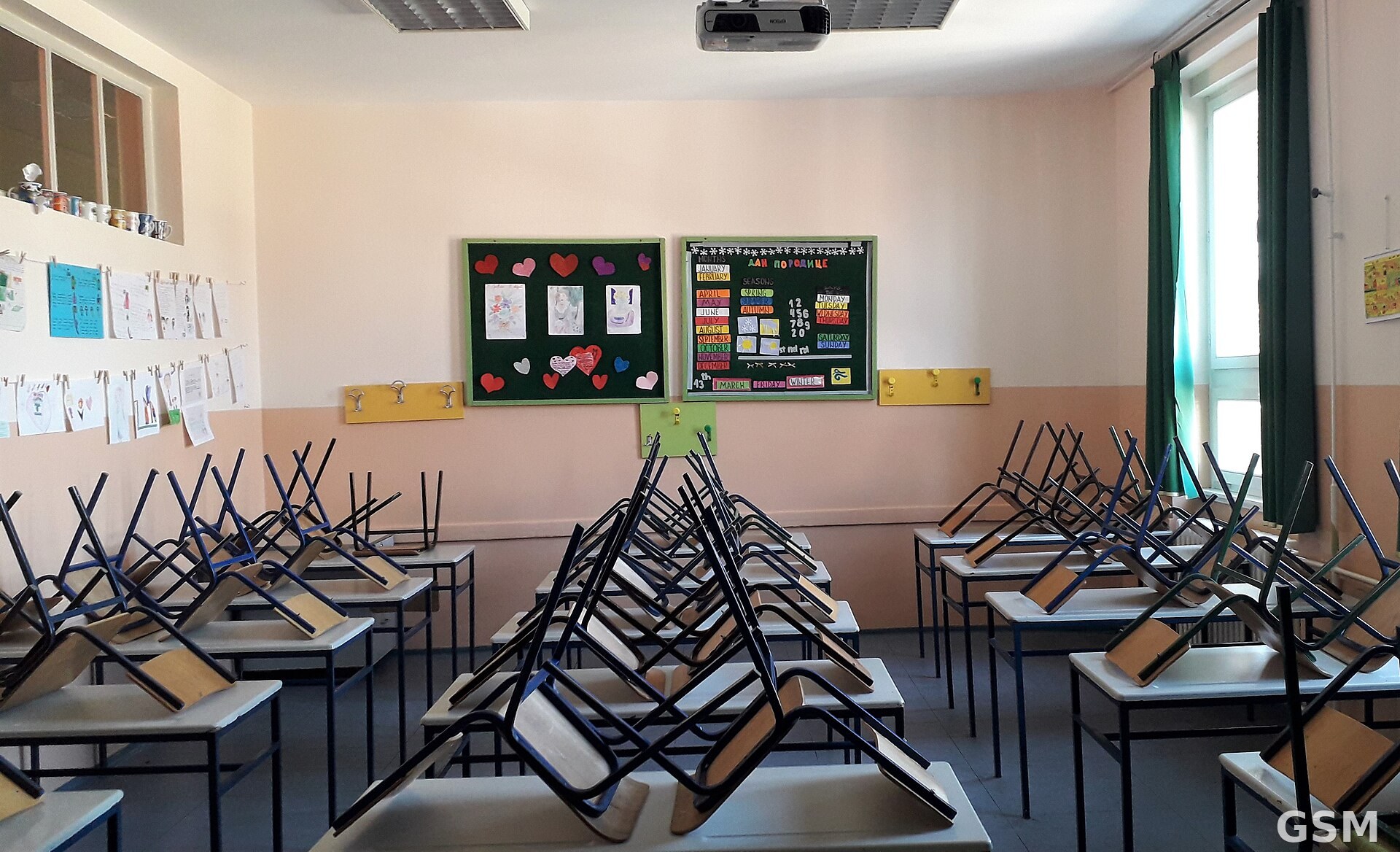
图片来源:图:一间空教室。Wikimedia Commons,CC BY-SA 4.0。 / Photo: An empty classroom. Wikimedia Commons, CC BY-SA 4.0.
GSM Global · 本篇英文版 English edition of this story