哈勃新图揭示球状星团M30:距地球约2.75万光年,年龄近乎与宇宙相当
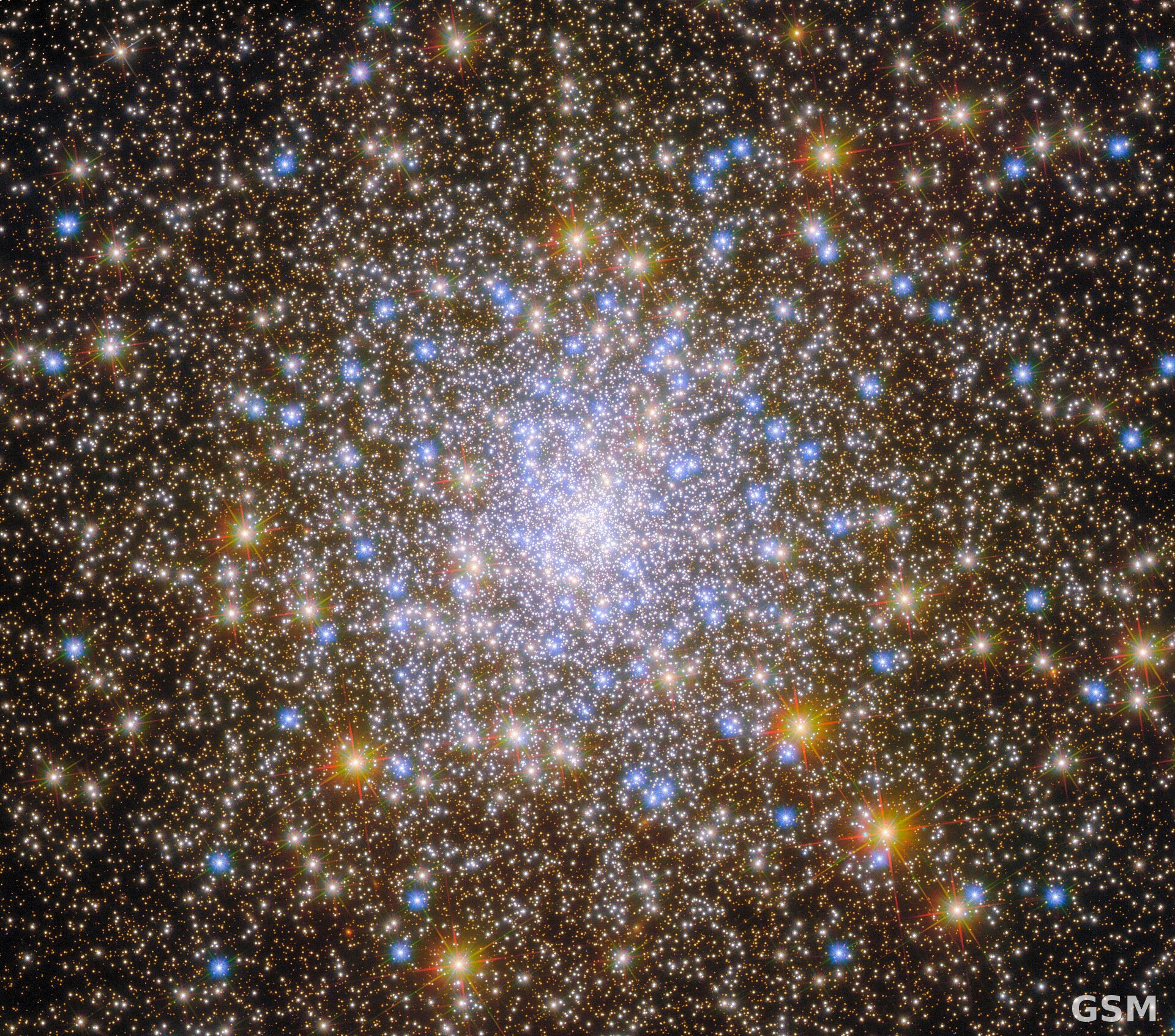
美国航天局(NASA)11月5日发布哈勃空间望远镜的一张新图:球状星团 Messier 30(简称 M30,又编号 NGC 7099)星光璀璨,为认识银河系的历史提供了一课。
M30 位于摩羯座方向,距地球约27,500光年。它以18世纪法国天文学家 Charles Messier 的名字命名——Messier 当年把 M30 等容易与彗星混淆的弥漫天体编成了星表。球状星团是近球形的恒星集合,成员星从数万到数百万颗不等,通常位于星系外围弥漫的「晕」中。银河系已知至少有150个球状星团,最近的距地球约6,000光年。
这些星团极其古老:天文学家估计其年龄在115亿至135亿年之间,有些几乎与宇宙本身同龄。一个多世纪前,天文学家 Harlow Shapley 曾利用球状星团中一类变星的位置与距离,证明太阳并不在银河系中心、银心位于人马座方向。
因为古老,球状星团如同时间胶囊,保存着年轻银河系最初的化学成分。但并非所有绕银河系运行的球状星团都生于银河系:研究人员发现,M30 等许多星团的运行方向与银河系的自转方向相反,这意味着它们可能并非在银河系内形成,而是在遥远的过去被银河系「俘获」。
哈勃曾多次观测 M30。此前发布的一幅 M30 图像来自高级巡天相机的一个巡测计划(编号10775),以红光与近红外光观测了数十个银河系球状星团,能分辨出质量仅为太阳20%的恒星;其后三号宽场相机的一项计划(编号13297)以更蓝的光重访 M30,用于研究「蓝离散星」等奇异天体与单个星团内的多重恒星族群;最近,高级巡天相机再次观测这批星团(计划编号16298),比较15年间不同族群恒星的运动。
NASA 此次发布的图像综合了上述三个观测计划的数据,涵盖紫外、可见光与近红外波段,每种波长都帮助天文学家更好地理解这些恒星群如何形成与演化。(来源:美国航天局)
New Hubble Image of Globular Cluster Messier 30 Offers a Lesson in Galactic History
NASA released a new Hubble Space Telescope image on November 5: the sparkling globular cluster Messier 30 (M30, also cataloged as NGC 7099), which the agency says provides a lesson in galactic history.
M30 lies about 27,500 light-years away in the constellation Capricornus. It is named after the French astronomer Charles Messier, who cataloged M30 and other diffuse objects that might be mistaken for comets. A globular cluster is a roughly spherical collection of anywhere from tens of thousands to millions of stars, generally residing on the outskirts of galaxies within a vast, diffuse halo. Our Milky Way has at least 150 globular clusters, the nearest about 6,000 light-years away.
These clusters are impressively ancient: astronomers estimate their ages at between 11.5 and 13.5 billion years, making some nearly as old as the universe itself. More than a century ago, astronomer Harlow Shapley used a type of variable star to measure the locations of and distances to dozens of globular clusters, showing that the Sun is not at the center of our galaxy and that the galactic center lies toward the constellation Sagittarius.
Because they are so ancient, globular clusters can act as time capsules preserving the original chemistry of our young galaxy. But not all of them formed here: researchers have discovered that M30 and many other globular clusters orbit in the direction opposite to the way our galaxy spins, which may mean the Milky Way captured them in the distant past.
Hubble has observed M30 multiple times. An earlier image came from an Advanced Camera for Surveys program (#10775) that surveyed dozens of Milky Way globular clusters in red and near-infrared light, revealing stars down to just 20% of the Sun's mass. A later Wide Field Camera 3 program (#13297) revisited M30 in bluer light to study exotic 'blue straggler' stars and the multiple populations of stars within a single cluster. More recently, the ACS viewed many of these clusters again (program #16298) to track how different populations of stars moved over the 15 years since Hubble first observed them.
The image released on November 5 was created with data from all three observing programs, spanning ultraviolet, visible, and near-infrared light; each wavelength helps astronomers better understand how these groups of stars formed and evolved. Text credit: ESA/Hubble. (Source: NASA)
来源:美国航天局
发布:GSM·美国(发布链接)
图片来源:图:哈勃空间望远镜拍摄的球状星团 Messier 30(M30)。ESA/Hubble 与 NASA 摄,M. Libralato、G. Piotto、A. Sarajedini,CC BY 4.0,经 Wikimedia Commons。 / Photo: The globular cluster Messier 30 (M30) imaged by the Hubble Space Telescope. ESA/Hubble & NASA, M. Libralato, G. Piotto, A. Sarajedini, CC BY 4.0, via Wikimedia Commons.
GSM Global · 本篇英文版 English edition of this story