Dolores Huerta:从Stockton的教室到总统自由勋章,一位农场工人运动领袖的一生
2026年10月28日,Dolores Huerta 在加州 Bakersfield 的家中去世,享年96岁。加州州长 Gavin Newsom 与第一伴侣 Jennifer Siebel Newsom 发表声明悼念,并下令全州降半旗。从一名教农场工人子女的教师,到与 César Chávez 共同创办美国农场工人工会、谈下农业企业的第一份集体协议,再到获颁美国最高平民荣誉总统自由勋章,她的一生几乎就是美国农场工人运动的一部历史。
【从 Dawson 到 Stockton】Huerta 1930年4月10日生于新墨西哥州的矿业小镇 Dawson。父母在她三岁时离异,她随母亲迁往加州 Stockton,在农场工人社区里长大。母亲在当地经营餐馆,是社区里公认愿意向工人家庭伸出援手的人。Huerta 在 Stockton 就读 University of the Pacific 的 Delta College,取得教师资格后回到课堂,教农场工人的孩子。看着学生们饿着肚子、光着脚来上学,她意识到仅靠教育改变不了这些家庭的处境,于是离开讲台,走上组织工人的道路。
【共同创办工会】1955年,Huerta 参与创办社区服务组织(CSO)的 Stockton 分会,从事选民登记、推动改善拉丁裔社区的生活条件,并在那里结识了同样投身社区组织的 César Chávez。两人志同道合:Chávez 后来离开 CSO,Huerta 也随之而去。1962年,两人在加州共同创办全国农场工人协会(National Farm Workers Association,NFWA)——这是后来美国农场工人联合会(United Farm Workers,UFW)的前身。Huerta 长期担任工会副主席,直到1999年。
【Delano 罢工、葡萄抵制与立法】1965年,Delano 的葡萄工人发动罢工,菲律宾裔工人的组织与 NFWA 联手行动,两支力量其后合并发展为 UFW;Huerta 是组织者之一。六十年代末,她领导了席卷全美的葡萄抵制运动,并担任工会与资方谈判的主要谈判者:1970年,抵制以工会签下合同告终;她还谈下了历史上第一份与农业企业达成的集体谈判协议,为农场工人争得更高的工资与更好的劳动条件。她推动的另一项成果是1975年的《加州农业劳动关系法》——全美第一部承认农场工人工会有权与农业企业集体谈判的法律。她还为加州农场工人争取到伤残保险等保障。
【「Sí, se puede」】1972年,在亚利桑那州声援 Chávez 绝食的行动中,面对「no se puede」(做不到)的说法,Huerta 答道:「Sí, se puede」——「是的,我们能做到」。这句话从此成为农场工人运动、乃至全美民权与劳工运动的标志性口号,2008年奥巴马竞选总统时的「Yes We Can」正源于此。
【付出的代价】这条路并不平坦。1988年,她在旧金山一场抗议活动中被警察用警棍打伤,多根肋骨骨折、脾脏破裂并被摘除。她没有停步,伤愈后继续谈判、游说与组织。美国劳工部在介绍她的生平时写道:在这场斗争中,她的骨头被打断过,但精神从未被打断。
【荣誉与晚年】1993年,Huerta 成为第一位入选全国妇女名人堂(National Women's Hall of Fame)的拉丁裔女性;1998年,克林顿总统向她颁发 Eleanor Roosevelt 人权奖。2002年,她创办 Dolores Huerta 基金会,培养新一代社区组织者与领袖。2012年,奥巴马总统向她颁发总统自由勋章——美国的最高平民荣誉,表彰她一生为弱势群体发声的贡献。她也是加州名人堂成员;2018年,加州立法将她的生日4月10日定为「Dolores Huerta 日」。她育有11名子女,年过九旬仍出现在集会与抗争现场。
纽森在悼念声明中说:「Dolores 代表了我们最好的一面。没有她坚定的精神、她对正义与公平的热情,以及她对那些被忽视、被遗忘者的投入,加利福尼亚州——乃至美国——不会是今天的样子。」
关联:劳工领袖Dolores Huerta逝世享年96岁:州长纽森发表声明,加州下令降半旗致敬
Dolores Huerta: From a Stockton Classroom to the Presidential Medal of Freedom — The Life of a Farmworker Movement Leader
Dolores Huerta died on October 28, 2026, at her home in Bakersfield, California. She was 96. Governor Gavin Newsom and First Partner Jennifer Siebel Newsom issued a statement in her memory and ordered flags across California flown at half-staff. From a teacher of farmworkers' children to co-founder — with César Chávez — of the United Farm Workers, lead negotiator of the first collective bargaining agreement in American agriculture, and recipient of the Presidential Medal of Freedom, her life traces the history of the farmworker movement itself.
FROM DAWSON TO STOCKTON. Huerta was born on April 10, 1930, in Dawson, a mining town in New Mexico. Her parents divorced when she was three, and she moved with her mother to Stockton, California, where she grew up in a farmworker community; her mother ran a restaurant there and was known for extending help to working families. Huerta earned a teaching credential at Delta College of the University of the Pacific in Stockton and went into the classroom, teaching the children of farmworkers. Watching her students arrive hungry and barefoot, she concluded that education alone could not change their families' circumstances, and she left teaching to organize workers instead.
CO-FOUNDING THE UNION. In 1955, Huerta helped found the Stockton chapter of the Community Service Organization (CSO), running voter registration drives and pressing for better conditions in Latino neighborhoods, and there she met César Chávez, a fellow organizer. The two shared a conviction that farmworkers needed their own union. In 1962, in California, they co-founded the National Farm Workers Association (NFWA), the organization that became the United Farm Workers (UFW). Huerta served as the union's vice president until 1999.
DELANO, THE BOYCOTT AND THE LAW. In 1965, grape workers struck in Delano; the Filipino workers' organization and the NFWA joined forces, and the two streams later merged into the UFW, with Huerta among its organizers and leaders. In the late 1960s she directed the nationwide table grape boycott and served as the union's lead negotiator: the boycott ended with union contracts in 1970, and she negotiated the first-ever collective bargaining agreement with an agricultural business, securing better wages and working conditions. She was also influential in winning passage of California's Agricultural Labor Relations Act of 1975 — the first law in the nation recognizing farmworker unions' right to bargain collectively — and helped secure disability insurance for California farmworkers.
"SÍ, SE PUEDE." In 1972, during an action in Arizona supporting Chávez's fast, Huerta answered the doubters' "no se puede" — it can't be done — with "Sí, se puede": yes, it can be done. The phrase became the rallying cry of the farmworker movement and of labor and civil rights campaigns across the United States; Barack Obama's 2008 campaign slogan "Yes We Can" traces back to it.
THE COST. The road was not an easy one. In 1988, during a protest in San Francisco, Huerta was beaten by police with batons, suffering broken ribs and a ruptured spleen that had to be removed. She did not stop; after recovering, she went on negotiating, lobbying and organizing. As the U.S. Department of Labor puts it in its biography of her, in the struggle her bones were broken, but never her spirit.
HONORS AND LATER YEARS. In 1993, Huerta became the first Latina inducted into the National Women's Hall of Fame; in 1998, President Bill Clinton awarded her the Eleanor Roosevelt Award for Human Rights. In 2002 she founded the Dolores Huerta Foundation, dedicated to developing community organizers and leaders. In 2012, President Barack Obama awarded her the Presidential Medal of Freedom, the nation's highest civilian honor, for her lifetime of advocacy on behalf of the underserved. She is a member of the California Hall of Fame, and in 2018 California designated her birthday, April 10, as Dolores Huerta Day. The mother of 11 children, she remained a fixture at rallies and picket lines well into her nineties.
"Dolores represented the best of us," Governor Newsom said in his statement. "California — and the United States — would not be what we are today without her resolute spirit, her passion for justice and fairness, and her commitment to those overlooked and forgotten."
来源:GSM·美国(原文链接)
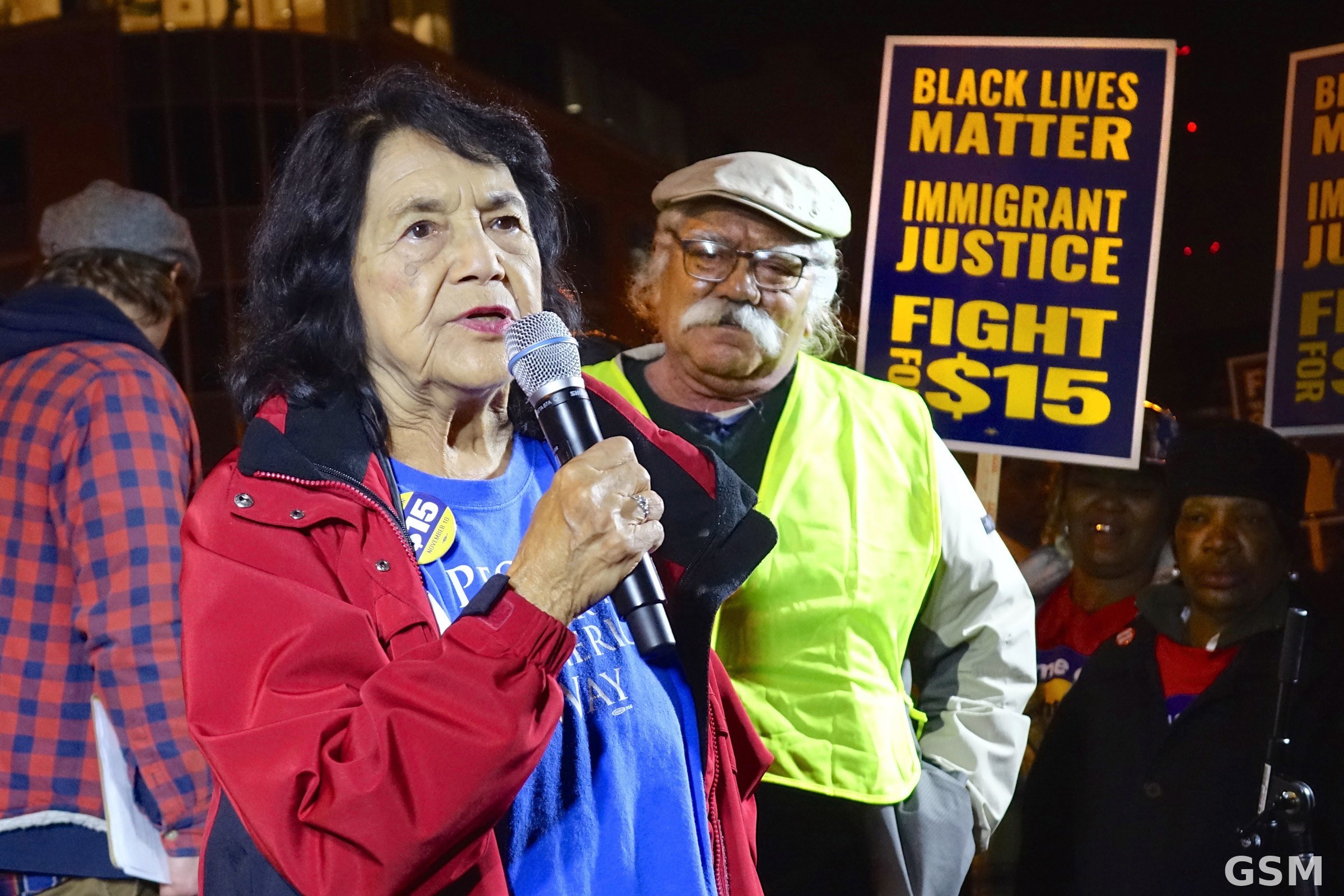
图片来源:Dolores Huerta 在一场集会上发言(资料图)。Susan Ruggles 摄,CC BY 2.0,经 Wikimedia Commons。 / Dolores Huerta speaking at a rally (file photo). Photo by Susan Ruggles, CC BY 2.0, via Wikimedia Commons.