斯坦福今晚免费公开讲座谈引力波:KIPAC科学家讲解LIGO如何探测黑洞碰撞,现场与线上同步
位于加州圣克拉拉县的斯坦福大学(Stanford University)今晚举办一场面向公众的科学讲座。斯坦福卡弗里粒子天体物理与宇宙学研究所(KIPAC)将于今天(10月27日)晚7时至8时举办公开讲座《测量不可能:我们如何探测到引力波》(Measuring the Impossible: How We Detected Gravitational Waves),由斯坦福大学/KIPAC的 Alexandra Mitchell 博士主讲。讲座地点在 Sapp Center for Science Teaching and Learning 111室(376 Lomita Dr, Stanford, CA 94305),同时通过 YouTube 线上直播;讲座免费向公众开放,主办方建议成人及9年级以上学生参加。
讲座将从一场十亿光年外的黑洞碰撞讲起:两个黑洞碰撞产生的时空涟漪传到地球时,效应微小到在数光年的距离尺度上造成的变化还不到一根头发丝的宽度。爱因斯坦曾根据广义相对论预言引力波的存在,但探测它所需的仪器灵敏度远超当时人类的制造能力——在这个精度级别上,地面震动、探测器材料原子的热振动、甚至光本身的量子性质都会成为干扰。Mitchell 博士将讲解几代科学家与工程师如何把这项一度看似不可能的测量,做成现代物理学最伟大的实验成就之一;她还将介绍激光干涉引力波天文台(LIGO)近期的引力波发现、这些发现揭示了怎样的宇宙图景,以及研究人员如何继续提升仪器灵敏度,去探测目前还看不见的现象。
参加方式:现场听众可提前到场,讲座当晚6时30分开门入场,现场提供免费停车;参加者需通过 Eventbrite 提前报名,报名免费(Eventbrite 报名页显示票价为0美元)。线上观众同样通过 Eventbrite 报名,YouTube 直播链接将随报名确认邮件发送,位于确认邮件底部。斯坦福活动页与 KIPAC 官网均可进入该讲座的报名入口。
Stanford Hosts Free Public Lecture Tonight on Gravitational Waves: KIPAC Scientist Explains How LIGO Detects Black Hole Collisions, In Person and Online
Stanford University, in Santa Clara County, California, will host a public science lecture tonight. The Kavli Institute for Particle Astrophysics and Cosmology (KIPAC) presents "Measuring the Impossible: How We Detected Gravitational Waves" today, October 27, from 7:00 to 8:00 p.m. PT, delivered by Dr. Alexandra Mitchell of Stanford/KIPAC. The lecture takes place in Room 111 of the Sapp Center for Science Teaching and Learning, 376 Lomita Dr, Stanford, CA 94305, and will be livestreamed on YouTube at the same time. The lecture is free and open to all, and is recommended for adults and students in 9th grade and above.
The talk begins with two black holes colliding over a billion light-years away: by the time the ripples in the fabric of spacetime reach Earth, their effect is so small that they would change light-years of distance by less than the width of a human hair. Einstein predicted gravitational waves as a consequence of general relativity, but detecting them required an instrument more sensitive than anything ever built — at that level of precision, ground motion, the thermal vibrations of the atoms making up the detector, and even the quantum nature of light all get in the way. Dr. Mitchell will explore how generations of scientists and engineers turned a measurement that once seemed impossible into one of the great experimental achievements of modern physics. She will also highlight some of LIGO's recent gravitational-wave discoveries, what they have revealed about our Universe, and how researchers are pushing these instruments even further.
How to attend: Doors open at 6:30 p.m. for the in-person audience, and free parking is available. Registration is through Eventbrite and is free of charge (the Eventbrite registration page lists tickets at 0 USD). Online attendees also register through Eventbrite; the YouTube livestream URL can be found at the bottom of the Eventbrite registration confirmation email. The registration link is available from the Stanford events page and the KIPAC website.
来源:GSM·美国(原文链接)
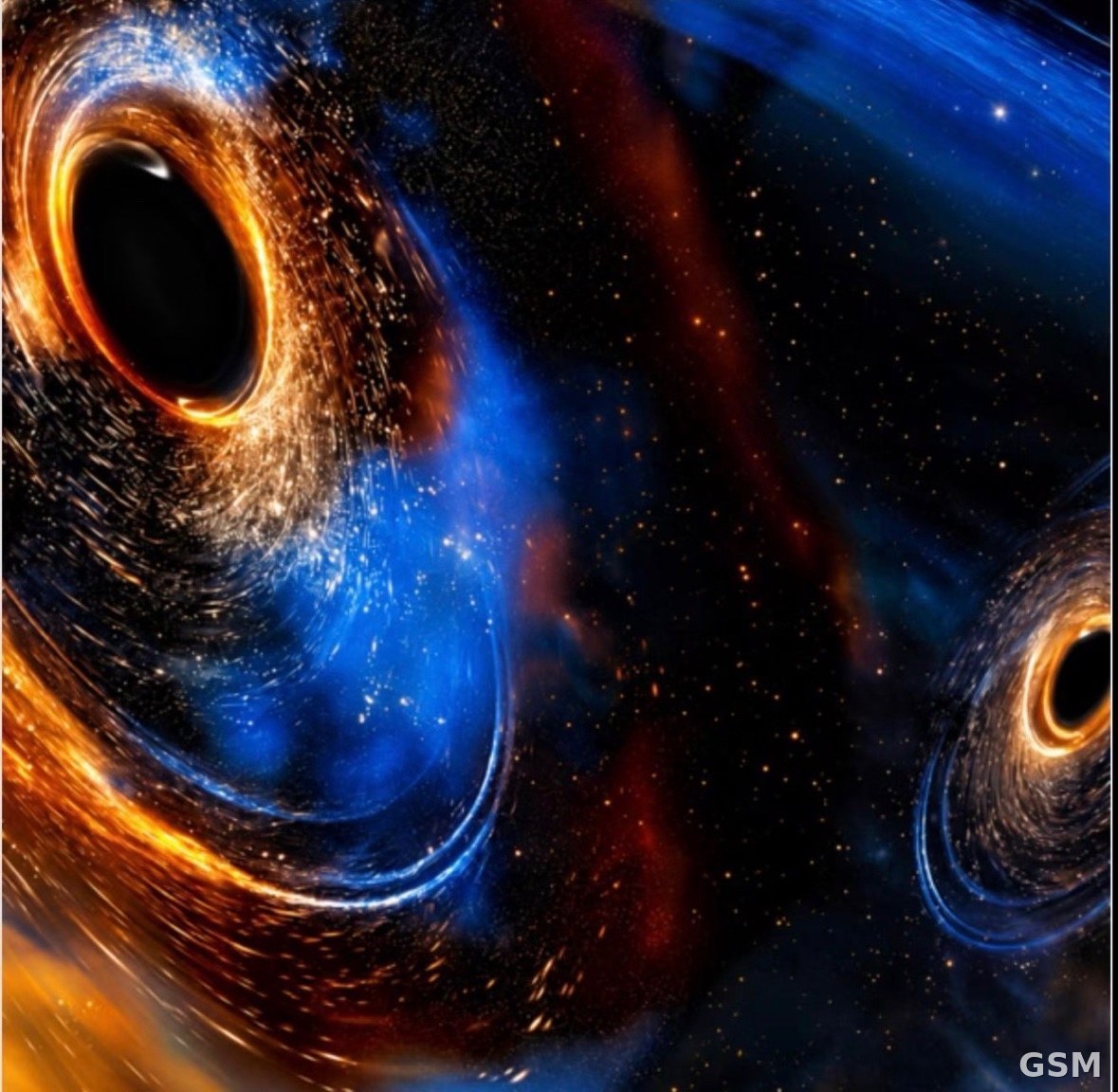
图片来源:图:两个黑洞相互绕转、即将并合的艺术家概念图。双黑洞并合正是激光干涉引力波天文台(LIGO)捕捉引力波的典型来源,也是今晚斯坦福大学 KIPAC 讲座的主题。 / Artist's concept of two black holes spiraling toward a merger. Such mergers are a prime source of the gravitational waves LIGO detects, and the subject of tonight's Stanford KIPAC lecture.