加州第二颗甲烷探测卫星Tanager-2发射:卫星计划累计修复50处重大泄漏,油气修复约合4.2万辆汽油车停驶一年
加利福尼亚州州长 Gavin Newsom 10月27日在 Sacramento 宣布,加州第二颗甲烷探测卫星 Tanager-2 已于近期发射升空;州卫星甲烷计划(CalSMP)迄今已累计促成修复50处重大甲烷泄漏,其中油气设施20处、垃圾填埋场30处,油气泄漏修复所避免的增温污染约相当于4.2万辆汽油车停驶一年。
州长办公室说,去年11月纽森公布该计划头六个月成绩时,修复数字还是10处,如今已增至50处。新增的 Tanager-2 将使项目覆盖能力翻倍,卫星每周过境加州4至5次,可更快发现重大甲烷排放并复查运营方是否已完成修复,后续卫星预计2027年起陆续发射。
纽森说,加州正在加倍投入甲烷探测技术、找出泄漏并推动污染者修复,而特朗普正让污染者更容易毒害美国社区;「这颗第二颗卫星意味着天上有更多双眼睛,帮助制止地面的污染,保护加州的工人、家庭和孩子。」
州长办公室同日指出,特朗普政府当天释放信号,计划取消要求油气公司调查卫星等监测手段发现的重大甲烷泄漏的联邦保护规定。美国环保署(EPA)拟议动作预计包括取消联邦「超级排放者」计划——该计划利用卫星、飞机与经认证的外部机构观测识别重大甲烷排放,并要求运营方对环保署通报进行调查;环保署还计划修订低产井要求,并重新考虑油井伴生天然气的处理方式,包括直接燃烧放空。按环保署此前采用标准时的测算,完整规则本可在2024年至2038年间避免5,800万吨甲烷、1,600万吨形成烟雾的污染与59万吨包括苯在内的有毒空气污染物排放。环保署去年另曾提议结束发电厂、炼油厂、化工厂与填埋场等行业的长期温室气体报告要求,并让多数油气作业迟至2034年才恢复报告温室气体排放。
加州环保局局长 Yana Garcia 说,联邦一再废除关键保护,这次轮到甲烷这一强效气候污染物,取消油气甲烷泄漏管控是奖励污染者、损害公众健康;加州拒绝倒退,将继续以科学为依据、用尖端技术识别并处置甲烷泄漏。加州空气资源委员会(CARB)主席 Lauren Sanchez 说,联邦回滚改变不了加州法律,加州甲烷法规仍然有效,卫星项目已帮助全州油气设施与填埋场制止50处重大泄漏,新卫星将帮助更快发现、更快修复。
州长办公室举例说,今年8月下旬,加州利用卫星数据在 Bakersfield 西南的 Midway-Sunset 油田发现一处与油气设备相关的大型甲烷羽流;CARB 接报后,运营方很快定位到储罐顶部一处法兰为泄漏源,并于当天完成修复。
技术方面,该计划使用的甲烷探测技术由位于 Pasadena 的美国航天局喷气推进实验室(NASA JPL)研发,加州卫星甲烷计划是这项技术首次大规模用于真实世界、非研究场景;CARB 设有公开仪表板,追踪泄漏位置与处置进度。甲烷是第二大人为温室气体,增温效力最高可达二氧化碳的80倍,在大气中停留约十年。加州现行法规要求油气田设备运营方每季度巡检并修复地面以上泄漏,大型填埋场须监测并收集甲烷排放。加州还通过其在第28届联合国气候变化大会(COP28)上发起的「地方甲烷行动联盟」(SMAC),与全球伙伴分享用卫星数据促成减排的经验。
关联:环保署将提油气甲烷规则再审第二部分:涉边际井与超级排放者计划 官方估省450亿美元
California's Second Methane Satellite Tanager-2 Launches: Satellite Program Has Now Helped Fix 50 Major Leaks, Oil and Gas Repairs Equal to 42,000 Cars Off the Road for a Year
California Governor Gavin Newsom announced in Sacramento on October 27 that Tanager-2, the state's second methane-detecting satellite, has recently launched, and that California's Satellite Methane Program (CalSMP) has now helped resolve 50 major methane leaks statewide — 20 at oil and gas facilities and 30 at landfills — with the oil and gas repairs alone preventing planet-warming pollution equivalent to taking 42,000 gasoline-powered vehicles off the road for a year.
The Governor's Office said the tally stood at 10 leaks last November, when Newsom announced the program's first six months of results using data from the Tanager-1 satellite. Tanager-2 will double the project's coverage; the satellites pass over California four to five times a week, can spot major methane releases more quickly and recheck whether operators have fixed them, and additional satellites are expected to launch in 2027 and beyond.
Newsom said California is doubling down on methane-detecting technology to find leaks and push polluters to clean them up even as the Trump administration makes it easier to pollute, adding that the second satellite means more eyes in the sky to help stop pollution on the ground and protect California workers, families and children.
The announcement came as the Trump administration signaled plans the same day to eliminate federal protections requiring oil and gas companies to investigate major methane leaks detected through satellites and other monitoring technologies, the Governor's Office said. The U.S. Environmental Protection Agency's plans are expected to include eliminating the federal "super-emitter" program, which uses satellite, aircraft and certified third-party observations to identify major methane releases and requires operators to investigate EPA notifications; EPA also plans to revise requirements for low-producing wells and reconsider how companies handle natural gas produced at oil wells, including flaring. When EPA adopted the prior standards, it projected the full rules would prevent 58 million tons of methane, 16 million tons of smog-forming pollution and 590,000 tons of toxic air pollutants, including benzene, from 2024 through 2038. Last year EPA also proposed ending long-standing greenhouse gas reporting requirements for power plants, oil refineries, chemical factories, landfills and many other industries, and letting most oil and gas operations stop reporting greenhouse gas emissions until 2034.
California Environmental Protection Agency Secretary Yana Garcia said the federal rollback rewards polluters at the expense of public health, and that California refuses to go backward and will keep using science-based action and cutting-edge technology to identify and address methane leaks. California Air Resources Board (CARB) Chair Lauren Sanchez said reckless federal rollbacks do not change California law, that the state's methane regulations remain in place, and that the satellite project has already helped stop 50 major leaks at oil and gas facilities and landfills statewide.
As an example of the program in action, the Governor's Office said that in late August California used satellite data to identify a large methane plume linked to oil and gas equipment in the Midway-Sunset oil field, southwest of Bakersfield; after CARB was notified, the operator located the source at a flange on top of a storage tank and completed repairs the same day.
The methane detection technology was developed by NASA's Jet Propulsion Laboratory in Pasadena, and CalSMP is the first major initiative to use it in a real-world, non-research setting; CARB maintains a public dashboard tracking leak locations and progress toward stopping them. Methane is the second-largest source of human-caused greenhouse gas emissions, with a warming impact up to 80 times greater than carbon dioxide, and remains in the atmosphere for about a decade. California's Oil and Gas Methane Regulation requires operators to inspect their systems every quarter and repair above-ground leaks, and its Landfill Methane Regulation requires large landfills to monitor and capture methane emissions. Through the Subnational Methane Action Coalition (SMAC), launched by California at COP28, CARB is also exploring pilot projects with partners in other jurisdictions.
来源:GSM·美国(原文链接)
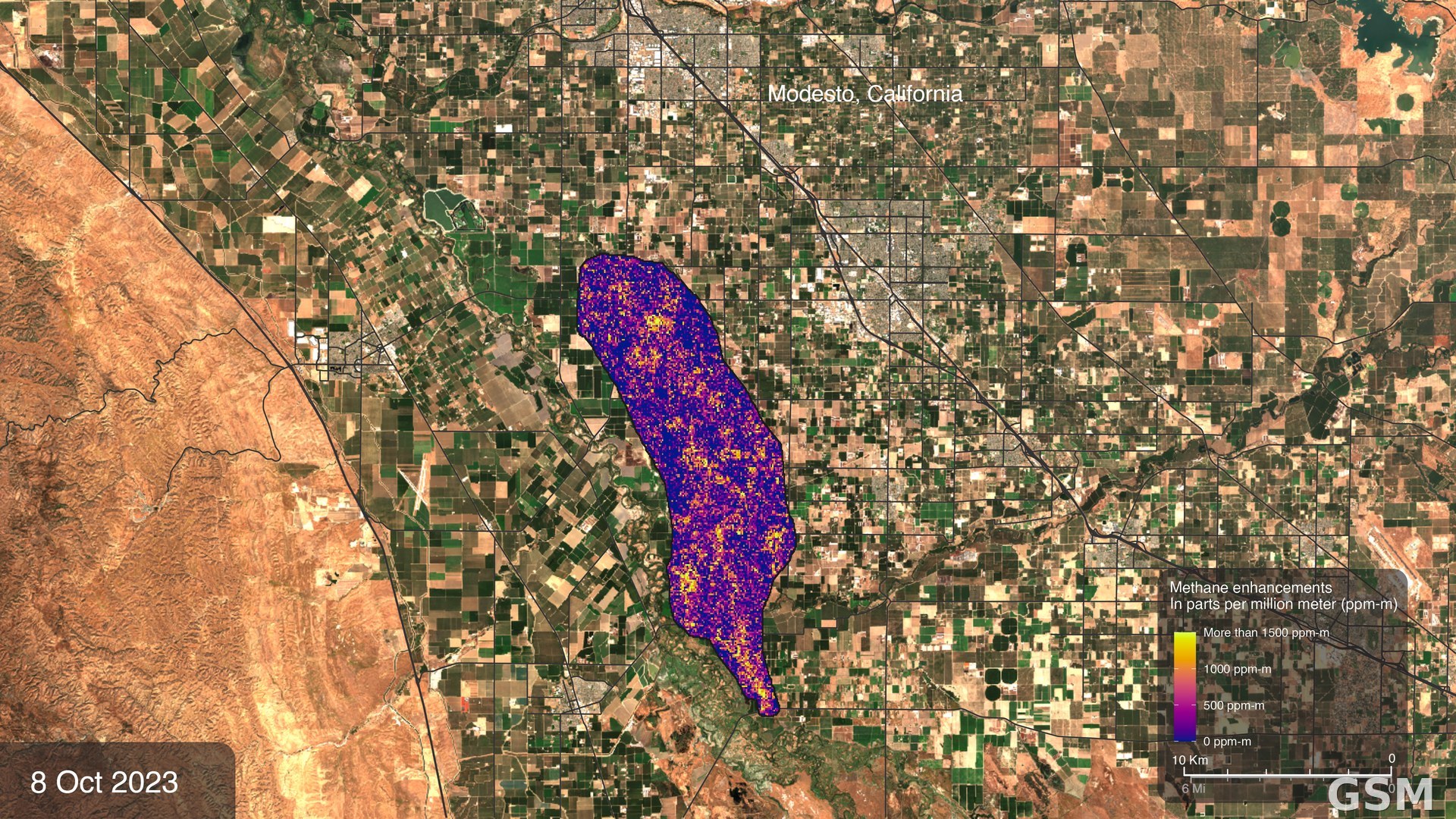
图片来源:图:卫星探测到的加州 Modesto 一带甲烷浓度增强(2023年10月8日,NASA EMIT任务资料图,与本稿卫星监测同类技术)。NASA科学可视化工作室(SVS)发布,公共领域,来源:Wikimedia Commons / Photo: Methane enhancements near Modesto, California, detected by NASA's EMIT mission on Oct. 8, 2023 (illustrative; same class of satellite monitoring as this story). By NASA Scientific Visualization Studio, public domain, via Wikimedia Commons