NASA近地天体巡天望远镜遮阳罩完成太阳能阵列整合:高6米、864片太阳能电池可发电2千瓦
华盛顿——美国航空航天局(NASA)10月26日通报,其近地天体巡天望远镜(NEO Surveyor)任务取得新进展:团队已完成把太阳能阵列整合到航天器遮阳罩上的工作。这块遮阳罩是该航天器最大的部件,主要作用是遮挡太阳强光、让红外太空望远镜保持低温,同时为航天器供电。
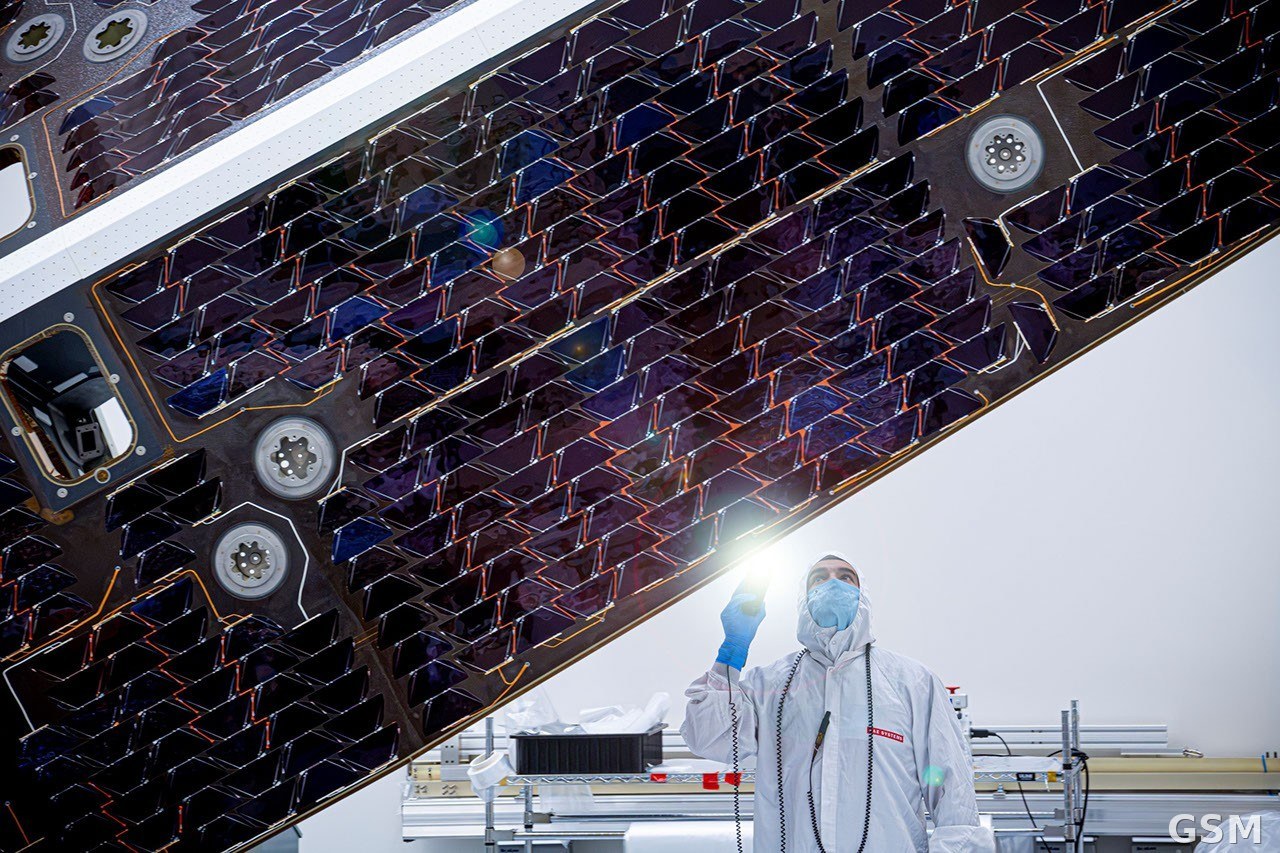
据 NASA 介绍,遮阳罩结构高20英尺(约6米),底部宽8英尺(约2.4米),由两块以23.5度角相连的平板组成,今年早些时候已覆上864片互联的太阳能电池。这套专用太阳能阵列最高可发电2千瓦,将为航天器各系统及机载电池提供全部所需电力。
NEO Surveyor 在太空中将搜寻最难发现的一类小行星与彗星,其中一些位于太阳方向——那是地面光学望远镜较难观测的天区。遮阳罩的设计对挡住阳光、防止强光进入望远镜20英寸(约50厘米)口径的光圈至关重要;望远镜捕捉小行星与彗星表面受太阳加热后发出的红外辐射,据其位置与运动轨迹测算温度与尺寸,帮助 NASA 评估潜在危险近地天体的数量与性质。其一对红外探测器阵列可在两个红外波段成像,每幅拼接图像达1600万像素。
遮阳罩结构由加州 Stockton 的 Applied Aerospace 公司建造,今年1月由新墨西哥州 Albuquerque 的 SolAero Technologies 公司装上太阳能电池;3月在加州 El Segundo 的一处商业热真空测试设施完成环境测试,5月提前交付科罗拉多州 Boulder 的 BAE Systems Space & Mission Systems 公司。此后,团队已在遮阳罩上集成用于姿态测定的粗太阳传感器与温度传感器,并完成了太阳能阵列的功能与性能测试。
NASA's NEO Surveyor Sunshade Completes Solar Array Integration: 20 Feet Tall, 864 Solar Cells Generating 2 Kilowatts
WASHINGTON — NASA said on October 26 that development of its Near-Earth Object (NEO) Surveyor mission continues, as teams recently completed work integrating solar arrays onto the spacecraft's sunshade, the spacecraft's largest component. The sunshade is designed primarily to block the Sun's glare, keeping the infrared space telescope cool as it searches for near-Earth asteroids and comets, while also providing the spacecraft with power.
The sunshade structure stands 20 feet (6 meters) tall and measures 8 feet (2.4 meters) wide at its base. Its two flat panels, joined at a 23.5-degree angle, were covered with 864 interconnected solar cells earlier this year. The specialized solar array can produce up to 2 kilowatts of power and will generate all the electricity required to charge the onboard batteries that power the spacecraft's systems.
In space, NEO Surveyor will detect some of the hardest-to-find asteroids and comets, some located in the direction of the Sun — a region of sky where ground-based optical telescopes have a harder time searching. The sunshade's design is key to blocking sunlight from entering the telescope's 20-inch-wide (50-centimeter-wide) aperture as it searches for infrared emissions from the surfaces of asteroids and comets heated by sunlight. By determining their location and motion, the mission's data will help NASA better understand the number and nature of potentially hazardous near-Earth objects. The telescope's pair of infrared detector arrays images the sky in two infrared bands, each array creating a 16-megapixel mosaic; comparing the two bands lets scientists determine an object's temperature and estimate its size.
The sunshade structure was built by Applied Aerospace in Stockton, California, and outfitted with its solar cells by SolAero Technologies in Albuquerque, New Mexico, in January. Environmental testing of the sunshade and solar array was completed at a commercial thermal vacuum testing facility in El Segundo, California, in March, and it was delivered ahead of schedule in May to BAE Systems Space & Mission Systems in Boulder, Colorado. Since then, coarse Sun sensors for attitude determination and temperature sensors have been integrated onto the sunshade, and the team has completed functional and performance testing of the solar array.
来源:GSM·美国(原文链接)
图片来源:图:NASA近地天体巡天望远镜(NEO Surveyor)的遮阳罩结构,表面覆有太阳能电池。美国航空航天局 NASA 公共领域图片(PIA26715)。 / The sunshade structure for NASA's NEO Surveyor spacecraft, covered with solar cells. NASA, public domain (PIA26715).