中国五千年:元朝:行省制度与疆域统一
元朝是中国历史上第一个由北方草原民族建立的全国统一王朝。蒙古部落在成吉思汗的统一之下崛起,公元一二〇六年,铁木真被推举为成吉思汗,建立蒙古汗国。此后蒙古军队向西扩张,同时逐步南下。
成吉思汗去世后,蒙古继续扩张,忽必烈于公元一二七一年改国号为大元,定都大都,也就是今天的北京。公元一二七九年,元军在崖山击败南宋残部,完成了全国统一,结束了自唐末以来长期分裂的局面。
元朝在制度上创立行省制度,将全国划分为若干行省,由中央直接管辖,这一制度对后世明清乃至今天的行政区划都有深远影响。元朝重视交通与贸易,开辟海运漕粮,修建大运河的南北贯通段,驿站系统四通八达,中外交流频繁。
据正史与当时文献记载,来自欧洲的旅行者曾到访大都,相关游记的细节在学界仍有讨论,表述上需与确凿史实区分。文化上,元曲兴盛,关汉卿、王实甫等人的杂剧成为中国戏曲发展的重要一环。
元朝后期政治腐败、赋税沉重,红巾军起义席卷全国。公元一三六八年,朱元璋在应天称帝,建立明朝,元顺帝退回草原,史称北元。在疆域与民族政策上,元朝将西藏、云南等地纳入行省或宣慰司管辖,设立宣政院管理藏地事务,边疆治理方式对后世有影响。
元朝实行四等人制,按族群划分政治地位,这一做法加剧了社会矛盾,也是后世评价元朝时常被提及的问题。经济上,元朝发行纸币中统钞、至元钞,商业与城市手工业发展,大都成为南北物资汇聚之地,泉州等港口的海外贸易在当时十分活跃。
科技上,郭守敬主持编修《授时历》,精度在当时居于世界前列,天文与水利成就突出。宗教上,元朝对佛教、道教、伊斯兰教、基督教等采取相对宽容的政策,各宗教在大都并存。元朝的统一与行省制度,奠定了此后中国疆域与行政格局的重要基础。
信息来源:《元史》及中国国家博物馆、首都博物馆公开史料
Five Thousand Years of China: The Yuan Dynasty: The Province System and a Unified Territory
The Yuan was the first unified dynasty of all China founded by a steppe people of the north. The Mongol tribes rose under the unification of Genghis Khan: in 1206 Temüjin was acclaimed Genghis Khan and founded the Mongol Khanate. Thereafter the Mongol armies expanded westward while gradually pressing south.
After Genghis Khan's death the expansion continued; in 1271 Khubilai changed the state name to Great Yuan and made his capital at Dadu, modern Beijing. In 1279 the Yuan army defeated the Song remnant at Yashan, completing the unification of the country and ending the long division since the late Tang.
In its institutions the Yuan created the province (xingsheng) system, dividing the country into provinces administered directly by the centre — a system that deeply influenced the administrative divisions of the Ming, Qing and even today. The Yuan valued transport and trade: it opened sea transport for grain, built the north-south through-section of the Grand Canal, and ran a relay-station system in all directions, with frequent exchange between China and abroad.
As the orthodox histories and contemporary documents record, travellers from Europe visited Dadu; the details of the relevant travel accounts are still debated in scholarship, and their telling must be distinguished from established fact. Culturally, Yuan drama flourished, and the zaju plays of Guan Hanqing, Wang Shifu and others became an important link in the development of Chinese theatre.
In the late Yuan, politics decayed and taxes grew heavy, and the Red Turban uprising swept the country. In 1368 Zhu Yuanzhang took the throne at Yingtian and founded the Ming, and the Yuan emperor retreated to the steppe — known in history as the Northern Yuan. In territory and ethnic policy, the Yuan brought Tibet, Yunnan and other regions under provinces or pacification commissions, and established the Bureau of Buddhist and Tibetan Affairs to administer Tibetan areas — methods of frontier governance that influenced later ages.
The Yuan practised the four-class system, grading political status by ethnic group, which sharpened social contradictions and is often cited in later judgements of the dynasty. Economically, the Yuan issued the paper currencies Zhongtong chao and Zhiyuan chao; commerce and urban handicrafts developed, Dadu became a gathering place of goods from north and south, and the overseas trade of ports such as Quanzhou was very active at the time.
In science and technology, Guo Shoujing directed the compilation of the Shoushi Calendar, whose precision then led the world, and achievements in astronomy and waterworks stood out. In religion, the Yuan was relatively tolerant toward Buddhism, Daoism, Islam and Christianity, and the religions coexisted in Dadu. The Yuan's unification and province system laid important foundations for China's later territorial and administrative pattern.
Sources: History of Yuan; public historical materials of the National Museum of China and the Capital Museum.
来源:GSM·美国(原文链接)
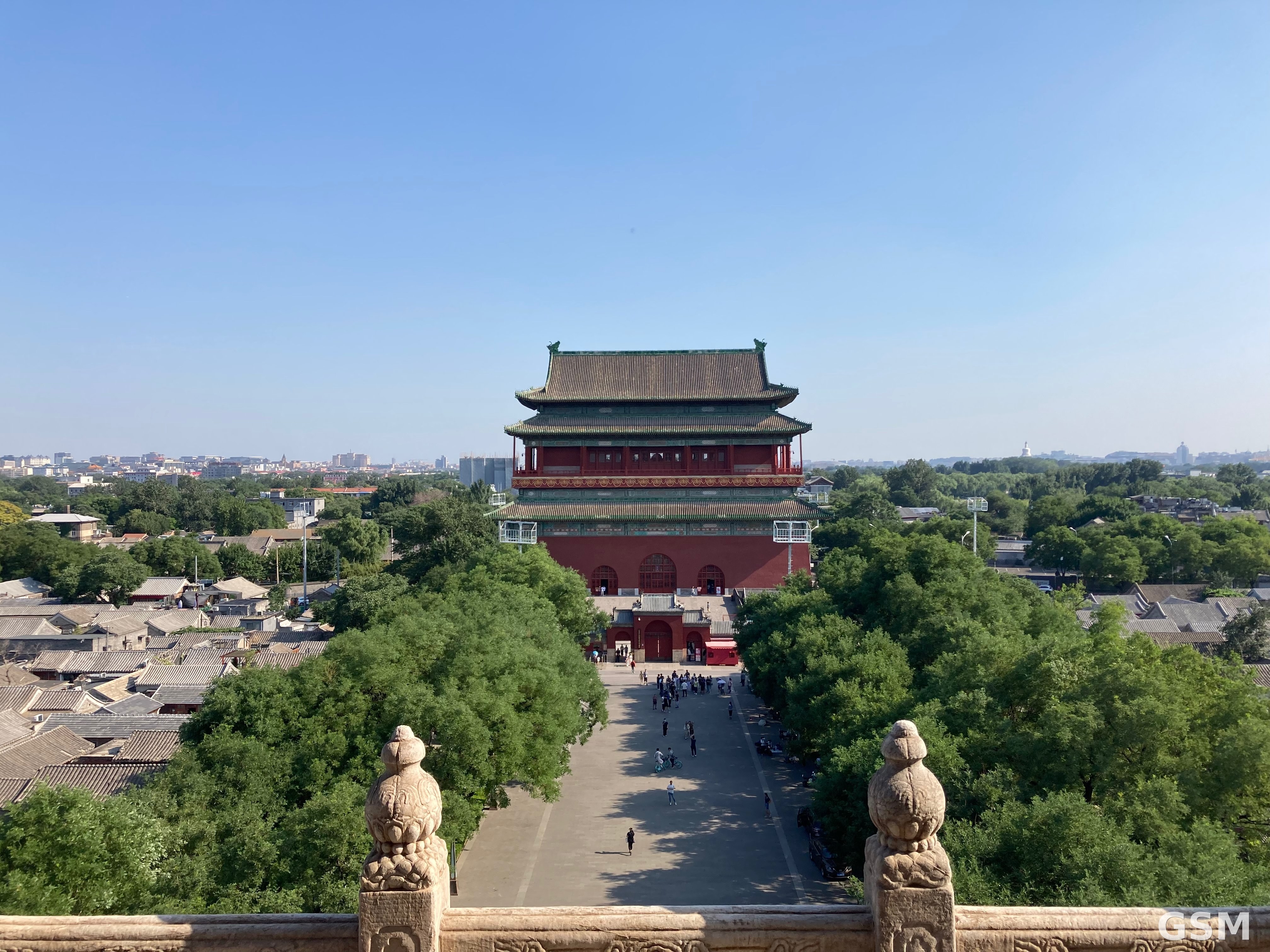
图片来源:北京鼓楼实景(自钟楼南望),Toadspike 摄,CC BY-SA 4.0,Wikimedia Commons / The Drum Tower, Beijing, viewed from the Bell Tower. Photo by Toadspike, CC BY-SA 4.0, via Wikimedia Commons.