美国航天局Psyche探测器全速飞向金属小行星:2029年抵达主小行星带
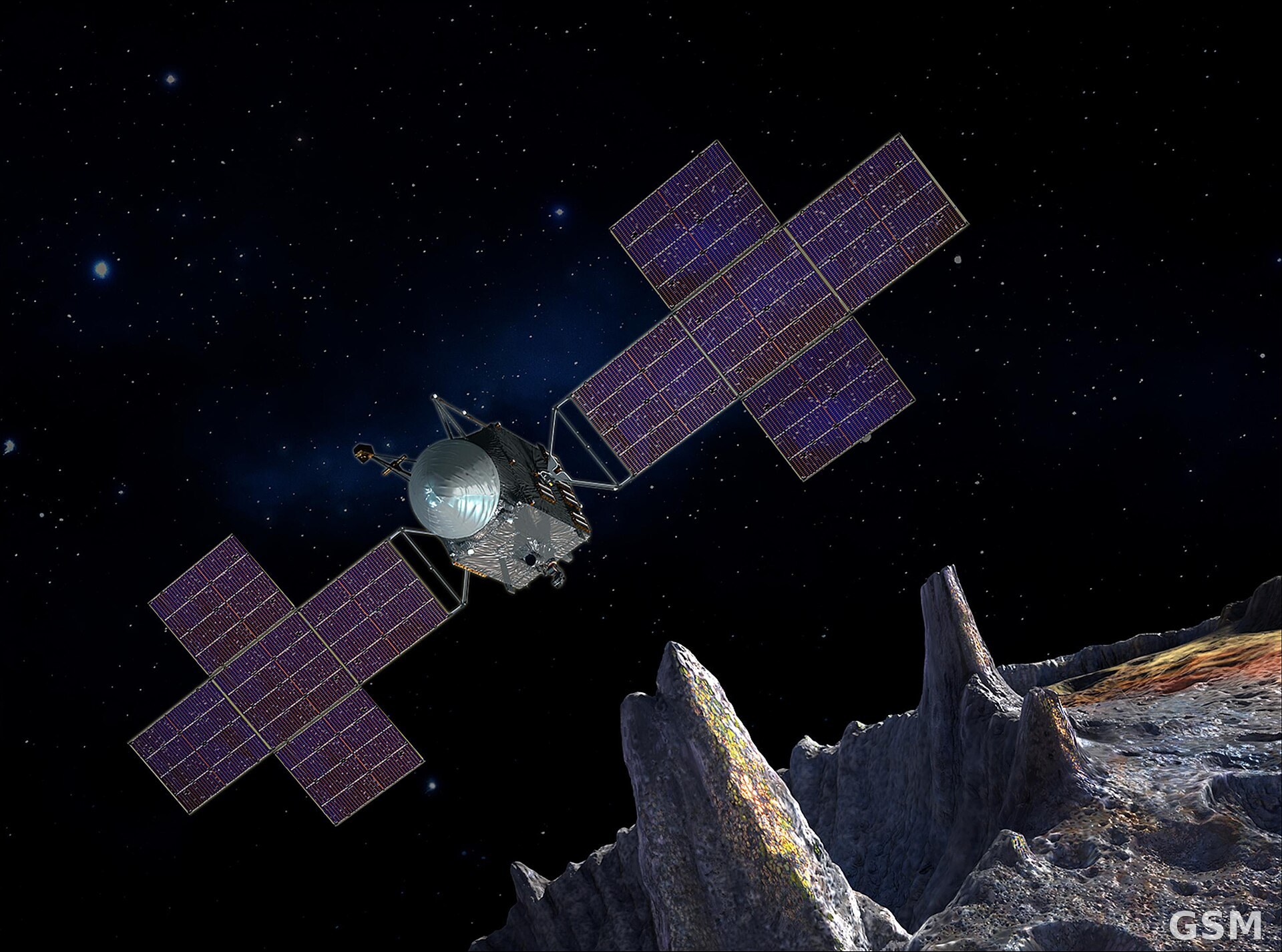
美国航天局 NASA 10月22日发布任务更新称,该机构的 Psyche 探测器在完成火星引力助推后,已启动推进器全速飞向主小行星带中与探测器同名的金属小行星 Psyche。Psyche 探测器于2023年10月发射升空,在飞行第一阶段间歇使用其电力推进系统,以调整到利用火星引力节省燃料、提升速度并微调轨道的位置。
NASA 表示,探测器自9月28日起开始近乎持续地使用推进系统,每周仅暂停一次与地球上的任务控制人员联系。位于南加州的 NASA 喷气推进实验室 Psyche 任务导航负责人 Don Han 表示,推进器自此将以接近90%的时间运行,直至探测器抵达小行星。任务时间表显示,探测器将在2029年夏季与小行星 Psyche 会合。
Psyche 探测器的太阳能电力推进系统利用电磁场排出惰性气体氙的带电原子产生推力,单台推进器最大推力为250毫牛,约相当于手托一节AA电池所受的重力。探测器装有四台此类推进器,轮流单台工作;在巡航阶段最高速度下,探测器相对地球观测者的速度将超过每小时100,000英里(约160,900公里)。探测器靠两组五片式十字形太阳能板发电,采光面积为800平方英尺(约75平方米)。探测器发射时携带近2,400磅(约1,090公斤)氙推进剂,分装在七个燃料箱中,发射三年以来已用掉约三分之一。
探测器抵达后将进入环绕小行星 Psyche 的轨道。这颗小行星最宽处约173英里(约280公里),被认为是一颗早期行星构件星子残留的部分金属核心。探测器将在为期两年的主要科学任务中以高低不同的轨道绕飞测绘并采集数据。任务首席研究员、加州大学伯克利分校的 Lindy Elkins-Tanton 表示,火星飞掠为团队提供了校准仪器和演练行星交会程序的机会,探测器现正由阳光驱动、深入太阳系飞向小行星带。
NASA's Psyche Spacecraft Heads at Full Throttle Toward Metal-Rich Asteroid: Arrival Set for 2029
NASA said in a mission update published on October 22, 2026, that its Psyche spacecraft, with a successful Mars gravity assist behind it, has fired up its thrusters and is accelerating toward the metal-rich asteroid of the same name in the main asteroid belt. The spacecraft launched in October 2023 and used its electric propulsion system intermittently during the first leg of its journey to reach the right position to harness Mars' gravity for a propellant-saving speed boost and a slight trajectory change.
According to NASA, the spacecraft began using its propulsion system nearly continuously on September 28, pausing just once each week to check in with mission controllers on Earth. Don Han, the Psyche mission's navigation lead at NASA's Jet Propulsion Laboratory in Southern California, said the thrusters will operate nearly 90 percent of the time from now until the spacecraft reaches the asteroid. The mission remains on track for a rendezvous with the asteroid Psyche in the summer of 2029.
The spacecraft's solar-powered propulsion system uses electromagnetic fields to expel charged atoms of the inert gas xenon, delivering up to 250 millinewtons of thrust, about the force of holding one AA battery. Its four thrusters operate one at a time, and at maximum cruise speed the spacecraft will travel at more than 100,000 mph (160,900 kph) relative to an observer on Earth. Two five-panel, cross-shaped solar arrays with a sunlight-collecting area of 800 square feet (75 square meters) generate its power. The spacecraft launched with nearly 2,400 pounds (1,090 kilograms) of xenon in seven fuel tanks and has used about one third of that supply in the three years since launch.
On arrival in 2029, the spacecraft will enter orbit around the asteroid Psyche, which is about 173 miles (280 kilometers) across at its widest point and is thought to be the partial core of a planetesimal, a building block of an early planet. It will map the asteroid and gather science data over a two-year prime science mission. Lindy Elkins-Tanton, the mission's principal investigator at the University of California, Berkeley, said the Mars flyby was an opportunity to calibrate instruments and practice procedures for a planetary encounter ahead of arriving at the asteroid.
来源:GSM·美国(原文链接)
图片来源:图:Psyche探测器飞向金属小行星的艺术概念图(PIA21499)。图片来源:NASA/JPL-Caltech/Arizona State University/Space Systems Loral/Peter Rubin,美国航天局公共领域图 / Photo: Artist's concept of the Psyche spacecraft (PIA21499). Source: NASA/JPL-Caltech/Arizona State University/Space Systems Loral/Peter Rubin (NASA public domain)