叙利亚首次以DNA鉴定确认失踪者身份:今年至少三例拉卡一家七口在2017年空袭中遇难、遗骸九年后确认
拉卡——据路透社报道,DNA检测今年已帮助确认叙利亚至少三例失踪者遗骸的身份,这是该国首次出现此类鉴定案例,是查明多年战争中失踪者下落努力的一次突破。其中两例由叙利亚失踪人员国家委员会完成,第三例由叙利亚与国际非政府组织完成:它们通过基因分析,确认了2017年从叙利亚拉卡驱逐「伊斯兰国」的战争中、在一次疑似空袭中遇难的一家人的遗骸。路透社称,这三例系其首次报道,为叙利亚各地家庭提供了寻求答案的一条可能路径——在阿萨德家族数十年统治与近14年内战之后,该国仍有数万人失踪。前总统巴沙尔·阿萨德2024年末被推翻后,调查人员得以进入长期无法触及的拘留中心与埋葬地点。但鉴定工作面临多重制约:战争期间无法进入相关地点、向家属采集DNA拭子存在后勤困难、法医专业知识与设备短缺。拉卡一案的调查核心是马纳尔·阿利维(Manar Aliwi)一家。2017年8月,阿利维与七名亲属在拉卡市中心一栋建筑的一楼躲避空袭,当时美军主导的空中力量正支援库尔德人主导的叙利亚武装与「伊斯兰国」武装作战。据向SJAC所作的证词,阿利维在拉卡之外的家人在当月与她失去联系;卫星图像显示,她藏身的建筑在2017年8月19日至25日之间被夷为废墟,但家人多年来一直不知道亲属是死在那里,还是逃出后死在别处。2024年,一个在拉卡同一建筑作业的排雷组织发现了腐烂的遗骸,叙利亚法医调查人员于当年晚些时候将其回收;在建筑中找到的身份文件帮助找到了阿利维的姐姐,她确认一家人曾藏身于此;遗骸旁发现的衣物与亲属提供的一张2017年8月照片中阿利维家人所穿衣物相符。调查人员随后从亲属处采集了基因参照样本。危地马拉法医人类学基金会(FAFG)在分析不同DNA样本与亲属陈述后确认,遗骸属于阿利维、她的丈夫和他们的五个孩子,其中包括一名3岁幼儿;幸存家属于2026年9月获知结果。阿利维的父亲——当时在建筑内的另一名家庭成员——下落仍不明。拉卡一案的鉴定工作由SJAC(叙利亚失踪人员与法医团队,一个总部设在该市、调查在「伊斯兰国」控制区失踪者下落的独立人道主义组织)与FAFG完成;FAFG是一个为调查危地马拉国内冲突期间未决杀戮案件而成立的非营利组织。SJAC主任穆罕默德·阿卜杜拉(Mohamed al-Abdullah)对路透社说,这一结果「提高了家属的期望,因为它表明了实际能做到什么」。另外两例中,国家委员会通过DNA配对确认了身份,并在红十字国际委员会专家复核鉴定结果后通知了家属;委员会对路透社如是说,但没有提供遇难者身份或死亡情形的细节。委员会称,它已从叙利亚各部委与非政府组织收集了约96,000份档案、从疑似乱葬岗地点回收的人类遗骸中取得约2,000份样本、并在有证据显示可能配对的案件中从亲属处取得29份DNA样本,其中两例得出了确认鉴定。委员会在一份书面声明中说:「这是重要的一步,但只是漫长道路的开始。」委员会称,在8月30日启动的一项全国计划下,它平均每天收到100份新的失踪报告,该计划最终将扩大从家属采集DNA的范围;它正与红十字国际委员会合作,在2027年5月前建立一个DNA实验室,并与失踪人员国际委员会合作建立第二个实验室,后者得到欧盟支持。但全国失踪人员数据库尚未上线。联合国负责澄清叙利亚失踪者下落、支持其家属的机构援引的估计显示,叙利亚失踪人数在130,000至300,000之间。阿利维之子穆罕默德·哈马达(Mohamed Hamadah)是她直系亲属中唯一的幸存者,他说:「现在我们可以安葬他们,有有标记的坟墓、可以去探望,至少让心里稍微安宁一点。这大约九年里,我们一直在想:他们出去了吗?去了别的城市吗?到了阿萨德政府控制区吗?」
Syria Achieves Its First DNA-Based Identifications of the Missing: At Least Three Cases This Year, Including a Raqqa Family of Seven Killed in a 2017 Airstrike
Raqqa — DNA testing has helped identify the remains of missing people in at least three cases in Syria this year, the country's first such identification cases and a breakthrough in efforts to establish the fates of people missing after years of war, Reuters reported.
Two of the cases were completed by Syria's National Commission for Missing Persons, while the third was the work of Syrian and international non-governmental organisations, which used genetic analysis to help identify the remains of a family killed in a suspected airstrike during the war to oust Islamic State from Syria's Raqqa in 2017. The three cases, reported by Reuters for the first time, offer a possible path towards answers for families across Syria, where tens of thousands of people remain missing after decades of repression under Assad family rule and a nearly 14-year civil war.
Former President Bashar al-Assad's overthrow in late 2024 opened access to detention centres and burial sites long beyond the reach of independent investigators. But efforts to identify the missing have been complicated by constraints including a lack of access to sites during the war, logistical challenges to gathering DNA swabs from families and a shortage of forensic expertise and equipment.
At the centre of the Raqqa investigation was the household of Manar Aliwi. In August 2017, Aliwi and seven of her relatives were sheltering from airstrikes on the first floor of a building in central Raqqa,
where US-led airpower was helping a Kurdish-led Syrian fighting force battle Islamic State militants. Aliwi's family outside Raqqa lost contact with her that month, according to testimony to SJAC. Satellite imagery showed the building she had been sheltering in reduced to a mound of rubble between August 19 and 25, 2017, but the family spent years wondering if their relatives had died in there or fled and perished elsewhere. In 2024, a demining organisation working in Raqqa at the same building discovered decomposing remains and Syrian forensic investigators recovered them later that year. Identity papers recovered in the building helped track down Aliwi's sister, who confirmed the family had been hiding there. Clothes found alongside the remains matched what members of the Aliwi family were wearing in an August 2017 photograph supplied by one of their relatives. Investigators then collected genetic reference samples from relatives. After analysing the different DNA samples and relatives' accounts, the Forensic Anthropology Foundation of Guatemala (FAFG) confirmed the remains belonged to Aliwi, her husband and their five children, including a 3-year-old. The surviving family members were informed in September 2026. The fate of Aliwi's father, the other member of the family who was in the building, is unclear.
The identification work for the Raqqa family was carried out by SJAC, the Syrian Missing Persons and Forensic Team — an independent humanitarian group based in the city that investigates the fate of people who disappeared in territory under Islamic State control — and FAFG, a non-profit formed to investigate unresolved killings during internal conflict in the Central American country. "The result raises the expectations of the families because it shows what's actually possible," SJAC's director Mohamed al-Abdullah told Reuters.
In the two other cases, the national commission confirmed identities through DNA matching and informed the families after experts from the International Committee of the Red Cross reviewed the findings, the commission told Reuters. It did not provide details about the victims or the circumstances of their deaths. The commission said it had collected around 96,000 files from Syrian ministries and NGOs, around 2,000 samples from human remains recovered at suspected mass grave sites and 29 DNA samples from relatives in cases where evidence suggested a possible match; two of those cases resulted in confirmed identifications. "This is an important step but it is only the beginning of a long path", the commission said in a written statement. It said it was receiving a daily average of 100 new missing-person reports under a national programme launched on August 30, which would eventually expand DNA collection from families. It is working with the ICRC to establish a DNA laboratory by May 2027, and a second laboratory with the International Commission on Missing Persons, supported by the European Union. But a national database of the missing is yet to be launched.
The United Nations body tasked with clarifying the fate of missing persons in Syria and supporting their families has cited estimates ranging from 130,000 to 300,000 people missing in Syria. For Mohamed Hamadah, Aliwi's son and the only surviving member of her immediate family, the identifications have answered questions that long haunted him. "Now we can bury them, have marked graves and visit them, and at least put our minds a little more at rest," he said. "For about nine years, we kept thinking: Did they get out? Did they go to another city? Did they reach Assad government-held areas?"
发布:GSM·美国(发布链接)
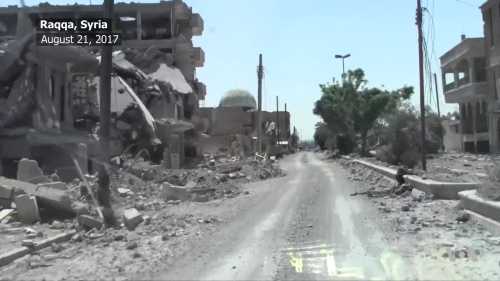
图片来源:叙利亚拉卡2017年8月遭战火损毁的街景,画面左上字样为原视频自带标注。照片:美国之音(VOA),公共领域,经维基共享资源。 / A destroyed street in Raqqa, Syria, in August 2017; the on-screen text is burned into the original footage. Photo: Voice of America, public domain, via Wikimedia Commons.
GSM Global · 本篇英文版 English edition of this story