斯坦福研讨会聚焦创新集群与高校合作:瑞典学者解析大湾区分校区现象
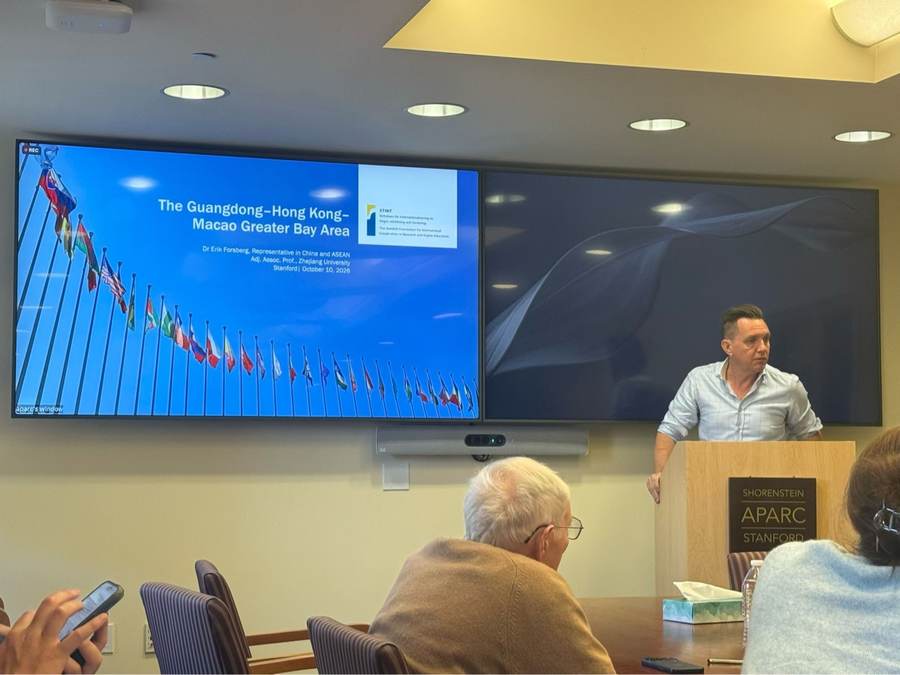
斯坦福大学——10月13日下午,斯坦福大学 Shorenstein 亚太研究中心(APARC)在该校 Encina Hall 的 Okimoto 会议室举办研讨会,主题为"规模化的两条路:东京—横滨与大湾区创新集群",来自瑞典国际科研与高等教育合作基金会(STINT)的三位学者分享了该机构"科学情报"项目的调研观察,探讨两大创新集群背后的大学科研生态与跨境合作。
东京—横滨与粤港澳大湾区的深圳—香港—广州,是当今全球两大顶尖科技创新集群:在世界知识产权组织(WIPO)《全球创新指数》2025 年创新集群排名中,深圳—香港—广州位列全球第一,东京—横滨位列第二。
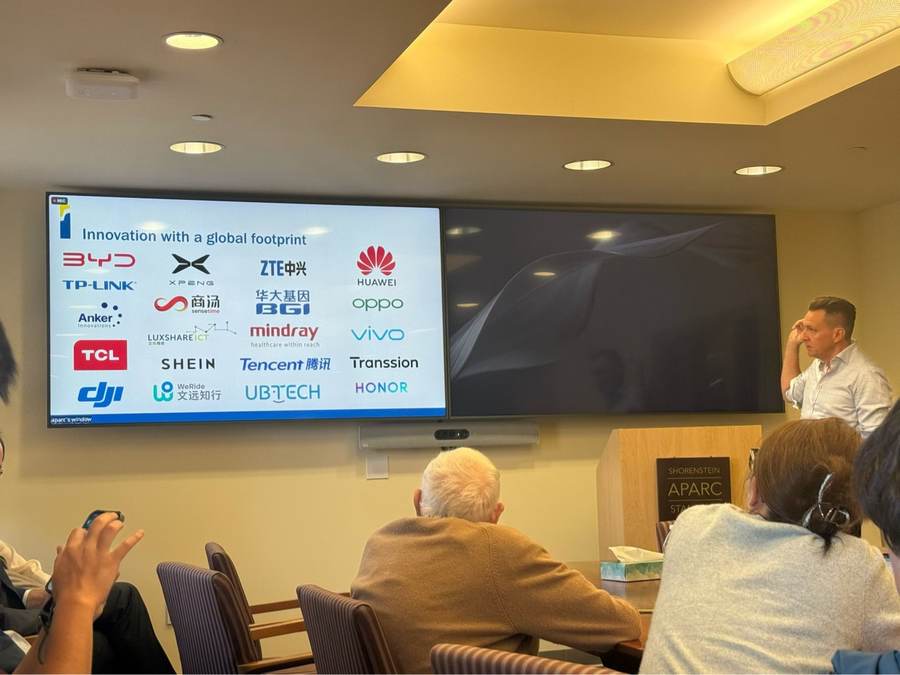
STINT 执行主任 Andreas Göthenberg 首先分享了该机构对全球科研与创新格局的观察。随后,STINT 驻中国与东盟代表 Erik Forsberg 主讲粤港澳大湾区部分。Forsberg 在中国工作超过 17 年,现任浙江大学兼职副教授。他以"Innovation with a global footprint"(创新走向全球)为题,用一页幻灯片列出比亚迪、华为、大疆、腾讯、小鹏、中兴、商汤、华大基因、迈瑞医疗、安克、TCL、SHEIN 等近 20 家具有全球布局的中国科技企业,作为观察大湾区从制造基地向原创创新策源地转型的背景材料。
Forsberg 报告的重点之一,是大湾区高校"分校区"现象背后的跨境教育合作。他梳理了两波浪潮:第一波始于 2000 年代初,北方名校南下深圳设立研究生院,包括清华大学、北京大学、哈尔滨工业大学;第二波自 2014 年起,香港高校北上办学——香港中文大学(深圳)2014 年建校、香港科技大学(广州)2022 年开学、香港城市大学(东莞)2024 年落成。此外,中山大学设有珠海、深圳校区,澳门大学校本部位于珠海横琴。Forsberg 指出,对国际合作伙伴而言,香港的制度衔接与治理经验是进入内地的独特桥梁。
研讨会另一部分由 STINT 驻日本与韩国科学研究员 Laura Barbieri 主讲东京—横滨集群。她常驻东京,现为日本政策研究大学院大学(GRIPS)访问学者。
信息来源:斯坦福大学 Shorenstein APARC 活动页、STINT 官网、现场报道。
Stanford Seminar on Innovation Clusters Spotlights University Cooperation and the Greater Bay Area's Cross-Border Campuses
Stanford — On the afternoon of October 13, Stanford University's Shorenstein Asia-Pacific Research Center (APARC) hosted a seminar titled "Two Routes to Scale: Innovation Clusters in Tokyo-Yokohama and the Greater Bay Area" in the Okimoto Conference Room of Encina Hall. Three scholars from STINT, the Swedish Foundation for International Cooperation in Research and Higher Education, presented observations from the foundation's Science Intelligence program, examining the university research ecosystems and cross-border collaboration behind two of the world's leading innovation clusters.
Tokyo-Yokohama and Shenzhen-Hong Kong-Guangzhou in China's Greater Bay Area are the world's two top science and innovation clusters: in the World Intellectual Property Organization's (WIPO) Global Innovation Index 2025 cluster ranking, Shenzhen-Hong Kong-Guangzhou placed first globally and Tokyo-Yokohama second.
STINT Executive Director Dr. Andreas Göthenberg opened by sharing the foundation's perspectives on the global science and innovation landscape. Dr. Erik Forsberg, STINT's Representative in China and ASEAN, then presented on the Greater Bay Area. Forsberg has worked in China for more than 17 years and is currently an Adjunct Associate Professor at Zhejiang University. In a presentation titled "Innovation with a global footprint," he used a single slide listing nearly 20 Chinese technology companies with global operations — including BYD, Huawei, DJI, Tencent, XPeng, ZTE, SenseTime, BGI, Mindray, Anker, TCL and SHEIN — as background for the Bay Area's shift from a manufacturing base toward a source of original innovation.
A central theme of Forsberg's talk was the cross-border university cooperation behind the Greater Bay Area's branch campuses. He described two waves: a first wave beginning in the early 2000s, when leading universities from northern China — Tsinghua University, Peking University and Harbin Institute of Technology — set up graduate schools in Shenzhen; and a second wave from 2014, as Hong Kong universities moved north — the Chinese University of Hong Kong, Shenzhen (established 2014), the Hong Kong University of Science and Technology (Guangzhou) (opened 2022) and City University of Hong Kong (Dongguan) (completed 2024). Sun Yat-sen University also operates campuses in Zhuhai and Shenzhen, and the University of Macau's main campus is located on Hengqin Island in Zhuhai. For international partners, Forsberg noted, Hong Kong's institutional alignment and governance experience offer a distinctive bridge into the mainland.
Dr. Laura Barbieri, a STINT Science Fellow in Japan and South Korea based in Tokyo and a visiting scholar at the National Graduate Institute for Policy Studies (GRIPS), presented on the Tokyo-Yokohama cluster.
Sources: Stanford Shorenstein APARC event page; STINT official website; GSM on-site reporting.
图片来源:Forsberg 博士在斯坦福大学 APARC 研讨会上主讲粤港澳大湾区(GSM 记者现场拍摄,2026年10月13日)